
The short answer
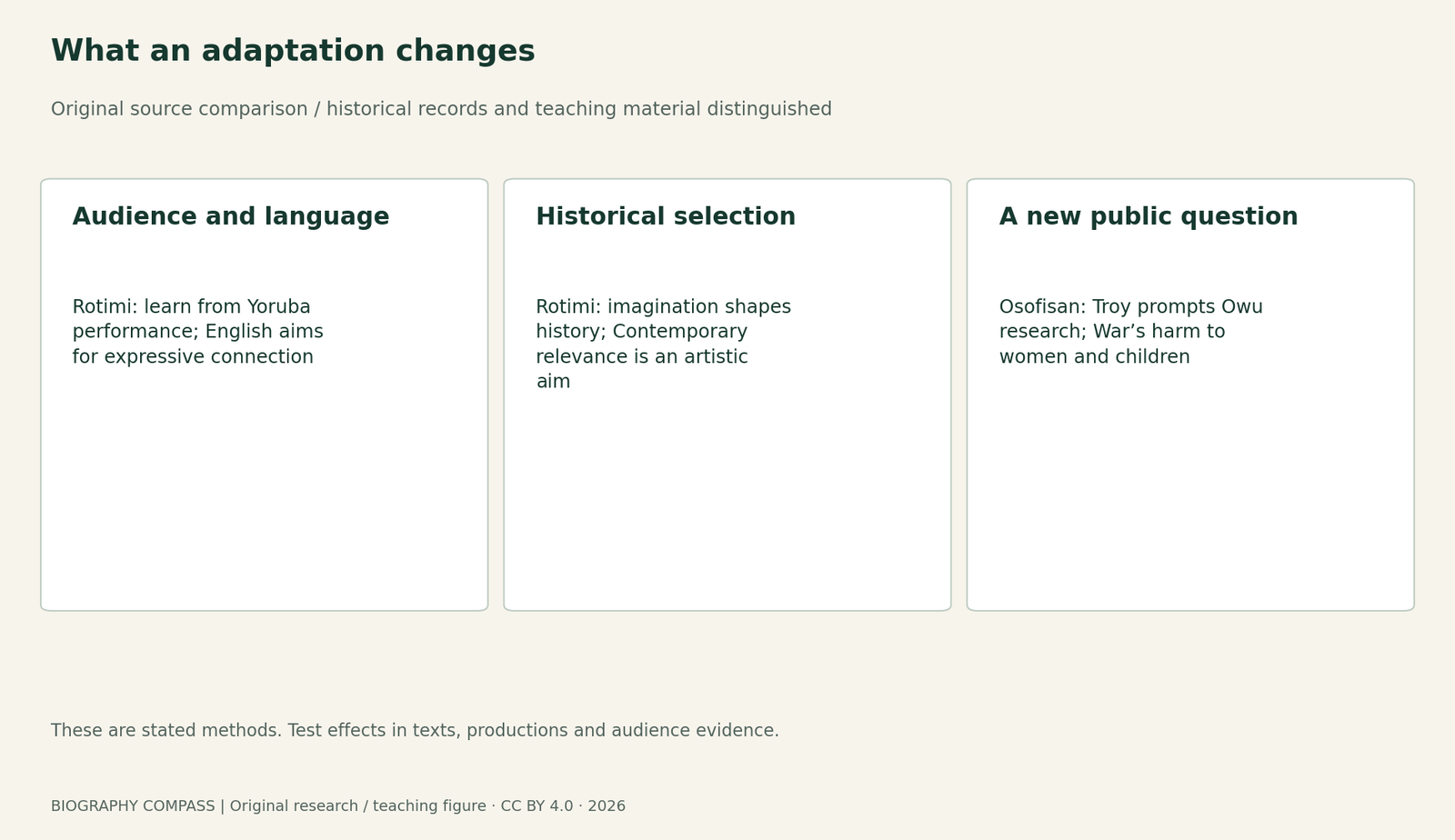
How can a dramatist use an inherited story without merely moving its names and locations? Rotimi’s 1981 interview and Osofisan’s 2023 account answer through artistic decisions: language, historical selection and the contemporary problem a play asks an audience to consider.
Original source comparison
What changes beyond names and setting?
Compare the purpose and scope of the actual accounts before extending their claims.
| Source or practice | What the source supports | What still needs examination |
|---|---|---|
| Rotimi: language | English designed to carry expressive effects learned through Yoruba performance. | Inspect particular lines and evidence from a production; intention alone is insufficient. |
| Rotimi: historical imagination | Selected history serves contemporary human questions. | Check historical claims independently of a dramatic scene. |
| Osofisan: Women of Owu | An inherited war-drama commission prompts Owu and contemporary-war connections. | Do not equate all three historical situations or infer a full borrowing map. |
Chronology
A timeline of the turning points
Production and publication
The Gods Are Not to Blame was first presented in 1968 and published in 1971.
Rotimi’s explanation
Interview at the University of Nigeria, Nsukka.
Osofisan’s recollection
Published explanation of the Women of Owu commission and contemporary concerns.
A prior story does not determine the new question
Rotimi’s The Gods Are Not to Blame has an Oedipus relationship, while Osofisan describes a commission to adapt Euripides’ Women of Troy that led to Women of Owu. The similarity is useful but incomplete. An inherited structure does not tell us what each dramatist wants a new public to consider. The sources used here are selected author interviews and a scholarly career account, not complete play readings. They support a comparison of declared methods. They do not support a scene-by-scene inventory of borrowing, or a judgment that every audience received the intended argument.
Rotimi separates welcoming a stranger from ethnic prejudice
In the 1981 interview, Enekwe asks whether the people in The Gods Are Not to Blame bear guilt for installing a stranger as king. Rotimi rejects that premise: accepting someone from outside is not the offence he wants to condemn. He identifies ethnic chauvinism as the concern. This answer demonstrates why comparison must keep the questioner’s proposition separate from the author’s reply. A research note that attributes both to Rotimi would reverse the point of the exchange. The more productive next step is to examine how the play distributes blame and knowledge, rather than assume that foreignness itself explains disaster.
Sources for this section: [2]
Language can change the relationship with an audience
On printed pages 41–42, Rotimi describes studying Yoruba artists, priests, chanters and performances because English could distance an author from a local public. He wanted English to approximate the expressive impact of the home language. He presents several plays as stages of an experiment, rather than announcing a universal formula. This is a more demanding adaptation question than whether a few local names or proverbs appear. It asks how imagery, rhythm and speech situations work for listeners. The interview explains his aim; checking its results would require close textual work and evidence from specific productions or audiences.
Sources for this section: [2]
History is selected for a purpose, not mechanically transferred
Rotimi explicitly describes historical imagination as a means of addressing concerns with continuing human relevance. Osofisan’s PUNCH interview supplies a differently focused example: the Euripides commission sent him towards Owu history, while the invasion of Iraq sharpened concern for women and children harmed by war. The comparison yields a practical result. A shared plot can connect situations without asserting that their causes, actors or consequences are identical. An adaptation study should identify the specific relation the artist proposes, then investigate the historical differences it leaves unresolved. Neither author’s account serves as independent historical verification of a dramatic scene.
Original exercise: design a scene around a public choice
Create a brief for a wholly invented scene about a community hall whose evening access has been cancelled. Do not write in either author’s style or borrow a dramatic passage. Specify four things: the inherited narrative function you would use, who gains the power to speak, one language decision that aids the intended audience, and the contemporary question left open. Then write two neutral lines of dialogue that embody the conflict without explaining its answer. Use the two interviews to justify why naming a local setting alone would be an inadequate adaptation method.
Reference answer: make form serve the question
One possible brief uses a messenger’s disputed report as the inherited function, gives an evening cleaner the first challenge to the official account, and chooses plain English with a recurring image of a locked door. The public question is who may define a shared institution’s purpose. Original dialogue: “The hall is open, according to the notice.” “Then why is my key the only one that no longer turns?” The change in speaking authority and the material image make the conflict legible. These are new illustrative choices, not an imitation of either playwright or a reconstruction of an actual event.
Use intention as a starting point for a testable reading
A completed comparison could select one scene from each legally available play, trace the speaking positions and examine one language decision in context. It should retain the gap between a 1981 explanation, a 2023 recollection, a published text and a particular performance. The biography adds another useful distinction: The Gods Are Not to Blame was first presented in 1968 and published in 1971. That difference does not explain its politics by itself. It locates the objects a researcher would need next. The interviews already answer the narrower question: these artists describe adaptation as purposeful transformation, not simple substitution of scenery.
Continue the chronology
Related history guides
Osundare: How Can a Newspaper Poem Reach a Public?
Explore a different question about language, audiences or creative collaboration.
Read the timeline20 August 2021 EP; May 2024 film; 10 May 2024 soundtrackWater & Garri: One Title, Three Creative Projects
Explore a different question about language, audiences or creative collaboration.
Read the timelineBiography context
Explore Nigeria through connected lives
Connected biographies
Artists and the questions behind their work
1938–2000
Ola Rotimi
Playwright, director and theatre teacherOla Rotimi was a Nigerian dramatist, director and teacher whose work joined formal theatre training with close attention to Yoruba language and performance. He used inherited stories and Nigerian history to examine leadership and community.Read biography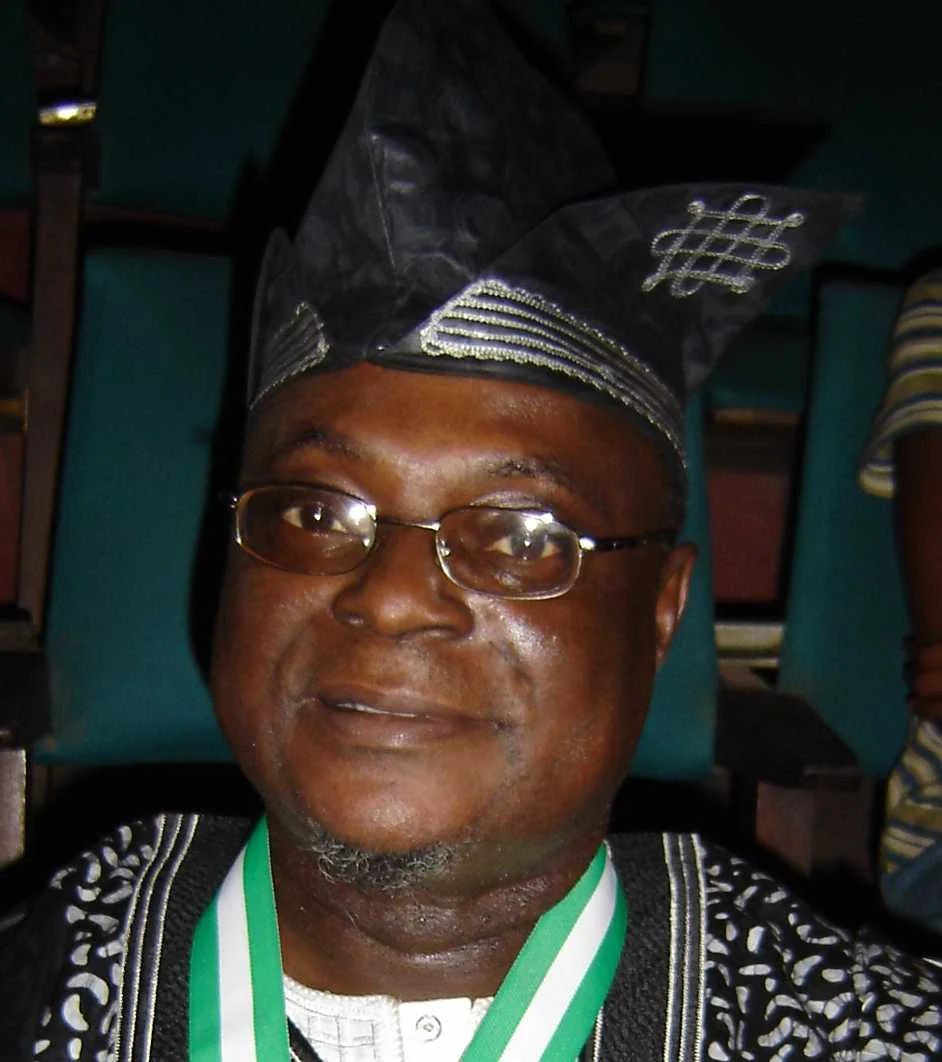
1946–
Femi Osofisan
Playwright, director, critic and poetFemi Osofisan is a Nigerian playwright, director, critic and poet whose work connects theatre with arguments about power and collective life. He has also written poetry under the name Okinba Launko.Read biographyQuick answers
Common questions
- Were the two complete plays compared?
- No. This comparison concerns declared methods in selected interviews, with a scholarly account for career and work dates.
- Is the invented dialogue a quotation or imitation?
- No. It is a new, neutral illustration written for this exercise.
Primary and institutional sources
How this history was checked
Read the named participant or release record within its stated scope. The underlying plays, poems, recordings and film are not presented as fully consumed. This article was reviewed on 27 October 2026.
- Donald Burness, Thomas J. Taylor and R. C. Lutz; EBSCO Research StartersOla Rotimi
- Onuora Ossie Enekwe; Okike 25/26, University of Nigeria repositoryInterview with Ola Rotimi, conducted 25 May 1981
- Fatteh Hamid; PUNCH, 17 June 2023Challenges caused by political leaders tempting me to japa — Prof Osofisan