In this biography
Quick facts
- Born
- 30 July 1940
- Died
- 16 September 2021
- Birthplace
- Ealing, London, England, United Kingdom
- Country
- United Kingdom
- Nationality
- British
- Known for
- Affordable Sinclair electronics and the ZX80, ZX81 and ZX Spectrum home computers
- First company
- Sinclair Radionics, 1961
- Pocket calculator
- Sinclair Executive, 1972
- Spectrum launch
- 23 April 1982
- Computer-rights sale
- Amstrad, April 1986
Why this life matters
Sinclair helped make programmable computers accessible to a much wider public. His career demonstrates both the power of a demanding price target and the risks when miniaturisation, reliability, production and customer expectations pull in different directions.
Timeline
Key moments
Born in Ealing
Born on 30 July; develops an early interest in electronics and miniaturisation.
Sinclair Radionics
Establishes a company producing consumer electronics and instruments.
Small products, different outcomes
The Executive calculator is followed by the troubled Black Watch.
Affordable home computers
The ZX80 and ZX81 bring programmable machines to a wider home market.
ZX Spectrum
The colour home computer launches on 23 April with 16K and 48K versions.
New ventures and financial pressure
Knighted in 1983; the QL and C5 programmes encounter commercial problems.
Computer rights change hands
Amstrad buys rights to Sinclair computer products; Sinclair pursues further projects.
Death
Dies on 16 September, aged eighty-one.
Electronics before the computer boom
Clive Marles Sinclair was born in Ealing on 30 July 1940. He became interested in electronics while young and worked in technical publishing before founding Sinclair Radionics in 1961. Writing for an audience of enthusiasts helped connect technical ideas with the practical question of what people might build or buy.
The company developed radios, hi-fi equipment, calculators, televisions and scientific instruments. The range is important: his ambition was not originally confined to computing. Miniaturisation and affordability linked otherwise different products. In a later oral-history interview, he recalled both his technical suppliers and his enthusiasm for good industrial design, describing a business that depended on outside expertise as well as its founder.
Miniaturisation brought success and expensive failures
The Sinclair Executive calculator appeared in 1972 as a notably slim electronic product. Its appeal fitted the company’s preference for making advanced functions smaller and more accessible. But the same ambition could outpace dependable production. The Black Watch, launched in 1975, suffered technical and battery problems and generated costly returns.
The Centre for Computing History’s watch account connects those losses with government support for Radionics. The Science Museum Group records Sinclair’s departure in 1979 and the subsequent disposal of the company’s operations. This was not simply a smooth renaming into the later computer business. Different companies and assets followed different paths, even when the founder’s name remained the public connection.
Computers made the price target culturally important
The ZX80 in 1980 and ZX81 in 1981 expanded the market for home computers. Their low prices put programming within reach of people who could not justify more expensive systems. They were also limited machines, requiring users to work within modest memory and input capabilities. Those constraints became part of the experience of learning what a computer could do.
The ZX Spectrum followed on 23 April 1982 with colour, sound and more memory. It connected to a domestic television and used cassette tapes for software. The 16K and 48K launch versions cost £125 and £175 respectively. A large audience of owners then created demand for games, magazines and programs that the manufacturer itself could never have supplied alone.
A famous founder depended on a design team
The Spectrum’s hardware was largely devised by Richard Altwasser. Rick Dickinson shaped its compact case, rubber keyboard and visual identity, while John Grant and Steve Vickers at Nine Tiles developed software. The preserved prototype reveals negotiations, technical compromises and unfinished peripheral support, rather than a machine arriving fully formed from one inventor’s imagination.
Sinclair set an influential direction and commercial brief. Engineers, designers, programmers and manufacturing partners made that brief into a product. Early production problems and waiting lists show why selling an inexpensive computer was not the same as delivering one reliably. Recognition of Sinclair’s achievement is stronger when it includes those collaborators and the experiences of customers waiting for working machines.
Expansion exposed the limits of the business
Sinclair was knighted in 1983. His businesses nevertheless encountered serious difficulties with the QL computer and the C5 electric vehicle. Made with Hoover, the C5 appeared in 1985 as a small electric recumbent vehicle. Its exposure to weather and concerns about safety and practical road use damaged its reception.
Financial pressure also affected the computer business. In April 1986 Amstrad acquired rights to manufacture and sell Sinclair computer products for £5 million. Amstrad’s later Spectrum models therefore belong to a changed commercial arrangement, not simply another machine personally developed by Sinclair. The transaction should not be confused with either the Spectrum’s 1982 launch or the complete disappearance of Sinclair’s other interests.
Personal transport and a complicated legacy
Sinclair continued experimenting after the computer-rights sale. Later work included the Z88 portable computer and the A-bike folding bicycle. His interest in personal transport survived the C5’s failure: a disappointing product had not extinguished the larger ambition of making individual journeys use smaller and lighter machines.
He died on 16 September 2021, aged eighty-one. The lasting significance of his computer business is visible in the people who learned to program and make software on its machines. That cultural contribution coexists with technical failures, difficult manufacturing and commercial losses. Neither the affectionate image of “Uncle Clive” nor the C5 alone adequately describes a career spent trying to turn ambitious electronics into everyday purchases.
Quick answers
Frequently asked questions about Clive Sinclair
- Did Clive Sinclair design the ZX Spectrum alone?
- No. He set its direction, while Richard Altwasser, Rick Dickinson, John Grant, Steve Vickers and other colleagues supplied hardware, industrial-design and software expertise.
- When did Amstrad acquire Sinclair computer rights?
- The purchase was announced in April 1986, four years after the original Spectrum launch. It concerned computer-product rights, rather than every aspect of Sinclair’s career.
- Was the C5 his only transport project?
- No. Sinclair maintained an interest in personal transport and later developed the A-bike folding bicycle among other projects.
Keep exploring
Lives connected to this story
- Alan Sugar
Follow Amstrad’s different commercial approach and its acquisition of Sinclair computer rights.
- James Dyson
Compare another British product entrepreneur through design, engineering teams and commercial risk.
Sources and further reading
Explore the evidence
These references support the biography and offer further reading. Official records, first-person accounts and independent reporting provide different perspectives; image records document attribution and licensing.
- 1. Centre for Computing HistoryClive Sinclair: biography and historical timeline
Read biography and timeline. One linked knighthood item is incorrectly indexed as 1982 although the named issue is from June 1983; 1983 is corroborated by the museum’s 2014 account.
- 2. Science Museum GroupClive Marles Sinclair, 1940–2021: birthplace and career
- 3. Science Museum GroupSinclair Radionics Limited, 1961–1980
- 4. Centre for Computing HistorySinclair White Watch: Black Watch development and failures
- 5. Centre for Computing HistorySir Clive Sinclair Surprises Visitors, 3 March 2014
- 6. Centre for Computing HistorySir Clive Sinclair dies aged 81, 16 September 2021
- 7. Archives of ITSir Clive Sinclair: selected 2019 interview-transcript passages
Read selected transcript passages on components, calculators, design and later ambitions, principally printed pp.4–5, 13–24. The interview contains uncertain memories, including denial of the independently documented Amstrad transaction; those statements are not adopted as settled facts. No complete oral-history or company-archive review is claimed.
- 8. Centre for Computing HistorySinclair launches the ZX Spectrum, 23 April 1982
- 9. Centre for Computing HistoryEarly Sinclair ZX Spectrum Computer: prices, design and early production
- 10. Centre for Computing HistorySinclair ZX Spectrum Prototype: hardware and Nine Tiles software development
Read the museum’s detailed prototype account, not the complete design papers or source code.
- 11. Computer History MuseumSinclair ZX Spectrum Microcomputer, 1982: object 102626684
- 12. Centre for Computing HistoryRick Dickinson: industrial design for Sinclair computers
- 13. Science Museum GroupSinclair C5 Electric Vehicle, 1985: manufacture and limitations
- 14. Centre for Computing HistoryAmstrad Buys Sinclair Research IP, 7 April 1986
- 15. Centre for Computing HistoryAmstrad plc: the separate 1986 computer-rights purchase and later Spectrum models
- 16. Wikimedia Commons / Adrian PingstoneSinclair.600pix.jpg: public-domain dedication and original upload history
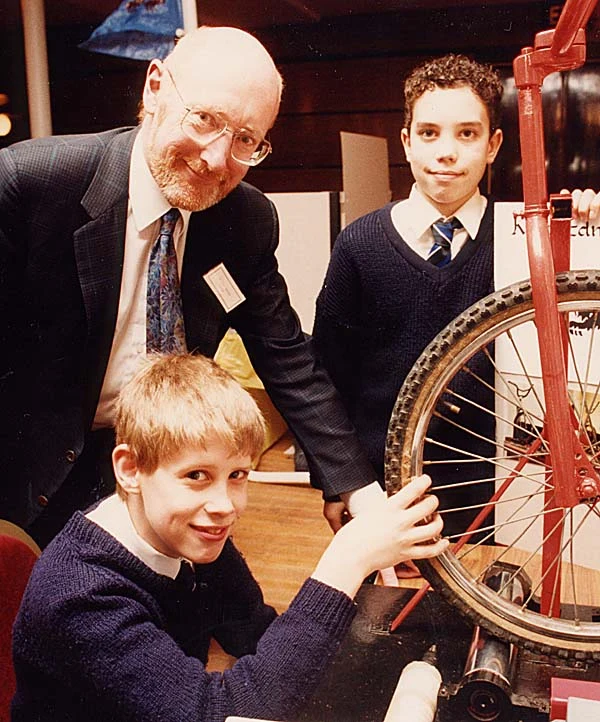
Author’s public-domain dedication and file history checked. The original 2005 group frame is used instead of the subsequent colour edit or extracted portrait.