
The short answer
The Spectrum’s place in computing history came from a particular combination: a relatively inexpensive machine, a recognisable design and an expanding world of software made by its users and independent businesses.
Chronology
A timeline of the turning points
ZX80
Sinclair’s low-cost computer establishes a broader home-computing direction.
ZX81
A successor expands the audience before the colour machine appears.
Spectrum launch
The original 16K and 48K models enter the British market.
Rights acquired by Amstrad
A separate transaction leads to later Spectrum models under Amstrad.
The problem was access to a programmable machine
Sinclair’s earlier ZX80 and ZX81 had already attracted buyers interested in a home computer at a manageable price. The Spectrum was a further step, launched on 23 April 1982. Colour graphics, sound and more memory expanded its possibilities without turning it into a complete office system with an expensive dedicated monitor.
The original choices were 16K of RAM for £125 or 48K for £175. Those are historical launch prices, not present-day equivalents. Buyers could use a domestic television as the display and cassette equipment to load software. The result was a computer designed to fit into an existing household, even though using it could still require patience and technical learning.
Several kinds of design had to meet
Clive Sinclair supplied the commercial direction, but different specialists made the machine. Richard Altwasser led much of the hardware development. Rick Dickinson designed its compact outward form and distinctive keyboard. John Grant and Steve Vickers at Nine Tiles supplied important software expertise. Naming these roles explains more than crediting every feature to a single famous founder.
The museum’s preserved prototype also reveals friction. Sinclair wanted to retain much of the earlier software, while Nine Tiles considered a larger revision necessary for the new machine’s capabilities. Hardware and software had to come together on a commercial schedule. This makes the Spectrum an example of coordination across organizations, not just a successful circuit or attractive case.
Cost and compactness created a recognisable experience
The rubber keyboard, small black case and rainbow motif made the Spectrum easy to recognise. They were also parts of a product with demanding cost limits. A small keyboard and a television connection offered a different experience from the full-sized keyboards and dedicated displays associated with many professional computer installations.
Its Zilog Z80 processor belonged to a wider family of contemporary computers. What mattered was the whole package available to the owner: machine, software, display and storage. Museums preserve both production computers and prototypes because a specification alone cannot show those choices. The design has a cultural identity, but its practical constraints remain part of the explanation rather than imperfections to erase from memory.
A popular launch still required dependable delivery
Demand and production were not the same thing. The Centre for Computing History records early waiting lists, manufacturing problems and repairs. Its early machine retains evidence of reworking. Such objects show the practical challenge behind an inexpensive mass-market product: a company has to deliver functioning machines, replace failures and support customers as well as announce specifications.
Nor did successful sales mean the original software was complete in every intended respect. The prototype account describes missing peripheral support and the difficulty of a planned later ROM change once large numbers of machines had been sold. These details distinguish the machine’s substantial public impact from a claim that the launch was technically flawless or that subsequent success was inevitable.
Owners and software makers extended its life
The Spectrum became an important platform for games and home programming. A common machine created an audience for independent developers, magazines and enthusiasts. The Computer History Museum also records its attraction to clone makers abroad. Its influence therefore reached beyond the company’s own software and beyond the British launch market.
The 1986 sale of Sinclair computer rights to Amstrad is a later chapter. Amstrad developed further models, including versions with integrated storage equipment, while Sinclair pursued other projects. Keeping these stages separate makes the 1982 launch easier to understand: it established a platform whose commercial ownership could change while the skills, software and memories of its users continued to develop.
Continue the chronology
Related history guides
Biography context
Explore United Kingdom through connected lives
Connected biographies
People behind the home-computer market
1940–2021
Clive Sinclair
Electronics entrepreneur, inventor and personal-transport developerClive Sinclair pursued small, affordable electronic products through calculators, televisions and computers. The ZX Spectrum became a landmark of British home computing. Product failures and financial pressure also shaped his career, which later concentrated on personal transport.Read biography
1947–
Alan Sugar
Amstrad founder, property investor, television businessman and life peerAlan Sugar founded Amstrad in 1968 and built it around affordable consumer electronics. Its CPC and PCW computers extended that approach into homes and offices. His later career spans satellite equipment, property, Tottenham Hotspur, television and enterprise advice.Read biographyQuick answers
Common questions
- Was the original Spectrum launched in 1986?
- No. It launched on 23 April 1982. April 1986 was the later purchase of Sinclair computer rights by Amstrad.
- Why are there two launch prices?
- The original 16K RAM model cost £125 and the 48K model £175. These describe two versions offered at launch.
- Did Sinclair write its software alone?
- No. Nine Tiles, including John Grant and Steve Vickers, contributed software, while other specialists worked on hardware and industrial design.
Primary and institutional sources
How this history was checked
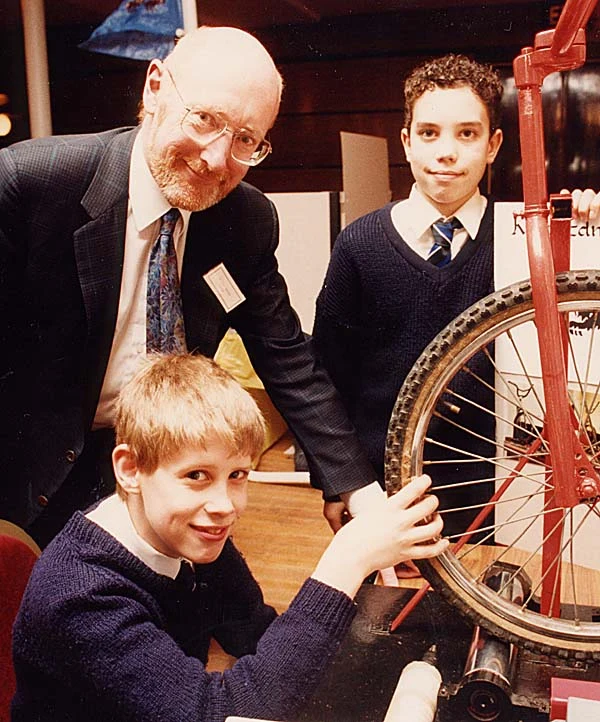
Museum object descriptions, the prototype account and designer biography were read. They support a history of development and use; no complete manual, source-code repository, production log or independent global sales census was examined. The 1992 photograph is clearly later than the launch. This article was reviewed on 23 October 2026.
- Centre for Computing HistorySinclair launches the ZX Spectrum, 23 April 1982
- Centre for Computing HistoryEarly Sinclair ZX Spectrum Computer: prices, design and early production
- Centre for Computing HistorySinclair ZX Spectrum Prototype: hardware and Nine Tiles software development
- Computer History MuseumSinclair ZX Spectrum Microcomputer, 1982: object 102626684
- Centre for Computing HistoryRick Dickinson: industrial design for Sinclair computers
- Centre for Computing HistoryAmstrad Buys Sinclair Research IP, 7 April 1986
- Centre for Computing HistoryAmstrad plc: the separate 1986 computer-rights purchase and later Spectrum models
- Wikimedia Commons / Adrian PingstoneSinclair.600pix.jpg: public-domain dedication and original upload history