In this biography
Quick facts
- Born
- 12 February 1809
- Died
- 1882
- Birthplace
- Shrewsbury, England
- Country
- United Kingdom
- Nationality
- Not independently established
- Known for
- Natural selection and On the Origin of Species
- Research area
- Naturalist and author
- Major work
- Natural selection and On the Origin of Species
Why this life matters
His evolutionary explanation grew through specimens, observation and correspondence across a wide research network. The 1858 communication also preserves Wallace’s independent contribution and makes the allocation of scientific credit part of that history.
Timeline
Key moments
Birth
Born on 12 February in Shrewsbury.
Beagle voyage
Travel supplied specimens and geological observations.
Marriage
Married Emma Wedgwood.
Downe
Moved to the home where much later research took place.
Joint communication
Darwin and Wallace’s contributions read on 1 July.
Origin
Published On the Origin of Species.
From family resources to a voyage
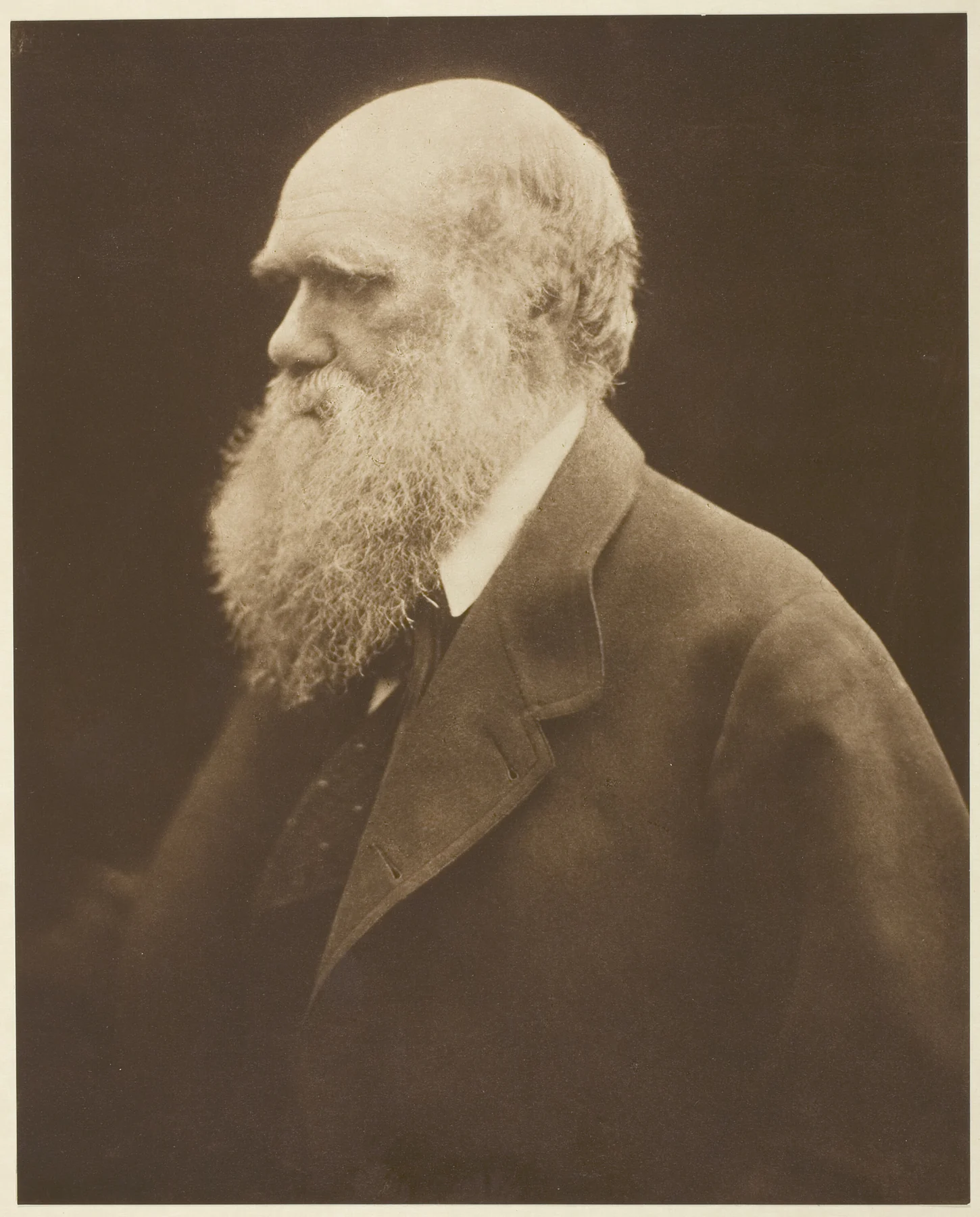
Born in Shrewsbury in 1809, Darwin studied at Edinburgh and Cambridge before joining HMS Beagle in 1831. John Stevens Henslow helped secure the opportunity. The five-year voyage supplied specimens and geological observations; later interpretation depended on work with other naturalists.
Darwin came from the Darwin and Wedgwood families and could pursue research outside a salaried university appointment. He married Emma Wedgwood in 1839. Their household, and later their home at Downe, supported the correspondence and observation on which his career rested.
Sources for this section: [1]
Research through an extended network
After returning in 1836, Darwin published on the voyage, worked on geology and zoology, and privately developed his ideas about species. His work was neither an instant conclusion on the Galápagos nor an isolated exercise. Letters connected collectors, specialists and observations across considerable distances.
Emma and their children assisted his work at home. Illness often limited his public activity, making written exchange especially important. Reading a biography alongside the surviving correspondence reveals that the final books emerged from a social network of inquiry rather than a single expedition alone.
Sources for this section: [1]
The 1858 communication and Wallace’s independent argument
In June 1858, Darwin learned that Alfred Russel Wallace had developed a related explanation while collecting in the Malay Archipelago. Charles Lyell and Joseph Hooker arranged a joint communication to the Linnean Society, read on 1 July. Its documents included extracts from Darwin’s earlier manuscript, a letter to Asa Gray, and Wallace’s essay.
The opening statement, signed by Lyell and Hooker, asserted independent thinking by both naturalists. It also defended publishing Darwin’s earlier work alongside Wallace’s. That statement is evidence for the organisers’ case; it is not a surviving statement of Wallace’s advance approval of the final arrangement.
A book, and a continuing research life
On the Origin of Species appeared in 1859, developing a much longer argument than the 1858 communication. Darwin continued studying plants, animals and human beings through books, experiments and letters. His public reputation grew while much of his daily work remained centred on home and garden.
He died in 1882 and was buried in Westminster Abbey. His importance lies both in the evolutionary explanation he helped establish and in the research practices that sustained it. The joint 1858 record also makes Wallace’s contribution visible instead of folding it into Darwin’s life as a mere prompt to publish.
Quick answers
Frequently asked questions about Charles Darwin
- What is Charles Darwin known for?
- Charles Darwin developed natural selection through travel, correspondence and long-term research; his 1858 publication shared credit with Alfred Russel Wallace.
- Why do the dates and records matter?
- The 1858 journal communication and the 1859 Origin are different publications. This article distinguishes authors from the people who communicated their documents.
Keep exploring
Lives connected to this story
- Isaac Newton
Compare another career reconstructed through published work and correspondence.
- James Clerk Maxwell
Explore a nineteenth-century research programme in a different field.
Sources and further reading
Explore the evidence
These references support the biography and offer further reading. Official records, first-person accounts and independent reporting provide different perspectives; image records document attribution and licensing.
- 1. Darwin Correspondence Project, Cambridge University LibraryAbout Darwin
- 2. Charles Darwin and Alfred Russel Wallace; Darwin Online original scanOn the tendency of species to form varieties (1858), pp.45–62
The 1858 journal communication and the 1859 Origin are different publications. This article distinguishes authors from the people who communicated their documents.
- 3. Darwin Correspondence ProjectLyell and Hooker to the Linnean Society, 30 June 1858, with editorial notes
The editors identify the printed introduction as their text source and note that its original manuscript has not been found. The introduction dates the Gray letter October 1857; an editorial note corrects the letter date to 5 September 1857.