In this biography
Quick facts
- Born
- 22 May 1859
- Died
- 7 July 1930
- Birthplace
- Edinburgh, Scotland
- Country
- United Kingdom
- Nationality
- Scottish
- Known for
- Sherlock Holmes and Dr Watson, historical fiction, Professor Challenger and public campaigns
- Medical education
- University of Edinburgh, 1876–1881
- Holmes debut
- A Study in Scarlet, 1887
- First Holmes collection
- The Adventures of Sherlock Holmes, 1892
- Another fictional lead
- Professor Challenger in The Lost World, 1912
Why this life matters
His detective stories joined observation, dramatic narration and magazine publishing, while his campaigns and spiritualism complicate the image of an uncomplicated rationalist.
Timeline
Key moments
Born in Edinburgh
Arthur Ignatius Conan Doyle was born on 22 May.
Medical education
He studied at the University of Edinburgh, where Joseph Bell was an important influence.
Holmes and Watson debut
A Study in Scarlet appeared in Beeton’s Christmas Annual.
Magazine success and collection
The Strand published the first Holmes short-story sequence before its 1892 collection.
Edalji campaign
Conan Doyle publicly examined the case of George Edalji.
The Lost World
The first Professor Challenger adventure appeared in serial and book form.
Spiritualism and later years
His public endorsement of the Cottingley photographs accompanied an increasingly prominent spiritualist commitment; he died in 1930.
Edinburgh medicine and habits of observation
Arthur Conan Doyle was born in Edinburgh on 22 May 1859. He studied medicine at the University of Edinburgh from 1876 to 1881. The university identifies the physician Joseph Bell as a major influence on Sherlock Holmes: attention to appearance and small details could lead to conclusions about a patient’s work and circumstances. Medical education supplied both knowledge and a model of disciplined inquiry.
The connection should not collapse a fictional character into a portrait of one teacher. Holmes is also made through dialogue, suspense and the viewpoint of Dr Watson. Conan Doyle’s medical career included practice in Southsea before writing became his principal livelihood. Moving from doctor to author did not mean abandoning the resources of his training; bodily observation and specialised knowledge remained available to his fiction.
Holmes, Watson and the magazine audience
A Study in Scarlet introduced Holmes and Watson in Beeton’s Christmas Annual in 1887. The Sign of Four followed in 1890. The first Holmes short stories began appearing in The Strand Magazine in July 1891, and twelve were collected as The Adventures of Sherlock Holmes in 1892. A reader could return regularly to familiar characters while receiving a new, largely complete case.
Watson supplies more than admiration. His partial knowledge controls suspense, his attention makes Holmes observable, and his personal life gives the partnership a changing context. Sidney Paget’s illustrations helped establish the detective’s visual identity alongside the prose. The result was a recognisable literary world supported by the repeat encounter between a monthly publication and its readers.
A literary career larger than one detective
Conan Doyle also wrote historical fiction, adventure, plays, poetry and nonfiction. The White Company, published in 1891, belongs to the historical work he took seriously alongside the profitable detective stories. The Lost World in 1912 introduced Professor Challenger and a different form of adventure. Its serial and book publication show that his relationship with the magazine market extended beyond Baker Street.
His wish for literary range helps place the apparent death of Holmes in The Final Problem in 1893. The detective later returned, but the episode exposes a tension between the author’s ambitions and his audience’s attachment to a character. Calling Conan Doyle simply the man who created Holmes can reproduce the very imbalance he tried to resist, leaving most of his writing invisible.
Public argument and the Edalji case
The writer also used his public standing to challenge injustice. In 1907 he examined the case of George Edalji, a solicitor convicted of attacks on animals. The Portsmouth collection describes his attention to Edalji’s poor eyesight and his published investigation. This was an intervention in a real legal case, where evidence and institutional decisions had consequences for someone’s life.
The campaign invites comparison with his fiction but is not another Holmes adventure. An author’s confidence cannot replace a court record, and later commemoration can simplify a complicated process. The value of the case in his biography is that it shows him applying public influence to questions of evidence, prejudice and responsibility, rather than confining those questions to entertaining plots.
Spiritualism, error and a complicated legacy
Conan Doyle’s commitment to spiritualism became a major part of his later public life. It was a religious conviction, not a deduction to be accepted because he had invented a rational detective. He promoted the Cottingley fairy photographs as genuine in The Strand in 1920. The University of Leeds archive records the later admission of fakery and preserves correspondence and other evidence connected with the episode.
He died on 7 July 1930. The contrast between his support for Edalji and his mistaken confidence in the fairy photographs offers a useful warning about reputation: persuasive observation in one setting does not guarantee sound judgement in another. His achievement remains the construction of compelling fiction and a durable detective partnership, while a complete biography must also accommodate his convictions, campaigns and errors.
Quick answers
Frequently asked questions about Arthur Conan Doyle
- Was Arthur Conan Doyle Scottish?
- Yes. He was born in Edinburgh, Scotland, and studied medicine at the University of Edinburgh before developing much of his professional career in England.
- Was The Adventures of Sherlock Holmes the first Holmes book?
- No. A Study in Scarlet appeared in 1887 and The Sign of Four in 1890. The Adventures is the first short-story collection, published in 1892.
- Was Sherlock Holmes based on a real doctor?
- Joseph Bell was an important model for the detective’s observational method, according to the University of Edinburgh. Holmes remains a fictional construction rather than a literal biography of Bell.
- Did Conan Doyle believe the Cottingley photographs?
- Yes. He publicly endorsed them as genuine. The later admission of fakery is documented by the University of Leeds, which holds the major archive of the episode.
Keep exploring
Lives connected to this story
- Agatha Christie
Follow the detective story into Christie’s closed circles of suspects and different investigative voices.
- Virginia Woolf
Compare the narrative work done by Watson with a modernist novel’s shifting perspectives.
Sources and further reading
Explore the evidence
These references support the biography and offer further reading. Official records, first-person accounts and independent reporting provide different perspectives; image records document attribution and licensing.
- 1. Portsmouth Conan Doyle CollectionA chronology of Conan Doyle’s life: birth, medicine, publications, campaigns and death
Selected dated entries were read. The July 1891–June 1892 first twelve-story sequence is distinguished from later Strand stories and the 1892 collection; no uncertain exact publication day is necessary here.
- 2. University of EdinburghSir Arthur Conan Doyle: medical education and Joseph Bell
- 3. British Library / John SutherlandSherlock Holmes, the world’s most famous literary detective: popular publishing and reception
- 4. Portsmouth Conan Doyle CollectionGeorge Edalji: Conan Doyle’s campaign against a wrongful conviction
- 5. Portsmouth Conan Doyle CollectionSpiritualism: Conan Doyle’s religious commitment
- 6. University of Leeds Special CollectionsCottingley Fairies Collection: photographs, correspondence and the later confession
Collection-level description and the library’s account were read, not all letters or the original photographic negatives. The images are identified as a hoax, not left as an unresolved supernatural claim.
- 7. University of Leeds LibraryFooled by fairies: the 1920 Strand publication and the hoax
- 8. Arthur Conan Doyle / Project GutenbergThe Adventures of Sherlock Holmes: contents and selected passages from the first two stories
The contents and selected opening, Irene Adler and Red-Headed League passages were read, not every Holmes story or a complete illustrated Strand run.
- 9. Portsmouth Conan Doyle CollectionA Goose and a Precious Stone: The Blue Carbuncle, January 1892 and collection context
- 10. Portsmouth Conan Doyle CollectionWhen Sherlock Got His Deerstalker: Paget and the July 1891–June 1892 sequence
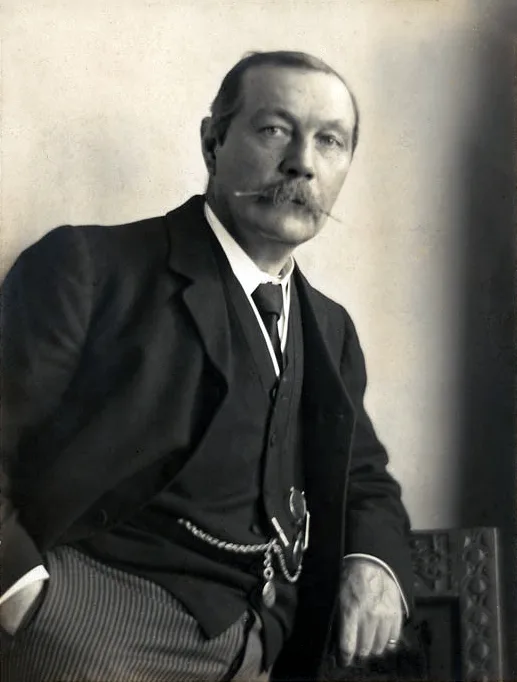
- 11. Walter Benington / Wikimedia CommonsExact 1914 portrait, public-domain basis and reversion of AI-enhanced revision
Downloaded current 517 × 682 PNG matches the reverted 2015 original. The 2023 AI-enhanced enlargement recorded in file history was excluded.
- 12. Wikimedia CommonsComplete original 517 × 682 PNG