In this biography
Quick facts
- Born
- 15 September 1890
- Died
- 12 January 1976
- Birthplace
- Torquay, Devon, England
- Country
- United Kingdom
- Nationality
- English
- Known for
- Hercule Poirot, Miss Marple, inventive detective fiction and The Mousetrap
- Birth name
- Agatha Mary Clarissa Miller
- First detective novel
- The Mysterious Affair at Styles, 1920
- Other pen name
- Mary Westmacott
- Stage landmark
- The Mousetrap opened in London in 1952
Why this life matters
Her work made the arrangement of testimony, clues and reader expectations central to the pleasures and moral questions of the detective story.
Timeline
Key moments
Born in Torquay
Agatha Miller was born on 15 September in Devon.
Hospital and dispensary work
Wartime service gave her practical knowledge of medicines and poisons.
Poirot reaches print
The Mysterious Affair at Styles introduced her Belgian detective.
Ackroyd and personal upheaval
The Murder of Roger Ackroyd appeared; her disappearance later that year prompted a national search.
New directions
The first Marple novel and first Mary Westmacott novel preceded Murder on the Orient Express.
The Mousetrap
The stage mystery began its London run.
Honour and final years
Made a dame in 1971, Christie died on 12 January 1976.
Torquay and the making of a storyteller
Agatha Christie was born Agatha Mary Clarissa Miller in Torquay, Devon, on 15 September 1890. She grew up at Ashfield in a family where stories, reading and imaginative play were everyday resources. Much of her early education took place at home, followed by periods of study in Paris. Music was a serious interest: she trained in piano and singing before writing became her profession.
This background helps explain a career broader than the familiar country-house puzzle. Christie learned to attend to voices, social performances and people whose apparent identity might be misleading. Those habits could serve a thriller, a play or a psychological novel. They do not make every later character a disguised acquaintance; invention reorganises experience rather than simply transcribing it.
War work and the first detective novel
During the First World War she worked in a hospital and dispensary. Pharmaceutical training supplied a practical understanding of substances that later became important to her fiction. The British Library’s archive-based account identifies her 1917 examination notes as surviving evidence of that learning. Knowledge mattered because an ingenious solution also needed a plausible material basis.
The Mysterious Affair at Styles, published in 1920, introduced Hercule Poirot, a Belgian detective in England. Christie had married Archibald Christie in 1914, and their daughter Rosalind was born in 1919. As her writing developed, she used different investigators and narrative forms. Tommy and Tuppence brought an adventurous partnership to The Secret Adversary, while Poirot offered a distinctive intelligence and manner.
A successful author through a difficult decade
The Murder of Roger Ackroyd in 1926 became a decisive success, showing how the reader’s assumptions about a story’s telling could become part of the mystery. That same year brought her mother’s death and the collapse of her first marriage. In December she disappeared, prompting a large search before she was found at a hotel in Harrogate.
The location and search are established events; competing explanations for the disappearance remain less secure. It is unnecessary to diagnose her retrospectively or turn an unresolved private episode into another solved detective plot. The career continued through divorce and new journeys. Miss Marple, whose knowledge grows from observing village behaviour, reached her first full-length novel in The Murder at the Vicarage in 1930.
Travel, archaeology and another writing name
Christie travelled to the Middle East independently in 1928 and married archaeologist Max Mallowan in 1930. Work and travel around excavations in Iraq and Syria furnished settings and social observations for several books. The National Trust records their purchase of Greenway in Devon in 1938 and the family collections preserved there. The English holiday home existed alongside an internationally mobile working life.
Murder on the Orient Express appeared as a novel in 1934. Yet the same decade also included writing under Mary Westmacott, beginning with Giant’s Bread in 1930. Her daughter’s recollection describes six novels concerned with emotional relationships and psychology. The pen name gave Christie room to work outside the expectations attached to a detective puzzle, without making those books literal accounts of her own life.
Theatre, later work and the reader’s role
Christie returned to pharmacy work in London during the Second World War while continuing to write. Her dramatic career also expanded. The Mousetrap opened in London in 1952, turning concealed histories and carefully released information into a shared theatrical experience. A stage audience hears a statement once, in the presence of other spectators; a reader can turn back and inspect an earlier sentence.
Made a dame in 1971, Christie died on 12 January 1976. Her lasting importance includes the active role she assigns her audience: noticing what has been said, who supplied it and why it seemed convincing. Her fictional worlds also carry assumptions about class, nationality and empire that deserve scrutiny. Reading her attentively means enjoying construction while remaining willing to question the social judgements embedded in it.
Quick answers
Frequently asked questions about Agatha Christie
- Was Agatha Christie also Mary Westmacott?
- Yes. She published six novels as Mary Westmacott, beginning with Giant’s Bread in 1930. They gave her scope to explore relationships beyond her usual crime-fiction audience’s expectations.
- Which detective came first, Poirot or Miss Marple?
- Poirot appeared in The Mysterious Affair at Styles in 1920. Miss Marple appeared in short stories before her first novel, The Murder at the Vicarage, in 1930.
- Did Christie take part in archaeological work?
- Yes. She accompanied Max Mallowan to excavations in Iraq and Syria and helped with tasks including cleaning, cataloguing and photographing finds.
- Was Murder on the Orient Express originally a film?
- No. A US serial appeared in 1933 and the novel in 1934. The well-known 1974 and 2017 films are later adaptations.
Keep exploring
Lives connected to this story
- Arthur Conan Doyle
Compare Poirot and Marple with the magazine-based detective storytelling of Sherlock Holmes.
- Virginia Woolf
Compare another interwar writer’s experiments with what a narrator reveals and what a reader assumes.
Sources and further reading
Explore the evidence
These references support the biography and offer further reading. Official records, first-person accounts and independent reporting provide different perspectives; image records document attribution and licensing.
- 1. Agatha Christie LimitedAbout Christie: dated life, wartime work, writing and later years
Selected chronological sections were read. The official account’s possible amnesia explanation is not adopted as a settled medical diagnosis.
- 2. British LibraryAgatha Christie exhibition announcement, 20 May 2026: archive objects, pharmacy notes and travels
Read as a 20 May 2026 exhibition announcement and archive-object description; the exhibition had not opened by this review date. No visit or inspection of the complete Christie archive is claimed.
- 3. National TrustHistory of Greenway: Christie, Mallowan, collections and the Second World War
- 4. Rosalind Hicks / Agatha Christie LimitedThe Mary Westmacotts: six novels and a family recollection written in 1990
- 5. Agatha Christie LimitedMurder on the Orient Express: 1934 novel, setting and adaptations
- 6. Agatha Christie LimitedFacts about Murder on the Orient Express: 1933 serial and 1934 novel
- 7. Agatha Christie LimitedAuthorised five-page opening extract: Taurus Express at Aleppo
The authorised five-page opening extract was read, not the complete copyrighted novel. No novel text is reproduced.
- 8. Ellen Turner / Newcastle UniversityLaw, the Domestic and Sovereignty in Interwar Women’s Writing, 2011: selected Orient Express discussion, printed pages 86–91
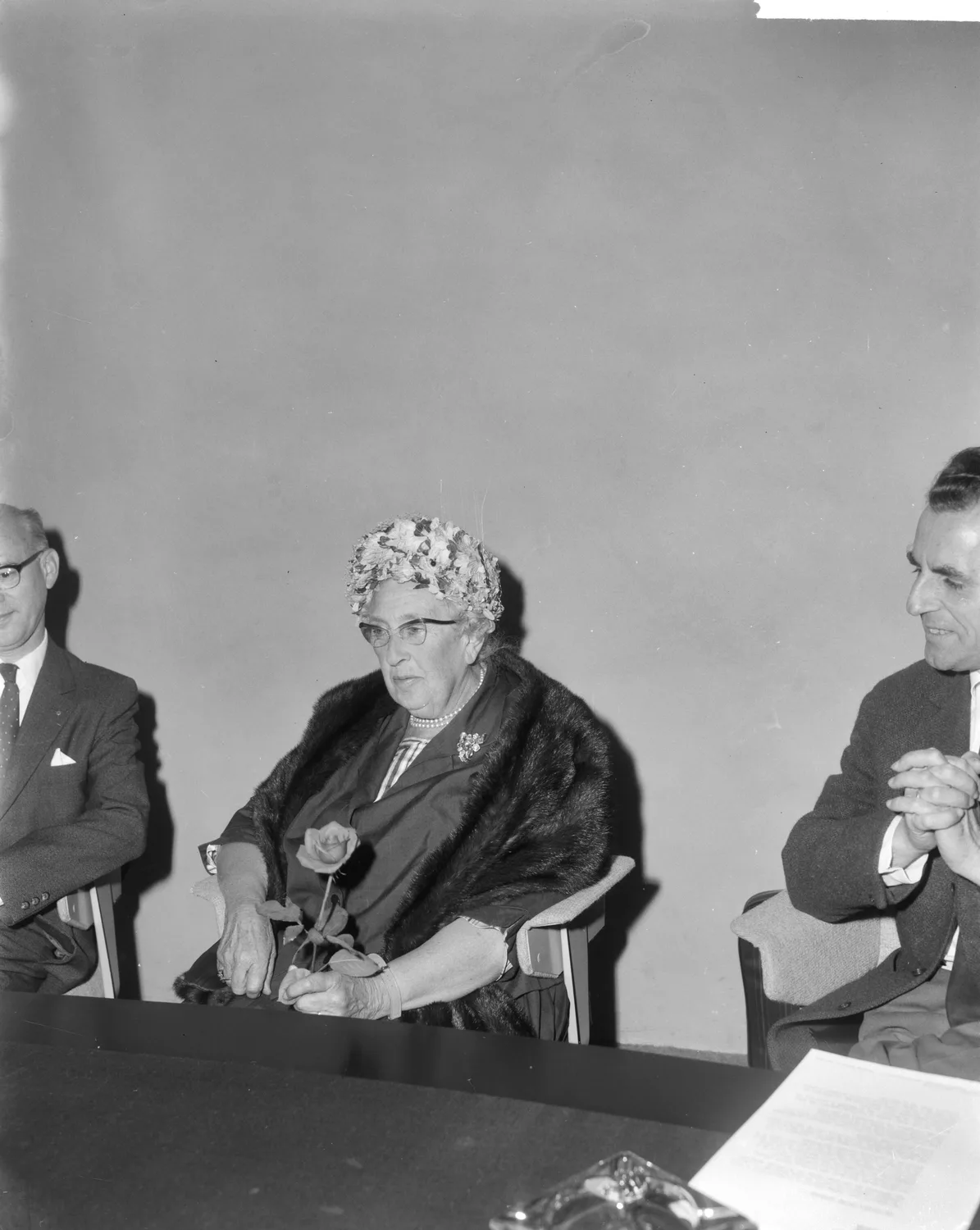
- 9. Joop van Bilsen / Nationaal Archief / Wikimedia CommonsExact uncropped photograph 916-8896, identity and CC0 dedication
Exact uncropped CC0 item and full supplied frame were downloaded and visually checked. The seated airport scene is described as seen, without turning its catalogue’s arrival wording into a claimed action.
- 10. Wikimedia CommonsComplete original 1964 photograph