In this biography
Quick facts
- Born
- 13 September 1966
- Birthplace
- Bangkok, Thailand
- Country
- Thailand
- Nationality
- Thai
- Known for
- Leading Bhumjaithai, health policy and two prime-ministerial appointments
- Office
- 32nd Prime Minister, from 7 September 2025
- Second appointment
- 19 March 2026, after a general election
- Political party
- Bhumjaithai Party
- Earlier national role
- Deputy prime minister and minister of public health
Why this life matters
Anutin’s career connects coalition brokerage, the COVID-19 response, cannabis reform and Thailand’s rapid sequence of parliamentary and judicial political transitions after 2023.
Timeline
Key moments
Born in Bangkok
Born on 13 September into a business family.
Completed an engineering degree
Earned a bachelor’s degree in industrial engineering from Hofstra University in New York.
Served in Thaksin-era governments
Held deputy-ministerial posts before the September 2006 military coup ended the administration.
Became Bhumjaithai leader
Took over a party that later became a pivotal participant in several coalition governments.
Led the public-health ministry
Served as deputy prime minister and public health minister through the COVID-19 pandemic and cannabis-policy change.
Became interior minister
Joined the Pheu Thai-led coalition as deputy prime minister and minister of interior before Bhumjaithai withdrew in June 2025.
Became the 32nd prime minister
Received the royal command after the House selected him following Paetongtarn Shinawatra’s removal from office.
Led Bhumjaithai to an election victory
The party won the largest number of House seats after his short first administration dissolved parliament.
Won a second appointment
The House again approved Anutin, and a new royal command began his second premiership.
Engineering, business and entry into politics
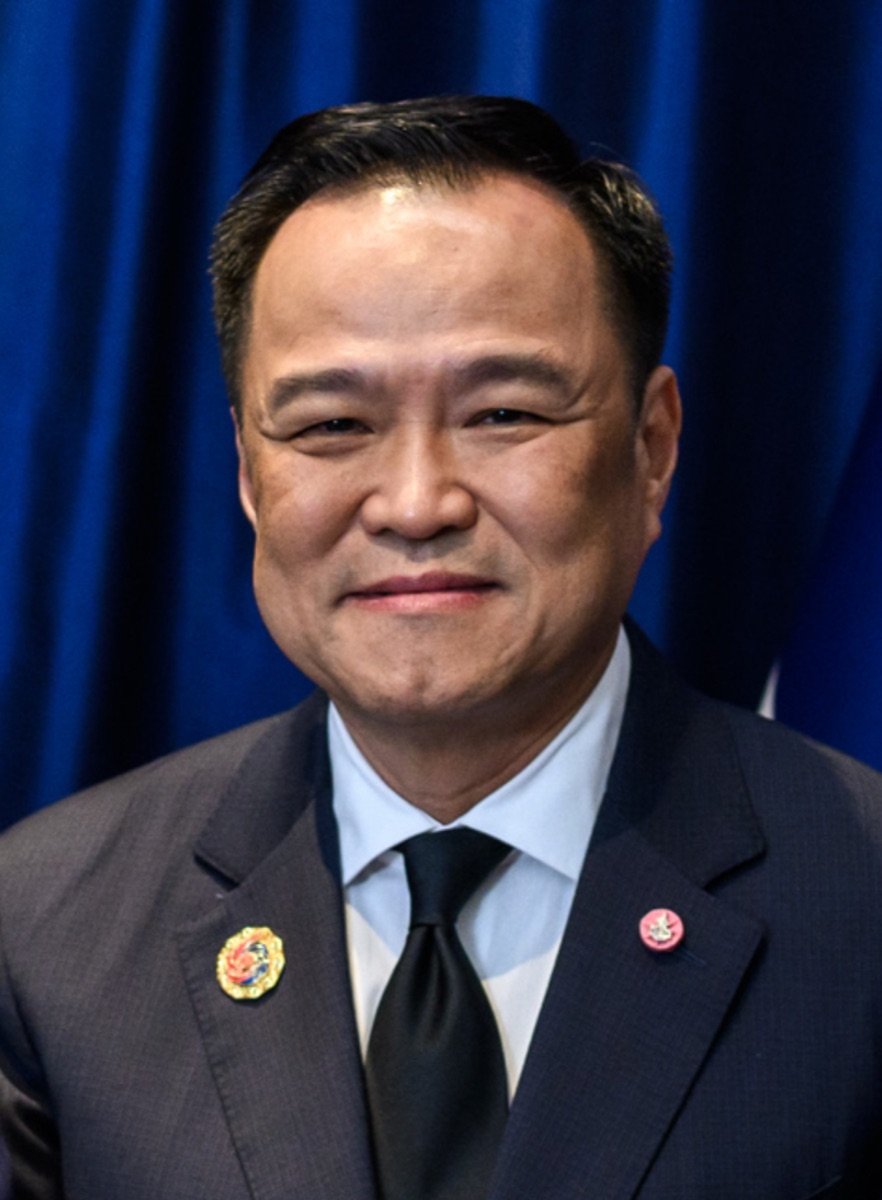
Anutin Charnvirakul was born in Bangkok on 13 September 1966. He studied at Assumption College and Worcester Academy before graduating in industrial engineering from Hofstra University in 1989 and completing a Mini MBA programme at Thammasat University in 1990. He worked in the family-linked construction sector before moving into national politics.
His early political career developed around parties associated with Thaksin Shinawatra. Anutin served as a deputy minister of commerce and a deputy minister of public health during the 2000s, then left office after the 2006 coup and the legal dissolution of Thai Rak Thai. He returned to front-line politics through Bhumjaithai and became the party’s leader in 2012.
Building Bhumjaithai into a coalition pivot
Bhumjaithai developed a strong organisational base in the northeast while presenting itself as a practical coalition party rather than a member of only one national camp. After the 2019 election, it joined the government led by Prayut Chan-o-cha. Anutin became both deputy prime minister and minister of public health, giving the party control of a ministry with a nationwide service network and a visible policy portfolio.
The party’s bargaining position grew again after the 2023 election. Although the Move Forward Party won the most seats, it did not form a government. Bhumjaithai joined the later Pheu Thai-led coalition, and Anutin became deputy prime minister and interior minister. His movement between coalitions made him a central example of how medium-sized parties can convert parliamentary numbers and regional organisation into national influence.
Public health, COVID-19 and cannabis policy
Anutin’s health-ministry term included Thailand’s response to COVID-19. The ministry worked with the World Health Organization on an early review of surveillance, laboratories, clinical management, risk communication and coordination, and launched a nationwide vaccination programme in June 2021. The record also attracted criticism over vaccine procurement, communication and the human cost of later waves; responsibility was distributed across the cabinet, health agencies and provincial systems rather than resting on one minister alone.
He was also the most visible political advocate of removing cannabis from the narcotics list in 2022. Bhumjaithai presented the change around medical use and household income, but the absence of a completed comprehensive law produced uncertainty over recreational access, retail growth and public-health controls. The policy increased Anutin’s national profile while leaving later governments to debate tighter regulation.
A first premiership after judicial removal
Bhumjaithai left Paetongtarn Shinawatra’s coalition in June 2025 after a leaked telephone conversation with Cambodian Senate president Hun Sen intensified a border and ethics controversy. On 29 August, the Constitutional Court ruled that Paetongtarn’s ministerial office had ended. The decision created another rapid parliamentary contest over the premiership.
The opposition People’s Party agreed to support Anutin without joining his government, in exchange for commitments that included an early dissolution and movement toward constitutional reform. The House selected him on 5 September, and the royal command appointing Thailand’s 32nd prime minister followed on 7 September. His first cabinet was a minority administration designed around a short timetable rather than a full parliamentary term.
Election victory and a second appointment
Anutin dissolved the House and led Bhumjaithai into the general election held on 8 February 2026. The party finished far ahead of its previous results and emerged as the largest force in the elected chamber. The result gave Anutin a stronger parliamentary base than the outside support arrangement that had produced his first administration.
The House approved him again on 19 March 2026, and the royal appointment began a second term as the same, 32nd numbered prime minister. As of this biography’s review on 3 October 2026, he also held the interior portfolio. His durability rests on coalition-building and regional party machinery, while assessments of his leadership continue to turn on public-health policy, cannabis regulation, economic delivery, institutional alliances and the quality of parliamentary accountability.
Quick answers
Frequently asked questions about Anutin Charnvirakul
- Who is Anutin Charnvirakul?
- Anutin Charnvirakul is the 32nd Prime Minister of Thailand. Anutin’s career connects coalition brokerage, the COVID-19 response, cannabis reform and Thailand’s rapid sequence of parliamentary and judicial political transitions after 2023.
- What is Anutin Charnvirakul best known for?
- Anutin Charnvirakul is best known for leading Bhumjaithai, health policy and two prime-ministerial appointments.
- When and where was Anutin Charnvirakul born?
- Anutin Charnvirakul was born on 13 September 1966 in Bangkok, Thailand.
Sources and further reading
How this biography was checked
Core dates and offices are checked against the sources below. This profile was last reviewed on 3 October 2026.
- Royal Thai GovernmentPrime Minister — Mr. Anutin Charnvirakul
- Secretariat of the Prime Minister of ThailandDirectory of Prime Ministers of Thailand
- World Health OrganizationReview of Thailand’s COVID-19 response
- World Health OrganizationNationwide COVID-19 vaccination rollout
- Constitutional Court of ThailandPress Release 32/2025 on the end of Paetongtarn’s office
- Ministry of Foreign Affairs of ThailandAppointment of Anutin Charnvirakul as prime minister
- Royal Thai GovernmentAnutin appointed as 32nd prime minister for a second term
- ReutersHow Anutin rose from cannabis advocate to prime minister
- Wikimedia CommonsPortrait and public-domain record