
The short answer
One share can carry several monetary labels. The selected Zenith documents distinguish nominal value, a rights-subscription price and a concurrent public-offer price; the figures are not interchangeable measures of money raised.
Record comparison
Compare the evidence
Keep the objects and assumptions attached to each statement.
| Item | What it establishes | What remains separate |
|---|---|---|
| Per-share nominal amount | Classifies a nominal capital amount when multiplied by shares. | Does not equal subscription cash. |
| Per-share issue price | Calculates stipulated gross cash for fully paid allotted shares. | Does not by itself give net proceeds or return. |
| Historical calendar | Identifies a stated schedule at a document stage. | Does not prove final allotment. |
Chronology
A timeline of the turning points
Chair’s letter
Two offering routes described.
Original opening date
Date printed in the circular.
Read the labels on the original instrument
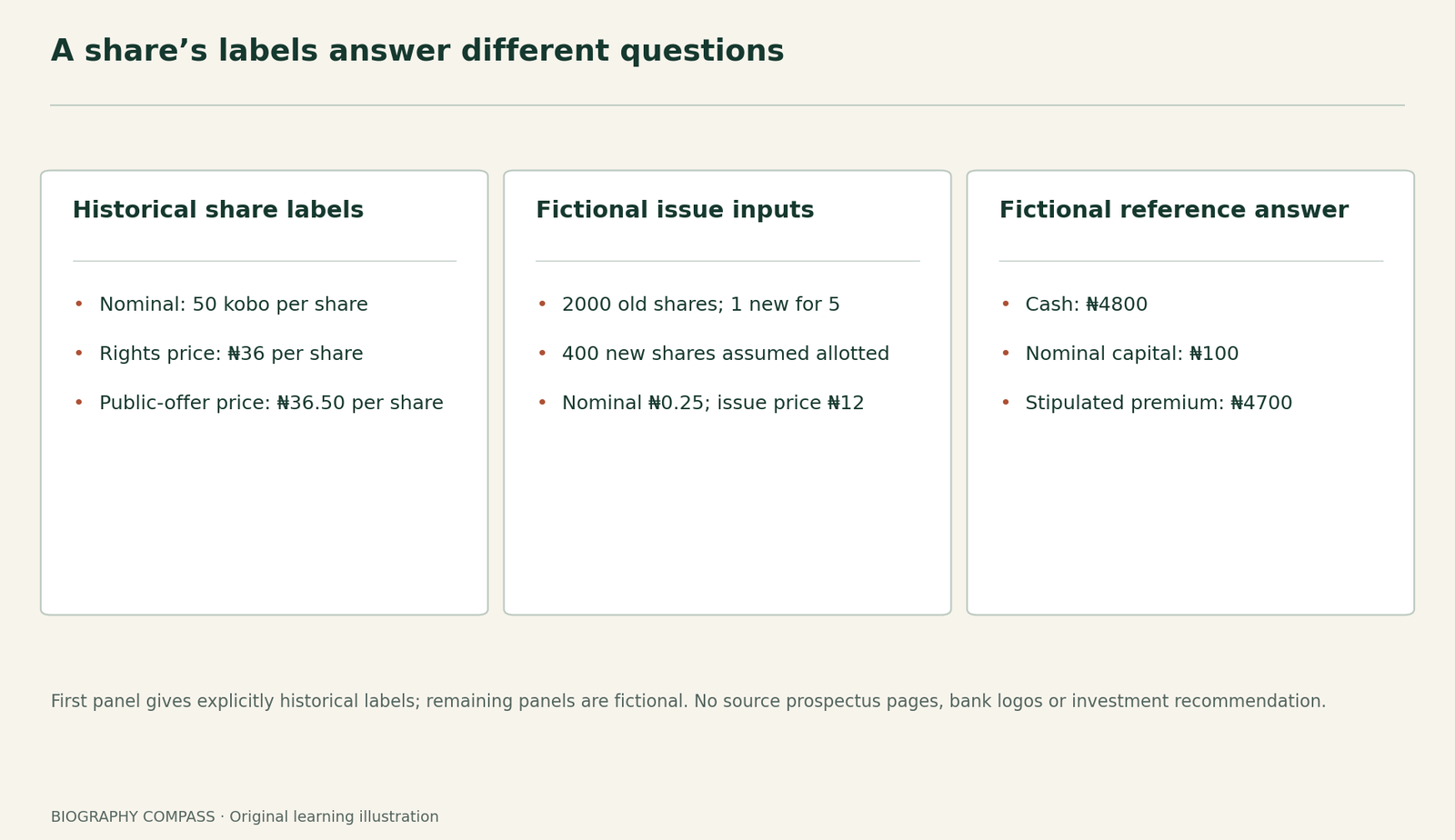
Page 17 of Zenith’s rights circular offers 5,232,748,964 ordinary shares of 50 kobo each at ₦36 per share, on a one-for-six basis. The chair’s letter on page 25 separately names a public offer at ₦36.50 per share.
The 50-kobo phrase labels the shares’ nominal value. The two naira prices concern different offers. Neither the nominal figure nor one subscription price is a current market quotation, a personal valuation of Jim Ovia or a final record of cash received.
Compare an intermediary record without losing units
CardinalStone’s overview also distinguishes the rights issue from the public offer. Its typography combines “₦0.50” and “Kobo”; it gives 23 September 2024 as the scheduled close.
The selected original circular instead prints 9 September in its original calendar.
Use the issuer’s unambiguous 50-kobo label and keep each schedule attached to its document. The two calendar statements are not an inspected extension order or completed-allotment notice. The exercise below stipulates its own inputs rather than treating a planned share count as shares ultimately issued.
Ask which quantity a multiplication would produce
Under the conversion 100 kobo = ₦1, 50 kobo is ₦0.50. A share count multiplied by nominal value produces an aggregate nominal amount. Multiplying by an issue price produces a gross payment amount under the assumed full-payment conditions. Those products answer different questions.
Their difference is arithmetic, but calling an actual balance-sheet entry share premium requires the applicable accounting context. The original circular lists capital and premium separately; it is not a licence to infer net proceeds, expenses, allocations or investor returns from a headline. Here the bookkeeping rule is supplied explicitly for a fictional issuer.
Work a fictional fully paid issue
A fictional issuer has 2000 existing shares and offers one new share for every five held. Assume all rights are accepted, paid and allotted. Each new share has nominal value ₦0.25 and issue price ₦12. For this exercise only, record cash less nominal capital as a premium amount and ignore all costs. These are invented inputs, not Zenith’s offer terms.
Task: calculate the new shares, cash, aggregate nominal capital and the stipulated premium. State the two monetary units clearly.
Reference answer: 2000 ÷ 5 = 400 new shares. Cash is 400 × ₦12 = ₦4800. Nominal capital is 400 × ₦0.25 = ₦100. The stipulated difference is ₦4700. The nominal value is 25 kobo per share, not ₦25; confusing those units would create a hundredfold error. None of the calculations establishes a market price, net proceeds after real costs or an expected return.
Continue the chronology
Related history guides
FirstBank and Access: Which Board?
Compare another way these business records distinguish their objects and measures.
Read the timeline2004, 2009 and 2014–2015 recordsInnoson and Coscharis: Assembly Records
Compare another way these business records distinguish their objects and measures.
Read the timelineBiography context
Explore Nigeria through connected lives
Connected biographies
People connected with these records
Born 1951
Jim Ovia
Banker and Zenith Bank founderOvia founded Zenith Bank and later chaired its board.Read biographyQuick answers
Common questions
- Is a share’s nominal value its market price?
- These are distinct quantities. The supplied exercise contains no market-price observation.
- Are the exercise numbers Zenith’s historical offer?
- No. All exercise inputs are fictional; historical values are explicitly labelled in the record comparison.
Primary and institutional sources
How this history was checked
Read these records alongside their dates, stated objects and access limits. The exercise and worked answer are original learning material. This article was reviewed on 30 October 2026.