
The short answer
A familiar banking brand can conceal several legal entities and different jobs. These Nigerian records show why the named organisation, the role and the kind of date must travel together.
Record comparison
Compare the evidence
Keep the objects and assumptions attached to each statement.
| Item | What it establishes | What remains separate |
|---|---|---|
| Entity | Use the full organisation named in the record. | Do not substitute the parent or a brand. |
| Role | Preserve chair, non-executive or CEO wording. | Do not merge oversight and executive work. |
| Date | Label announcement, decision and effective events. | Leave missing precision unresolved. |
Chronology
A timeline of the turning points
Announcement report
TheCable reports the FirstBank changes.
Effective appointment
Awosika’s chair appointment takes effect.
Different board role
Access Holdings return statement.
An announcement is not its effective date
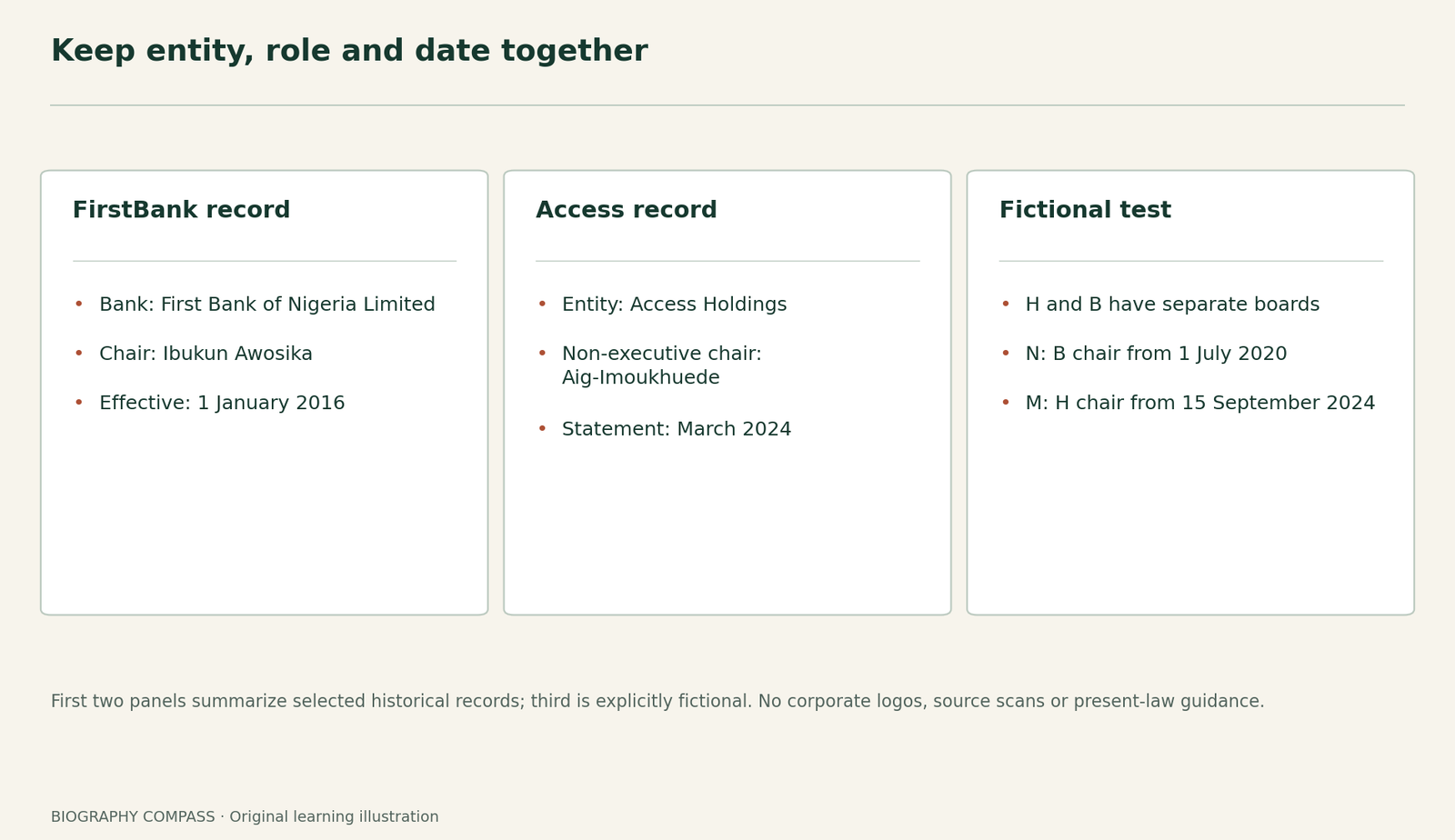
First Bank of Nigeria Limited’s 2015 report records Ibukun Awosika’s chair appointment with effect from 1 January 2016.
TheCable reported the appointment on 8 September 2015, identifying FBN Holdings as the announcing parent and distinguishing other appointments at the group and its merchant bank.
Thus “announced in 2015” and “effective in 2016” answer different questions. The issuer of an announcement need not be the company whose board receives the appointee. Read the named legal entity rather than replacing it with the shortest familiar brand.
A return can involve a different organisation and job
Access’s record names Aigboje Aig-Imoukhuede as non-executive chair of Access Holdings. Its body is dated 13 March 2024, while the web wrapper says 13 May.
His earlier Access Bank chief-executive term had ended in 2013.
The bank’s 2010 profile dates his move from GTBank to March 2002.
This is not a simple resumption of the same job. Nor does a web-posting date automatically establish the date an appointment became legally effective. Preserve both visible dates and the precision the text actually supplies; an exact effective day cannot be invented to make a neat timeline.
Build a record before telling the story
For each claim, write five fields: person; exact entity; role; event described; and date attached to that event. Add a sixth field for what remains unknown. A chair is not automatically a chief executive. A holding-company title is not automatically a subsidiary-bank title.
The historical finding is concrete: the FirstBank record supplies an explicit future effective day, whereas the Access material changes both the organisation and the role relative to the earlier bank career. The different document stages limit the comparison. They do not supply ownership percentages, complete appointment instruments or a review of present governance law.
Practice on a supplied fictional group
Suppose Harbour Holdings PLC, H, owns 80% of Harbour Bank Limited, B. For this exercise they have separate boards and no rule automatically links their chairs. A statement dated 4 June 2020 says N has been appointed B’s chair effective 1 July. On 15 September 2024, H announces M as its non-executive chair with immediate effect. B later announces its CEO P will leave on 31 December 2024.
Task: identify the entity, role and effective event for N and M. Can the supplied ownership percentage establish who is B’s CEO, or turn M into B’s chair?
Reference answer: N is B’s chair from 1 July 2020; 4 June is the announcement date. M becomes H’s non-executive chair on 15 September 2024 under the supplied immediate-effect wording. P’s announced departure concerns B’s CEO role and a future end date. Nothing supplied appoints M to B’s board or names a successor CEO. The 80% figure establishes the fictional ownership relation only.
Continue the chronology
Related history guides
Zenith’s 2024 Offer: Par Value and Price
Compare another way these business records distinguish their objects and measures.
Read the timeline2004, 2009 and 2014–2015 recordsInnoson and Coscharis: Assembly Records
Compare another way these business records distinguish their objects and measures.
Read the timelineBiography context
Explore Nigeria through connected lives
Connected biographies
People connected with these records
Career documented by 2009
Ibukun Awosika
Furniture entrepreneur and bank leaderAwosika built furniture businesses before becoming FirstBank’s first woman chair.Read biographyBorn 1966
Aigboje Aig-Imoukhuede
Banker, investor and philanthropistAig-Imoukhuede led Access Bank and later chaired Access Holdings.Read biographyQuick answers
Common questions
- Does an ownership percentage identify a chair?
- In the supplied fictional case it does not. The boards and appointment rules are explicitly separate.
- Must all dates on a corporate web page describe the same event?
- No. A page’s publication wrapper, a dated statement and an explicit effective date can refer to different events.
Primary and institutional sources
How this history was checked
Read these records alongside their dates, stated objects and access limits. The exercise and worked answer are original learning material. This article was reviewed on 30 October 2026.
- First Bank of Nigeria LimitedAnnual Report and Accounts 2015: Ibukun Awosika
- Mayowa Tijani, TheCableMeet the first female chairman of First Bank, 8 September 2015
- Access HoldingsHoldco Chairman Return: statement dated 13 March 2024
- Aig-Imoukhuede FoundationAigboje Aig-Imoukhuede
- Access Bank2010 Annual Report: Aigboje Aig-Imoukhuede