
The short answer
Why did the 1951 orphanage observations complicate a calories-only explanation of growth?
Read the evidence
Widdowson: Growth, Food and Care
Keep food supplied, food consumed and a complete explanation of growth distinct.
| Record or comparison | What the record supports | What remains separate |
|---|---|---|
| 1951 publication record | Establishes the dated report and its author | Without an abstract or full text, it does not independently supply the original methods |
| Later peer-reviewed historical accounts | Describe a comparison that complicates a food-allocation-only explanation | They do not prove one exclusive mechanism or provide a newly checked original dataset |
Separate the original record from its retellings
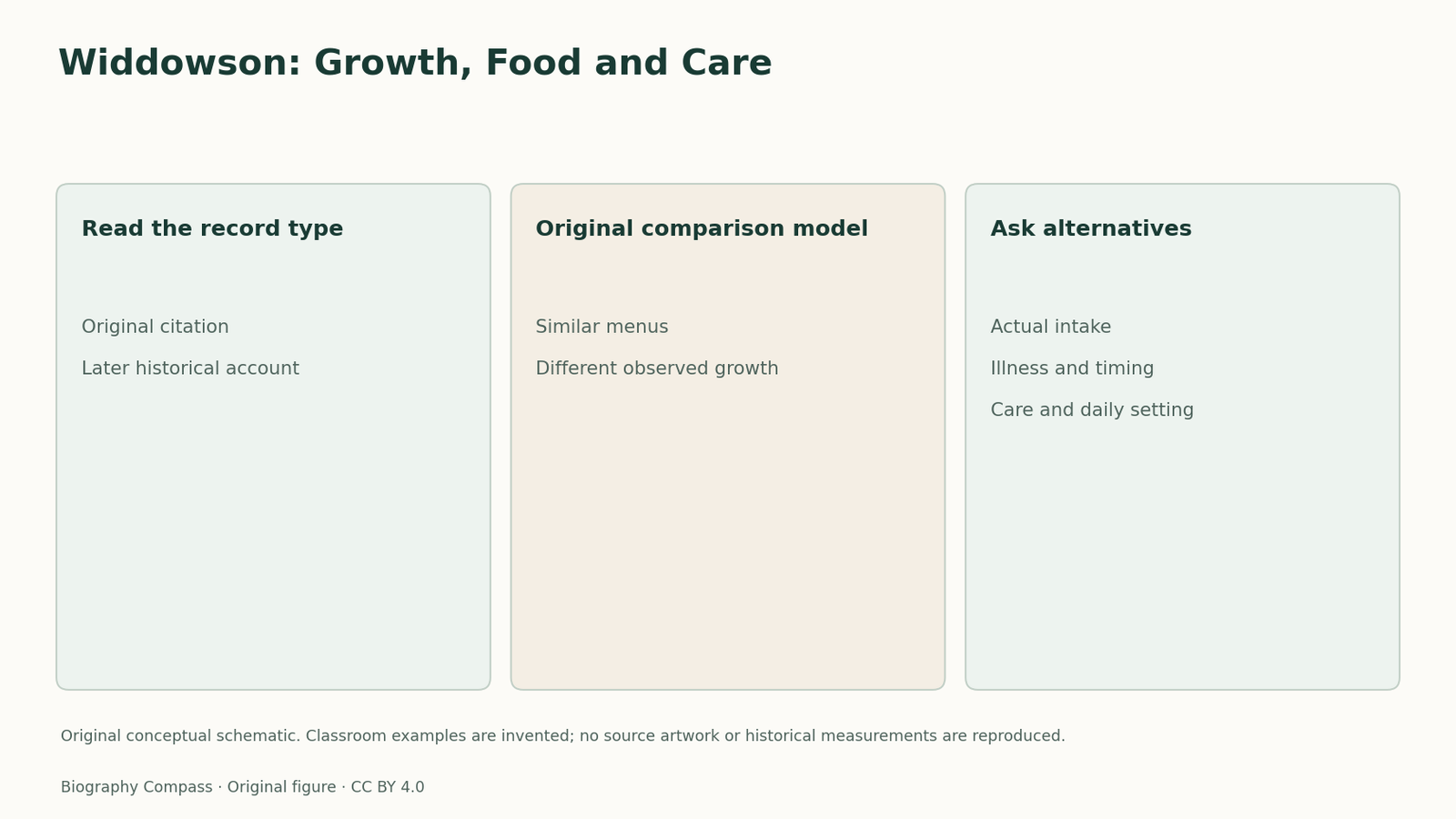
Mental Contentment and Physical Growth was published by Elsie Widdowson in The Lancet in 1951. The accessible bibliographic record contains no abstract, and the original full text was not available for this review. The substantive historical account here is therefore attributed to later peer-reviewed discussions. This distinction matters: a title and citation establish that a report exists, while its methods and outcomes require either the original text or a clearly identified account of it. The two should not be silently substituted.
What the later accounts describe
The reviewed histories describe children in two postwar German institutions, initially compared under similar dietary provision. A later review discusses subsequent supplementation alongside a reversal in relative growth, drawing attention to changes in the caregiving environment. The interpretation complicates a description based only on the food supplied. It does not establish that food is irrelevant, that intake was identical in every child, or that one emotional variable was the only possible cause. Institutional setting, individual consumption and other conditions remain questions a reader should ask.
An original competing-explanations exercise
Give students an invented table with two homes, similar menus and different average weight gains. Ask for three possible questions before selecting a cause. Suitable answers include how much each child actually ate, whether illness differed, and how care or daily routines differed. Now add a second period in which one home receives more food but the relative pattern changes. Ask whether this observation proves that calories have no biological effect. It does not; it challenges a simple explanation based solely on the recorded food allocation. Finally, ask what records could distinguish the alternatives. Individual intake, illness histories, timing and consistent measurement would address different parts of the problem. The scenario is an original reasoning exercise, not Widdowson’s data or a reconstruction of her experimental design.
A useful conclusion without an oversized claim
The historical comparison draws attention to the difference between providing food and explaining a person’s growth. Widdowson’s career in chemistry, food composition and infant nutrition helps place that concern within a larger programme. The later accounts support treating care and context as questions worth investigating; they do not license a precise physiological mechanism or effect estimate that has not been reviewed. Reading the report’s influence this way preserves its importance while keeping the limits of the available historical evidence visible.
Continue the chronology
Related history guides
Why are a food-composition value, an edible portion and a person's requirement different quantities?
Distinguish food composition from an individual’s intake or requirements.
Read the timeline1951What could a case-control study show about prenatal radiography and childhood cancer, and what could it not settle alone?
Compare how historical observational evidence supports questions while retaining alternative explanations.
Read the timelineBiography context
Explore United Kingdom through connected lives
Connected biographies
Researchers and related questions
1906–2000
Elsie Widdowson
Chemist and nutrition researcherElsie Widdowson brought chemical analysis and human nutrition together in a long research partnership with Robert McCance and a substantial independent career.Read biography1898–1993
Robert McCance
Physician and nutrition researcherRobert McCance combined medicine and biochemistry in nutritional research, producing influential food-composition work with Elsie Widdowson.Read biography
1906–2002
Alice Stewart
Physician and epidemiologistAlice Stewart investigated environmental and occupational health before leading a major case-control investigation of childhood cancer.Read biographyQuick answers
Common questions
- Was Widdowson’s 1951 full paper directly read?
- No. Its publication record was checked; substantive retellings are explicitly attributed to the registered peer-reviewed histories.
- Does the comparison show that food does not matter?
- No. It motivates questions beyond recorded food allocation and does not remove nutrition from an explanation of growth.
Primary and institutional sources
How this history was checked
Publication metadata is explicitly separated from later peer-reviewed accounts. The original 1951 full text and its numerical results were not available and are not reconstructed. This article was reviewed on 7 November 2026.
- Royal College of PhysiciansElsie May Widdowson
- King’s College LondonDr Elsie Widdowson
- Royal College of Paediatrics and Child HealthDr Elsie Widdowson
- The Lancet / PubMedMental contentment and physical growth
- Monographs of the Society for Research in Child Development / PMCGrowth Failure in Institutionalized Children
- Psychological Medicine / Cambridge University PressEffects of early nutrition on neurological and mental competence in human beings