
The short answer
What could a case-control study show about prenatal radiography and childhood cancer, and what could it not settle alone?
Read the evidence
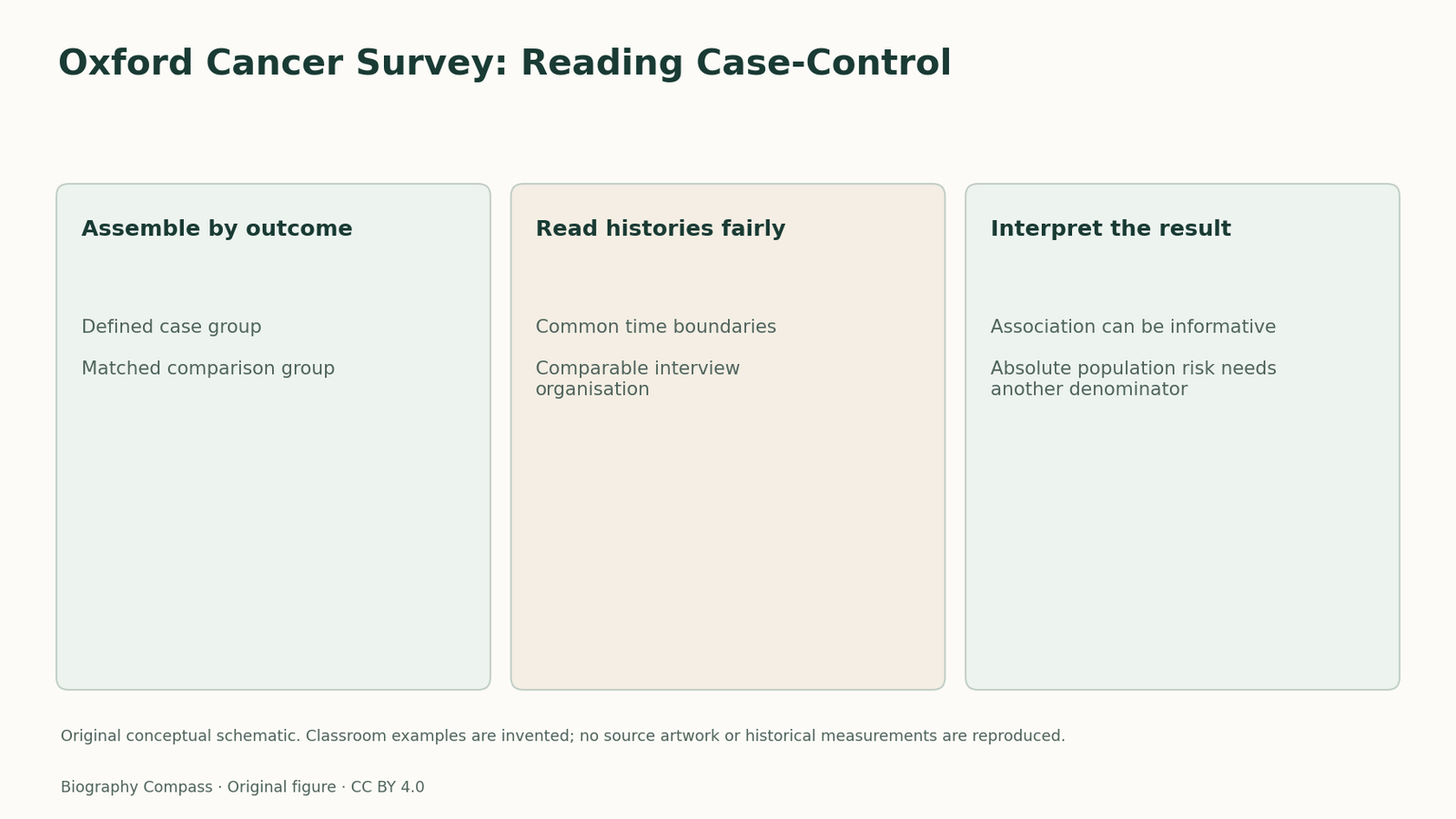
Oxford Cancer Survey: Reading Case-Control
Compare participant selection and historical measurement before interpreting an association.
| Record or comparison | What the record supports | What remains separate |
|---|---|---|
| 1958 survey methods | Outcome-defined cases were compared with matched birth-register controls | This was not random assignment of an exposure |
| Later survey history | A case-control approach made a rare-outcome investigation practical | Practical design does not eliminate recall, selection or confounding problems |
Begin with how participants entered the study
The Oxford survey’s initial design began with a defined set of childhood cancer deaths, then identified comparison children. The 1958 methods describe deaths before age ten in England and Wales during 1953–55 and controls matched using birth-register information. This makes it a case-control investigation: participants were assembled by outcome status, and prior histories were compared. Stiller’s later account explains why this approach was practical for a rare outcome. It should not be described as a trial that assigned radiography to pregnant women.
Time windows were part of the measurement
The original methods distinguish the cutoffs used for different histories. A comparison child’s medical history was related to the matched case’s onset, while maternal radiography history concerned the period before birth. These rules matter because one group should not gain extra opportunities for an exposure merely by being observed for longer. Matching and common interview organisation can reduce some differences, but they cannot guarantee perfect memory or remove an unmeasured common cause. The methods establish what was compared; evaluating causation requires attention to additional evidence.
Sources for this section: [3]
An original comparison-sheet exercise
Imagine a teaching sheet with twenty cases and twenty matched controls. In this invented example, six case histories and two control histories record a prenatal exposure. Ask whether those counts by themselves give the absolute risk among all exposed pregnancies. The answer is no: the sheet was assembled by outcome and supplies no denominator of all exposed pregnancies in the population. Next ask students to suggest two alternative explanations worth checking before declaring the exposure causal. Suitable answers include different recall or record completeness, and another condition connected with both the exposure and the outcome. Finally, ask why applying one medical-history cutoff to cases and a later cutoff to controls would be a problem. It would create unequal opportunities to accumulate reported events. These numbers are invented and are not Oxford survey results.
What the design can contribute
Oxford’s institutional history places Stewart’s survey within her wider work on social medicine and radiation. That context does not settle every interpretation of the survey, but it explains why exposure histories were investigated so systematically. A disciplined reading identifies the population, selection rules, matching and time windows before considering the strength of the association. The resulting evidence can motivate further study and challenge an assumption of harmlessness. It remains distinct from a directly measured radiation dose, an experimentally assigned exposure or a complete account of biological causation.
Continue the chronology
Related history guides
How did the Donora investigation and controlled exposure studies answer different air-pollution questions?
Compare an observational population design with a controlled animal experiment.
Read the timeline1953–1958How did concealed allocation differ from blinded assessment in the 1948 streptomycin trial?
Distinguish matching an observational comparison from concealed trial allocation.
Read the timelineBiography context
Explore United Kingdom through connected lives
Connected biographies
Researchers and related questions
1906–2002
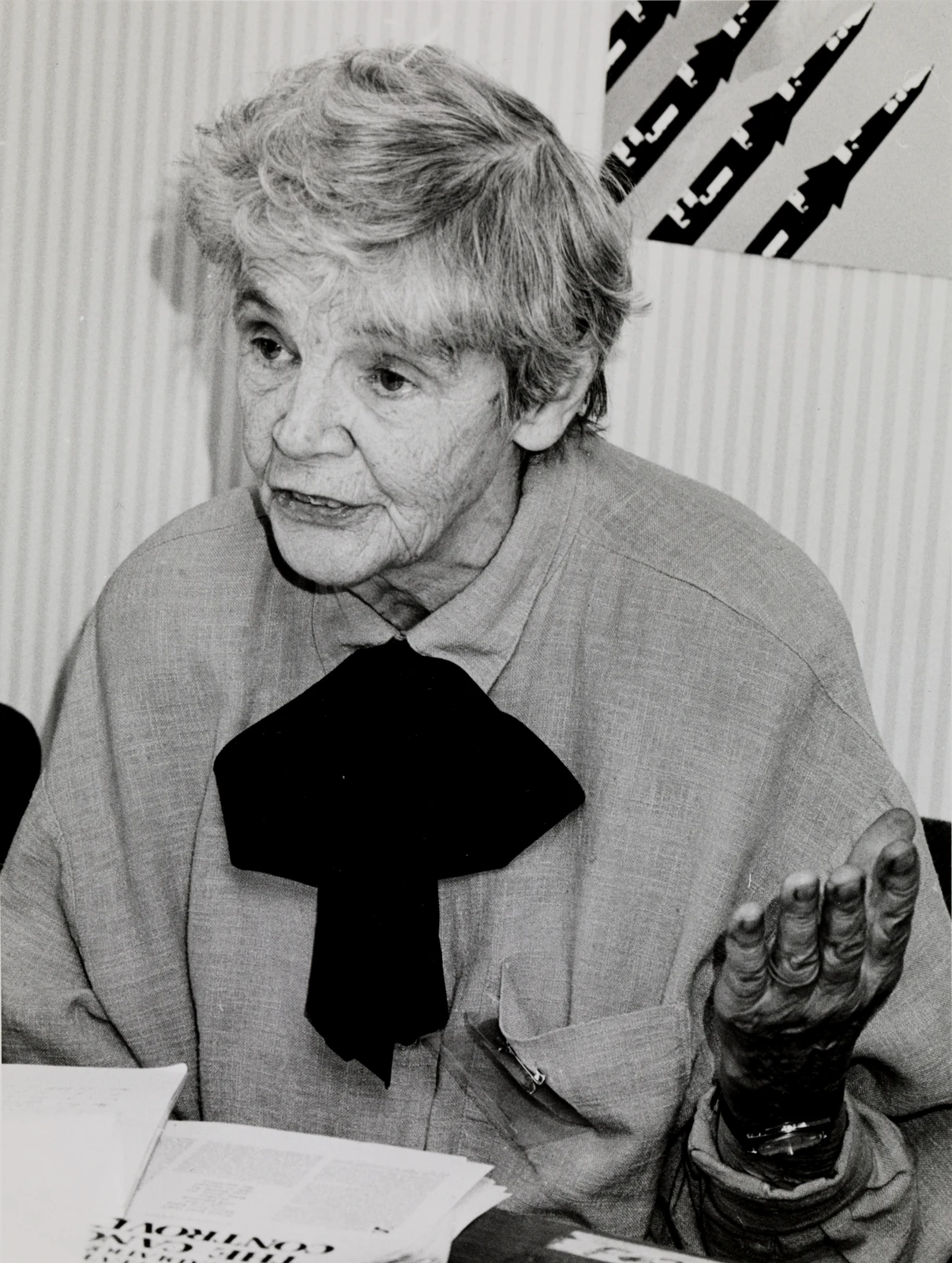
Alice Stewart
Physician and epidemiologistAlice Stewart investigated environmental and occupational health before leading a major case-control investigation of childhood cancer.Read biography1921–1998
Mary Amdur
Toxicologist and air-pollution researcherMary Amdur investigated how pollutants affected respiration, bringing chemistry and controlled experiments into questions raised by severe urban smog.Read biography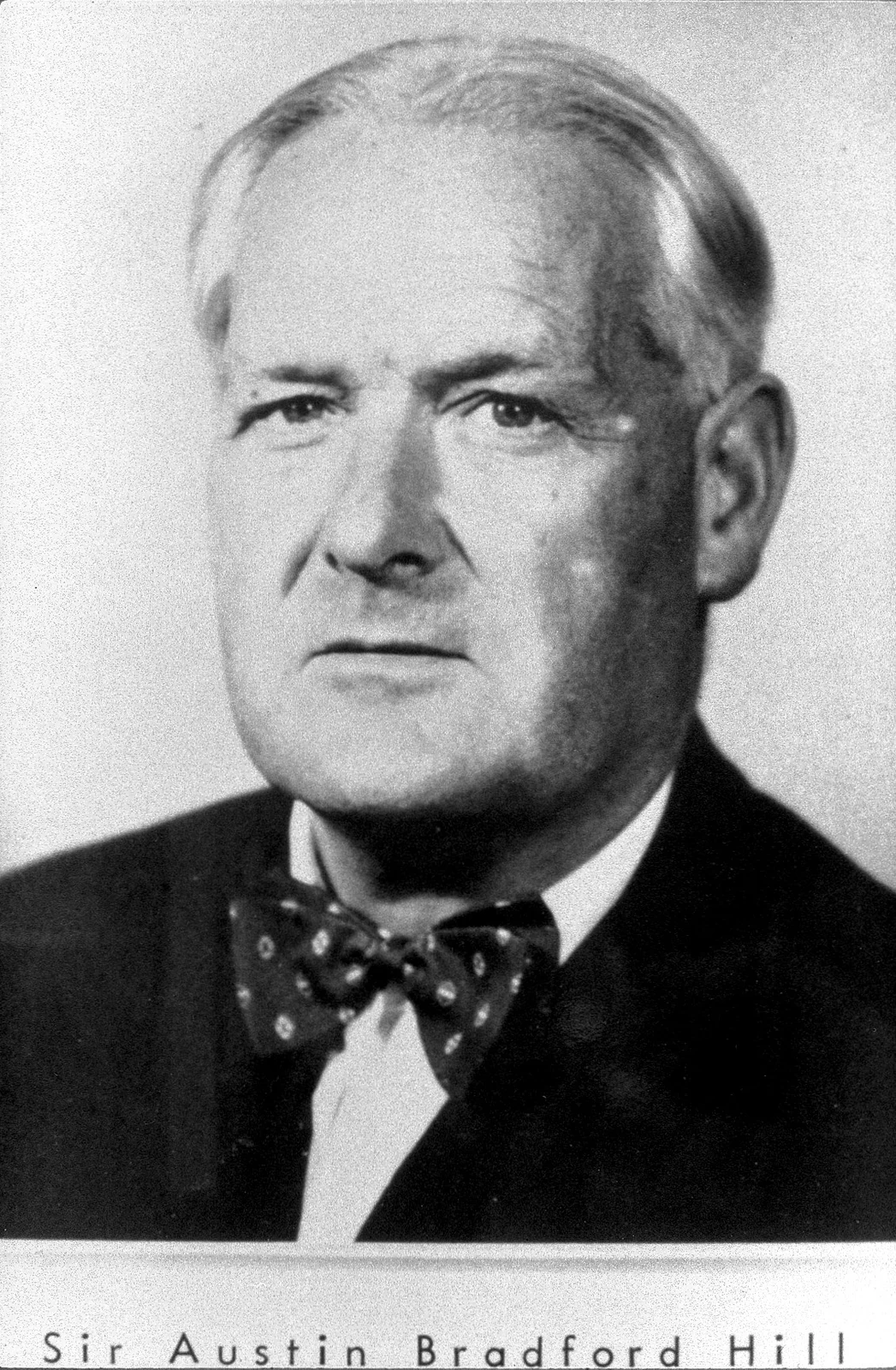
1897–1991
Austin Bradford Hill
Medical statistician and epidemiologistAustin Bradford Hill translated statistical reasoning into practical medical research, helping investigators build fairer comparisons and assess their limits.Read biographyQuick answers
Common questions
- Was the Oxford survey a randomised trial?
- No. It compared prior histories of cases and matched controls.
- Do the invented classroom counts give absolute risk?
- No. An outcome-selected case-control sample does not supply all exposed pregnancies as a denominator.
Primary and institutional sources
How this history was checked
Selected original methods are compared with Oxford’s career account and a later institutional history. Full survey tables and later dose estimates were not independently reanalysed. This article was reviewed on 7 November 2026.
- University of Oxford, Medical Sciences DivisionProfessor Alice Stewart
- British Journal of Cancer / PMCChildhood cancer research in Oxford I: the Oxford Survey of Childhood Cancers
- British Medical JournalA Survey of Childhood Malignancies
- History of Modern Biomedicine Research GroupPopulation-Based Research in South Wales — witness biographies