
The short answer
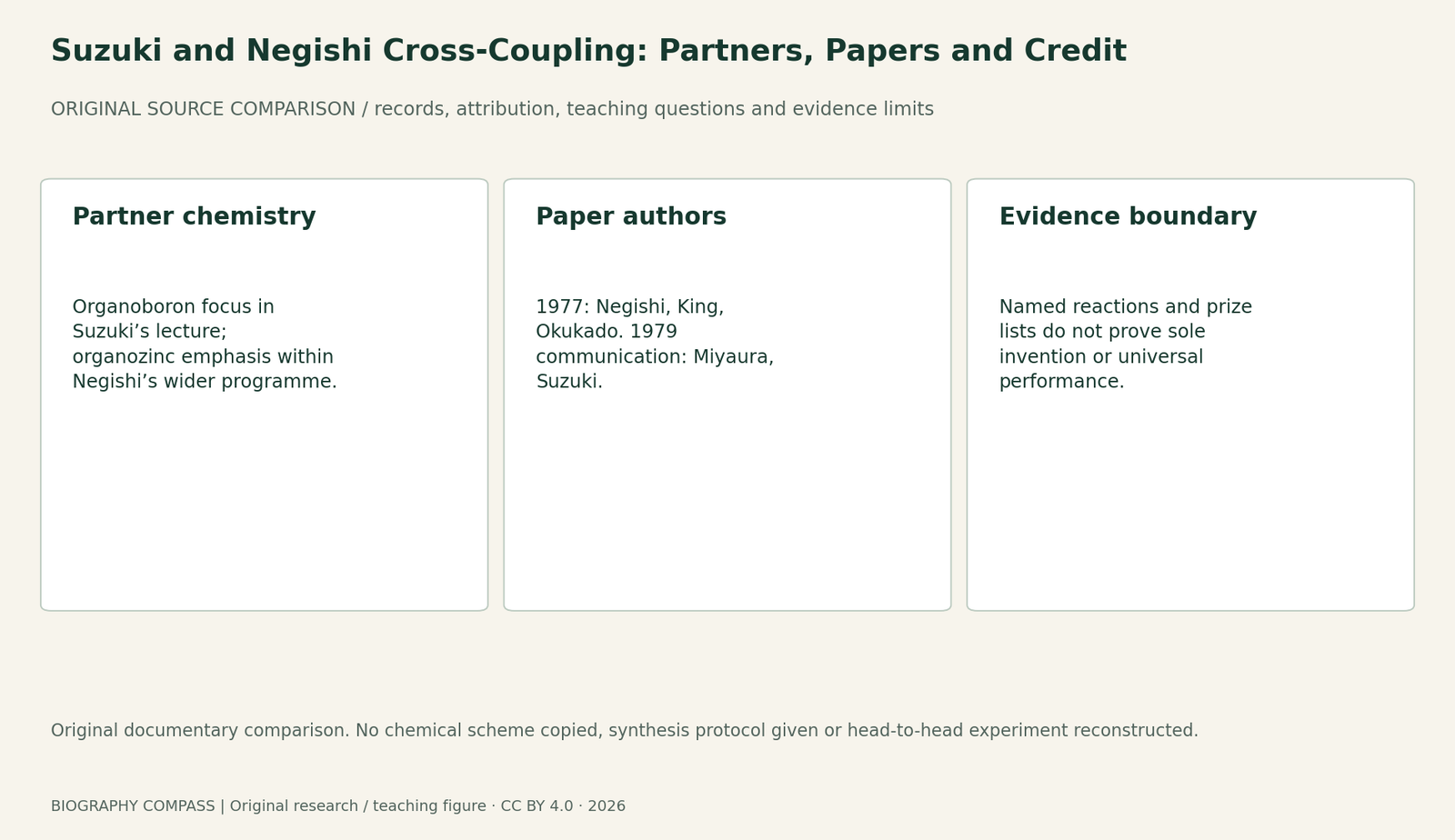
Named reactions are compact labels for research programmes. Comparing the partner chemistry and the actual publication records makes those labels useful without turning them into claims of identical methods or sole invention.
Read the evidence
What each record can establish
Compare what each record establishes with the claim being made.
| Record | Useful distinction | Limit |
|---|---|---|
| Suzuki programme | Organoboron partner; base and conditions matter | A reaction name does not supply a universal result |
| Negishi programme | Organozinc emphasis within broader organometallic work | Not every studied partner was zinc |
| Original paper | Specific authors and issue date | Not identical to the prizewinner list |
Chronology
A timeline of the turning points
Organozinc publication
The journal record names Negishi, King and Okukado.
Organoboron communication
The record names Miyaura and Suzuki.
Online interface date
Not a replacement for the 1977 issue year.
Nobel recognition
A different record with a different purpose.
Read author lists separately from prize names
The 1977 organozinc paper’s publisher record lists Eiichi Negishi, Anthony O. King and Nobuhisa Okukado. Its issue date is 1977 even though the modern interface also displays an online date in 2002. A digitisation date should not become the date of the original discovery.
The 1979 communication on organoboron coupling lists Norio Miyaura and Akira Suzuki. These author lists differ from the three laureates recognised in 2010: Richard Heck, Negishi and Suzuki. A prize citation and a particular paper record are answering different attribution questions.
The retrospective records complicate simple firsts
Negishi’s lecture acknowledges earlier and contemporary work by other researchers. It also discusses a borate observation preceding the later extensive organoboron studies. The development is not well described by treating a named reaction as the first imaginable carbon-coupling event of its type.
Suzuki’s tables identify specific reagents and conditions. Some comparisons change more than one variable. They are not a controlled head-to-head ranking of every Suzuki route against every Negishi route. The historical numbers cannot support a universal claim about yield, environmental burden or performance in an untested process.
Attribution exercise and answer
Question: a caption credits Suzuki, Heck and Negishi as the authors of the 1977 organozinc paper and calls its 2002 online date the invention year. What should change? Answer: use the paper’s own author list—Negishi, King and Okukado—and its 1977 journal issue. Keep the 2010 Nobel record as a separate recognition.
Question: does the 1979 paper label prove that all organoboron coupling chemistry began in that one experiment? Answer: no. The lecture discusses a wider development and its predecessors. Accurate credit can recognise a major methodological programme without erasing earlier observations or collaborators.
Continue the chronology
Related history guides
Fukui’s Frontier Orbitals: From a 1952 Claim to a Wider Theory
Compare Fukui’s 1952 research claim with his 1981 lecture, preserve the collaborators’ credit and practise separating a model’s scope from a universal prediction.
Read the timeline1966–2001Noyori’s Asymmetric Catalysis: Conversion and Enantiomeric Excess
Learn why conversion and enantiomeric excess differ through Noyori’s records and a worked fictional example, with clear assumptions and reference answers.
Read the timeline1980–1991Yoshino’s Lithium-Ion Battery: Prototype, Patent and Commercial Launch
Compare Yoshino’s battery account, corporate patent dates and commercial history to distinguish the 1983 experiment, 1985 milestone and 1991 launch.
Read the timelineBiography context
Explore Japan and United States through connected lives
Akira Suzuki
Akira Suzuki helped develop organoboron cross-coupling through a long Hokkaido career, with Norio Miyaura and other collaborators central to the research record.
Explore the biographiesBiographyEi-ichi Negishi
Ei-ichi Negishi developed organometallic methods for joining carbon fragments, building a research programme across industrial chemistry, Syracuse and Purdue.
Explore the biographiesConnected biographies
People behind the records
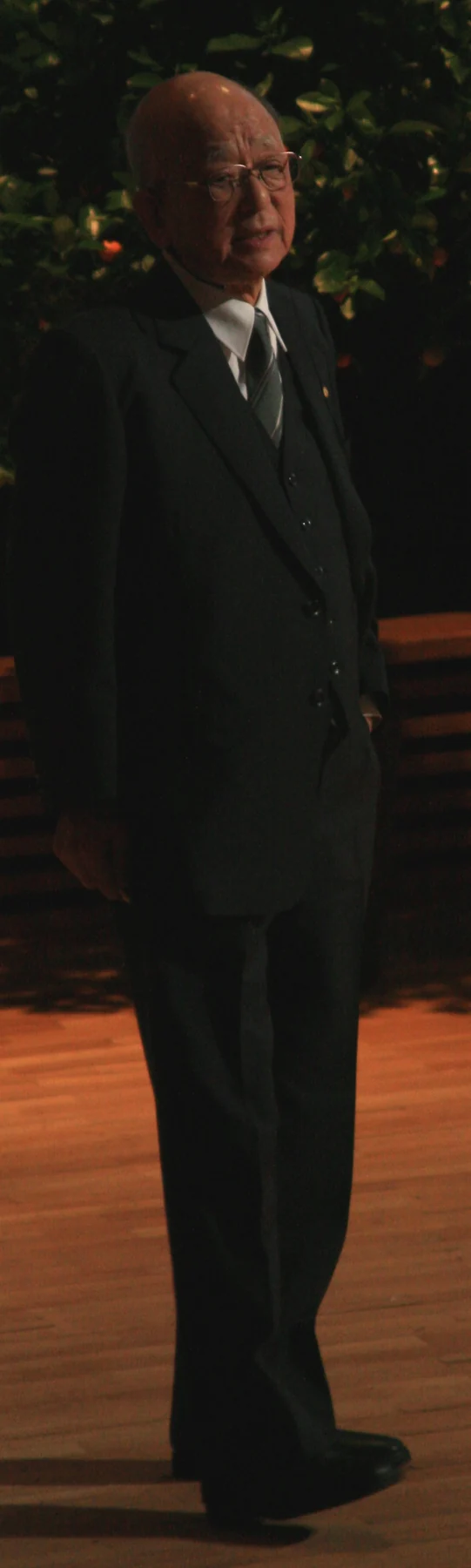
1930–
Akira Suzuki
Organic chemistAkira Suzuki helped develop organoboron cross-coupling through a long Hokkaido career, with Norio Miyaura and other collaborators central to the research record.Read biography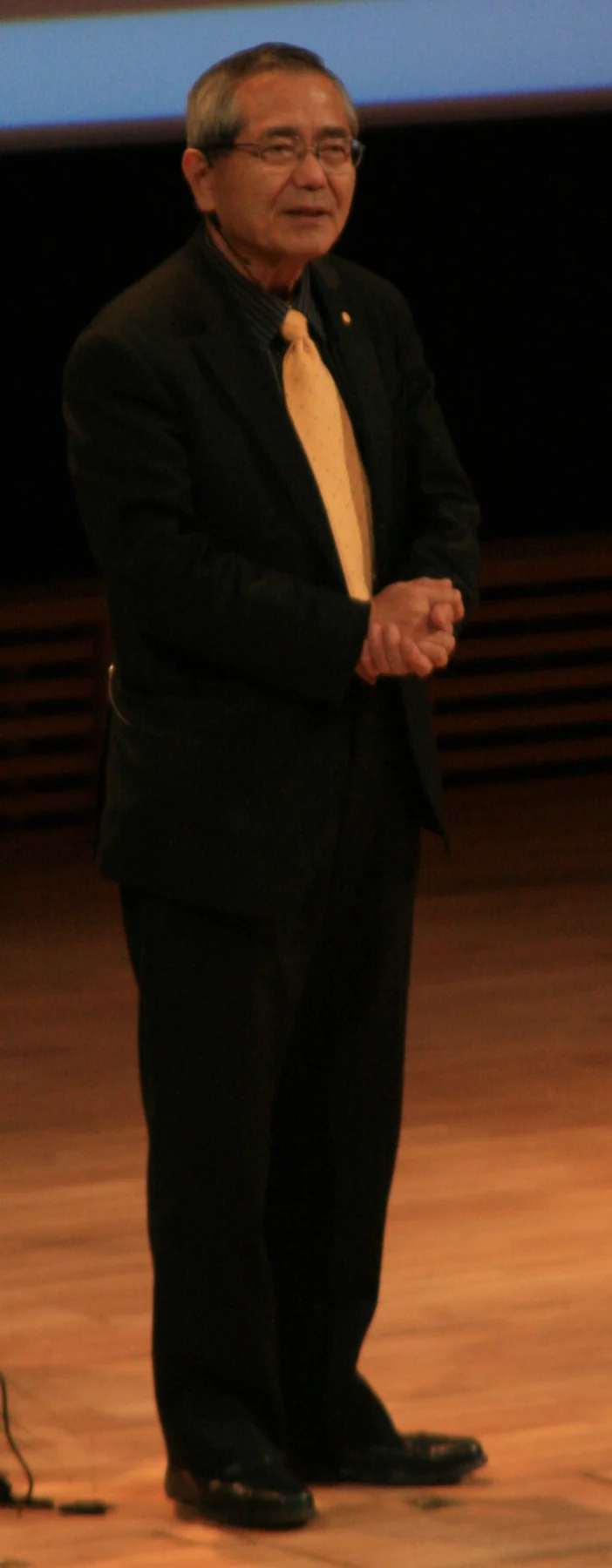
1935–2021
Ei-ichi Negishi
Organic and organometallic chemistEi-ichi Negishi developed organometallic methods for joining carbon fragments, building a research programme across industrial chemistry, Syracuse and Purdue.Read biographyQuick answers
Common questions
- Are Suzuki and Negishi coupling identical?
- No. Organoboron and organozinc partners are an important distinction, while the wider programmes include further variations.
- Does the Nobel record replace a paper’s authors?
- No. Use each paper’s own author list and distinguish later recognition.
Primary and institutional sources
How this history was checked
The records below distinguish original research, later recollection, institutional summaries and the independent learning exercise. This article was reviewed on 29 October 2026.
- Akira Suzuki; Nobel Prize, 2010Organoborane cross-coupling lecture
- Ei-ichi Negishi; Nobel Prize, 2010Transition-metal research retrospective
- ACS Publications1977 organozinc paper: publication and authors
- Miyaura and Suzuki; RSC1979 communication bibliographic record
- Hokkaido UniversityUniversity career and prize record