
The short answer
A reaction can consume much of its starting material without strongly preferring one enantiomer. It can also give a highly one-sided product mixture while leaving much of the starting material unreacted. The two measurements answer different questions.
Read the evidence
What each record can establish
Compare what each record establishes with the claim being made.
| Quantity | Denominator | Fictional result |
|---|---|---|
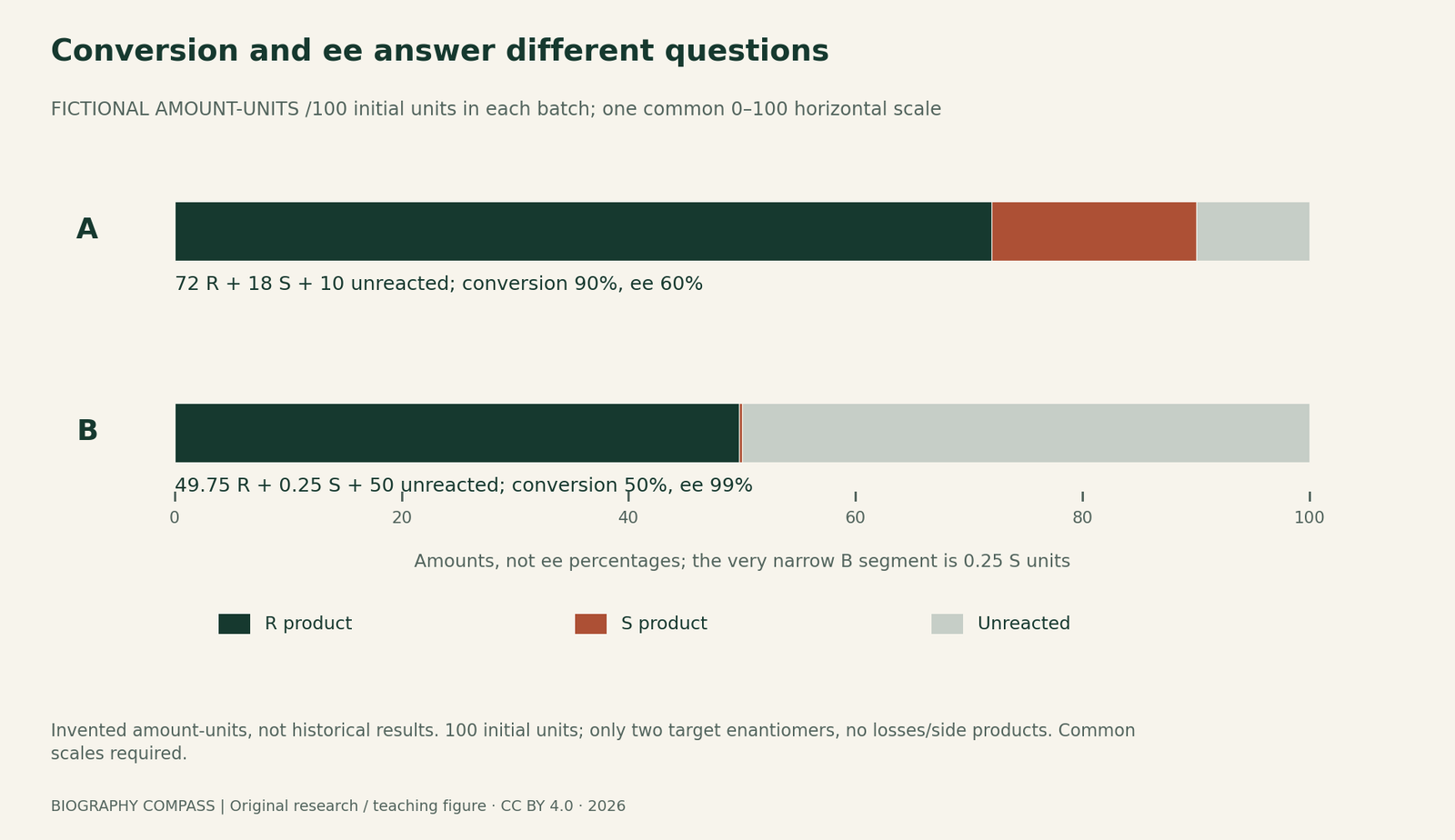
| A conversion | 100 initial substrate units | 90 reacted:90% |
| A ee | 90 units of the two product enantiomers | 54-unit difference:60% |
| B conversion | 100 initial substrate units | 50 reacted:50% |
| B ee | 50 units of the two product enantiomers | 49.5-unit difference:99% |
Chronology
A timeline of the turning points
Early asymmetric catalysis
The lecture distinguishes this reaction class and its modest ee.
BINAP research reported
A later stage described in Noyori’s autobiography.
Nobel lecture
A retrospective evaluation of progress and practical requirements.
Read the early result in its own units
Noyori’s 2001 lecture revisits the 1966 work in Nozaki’s laboratory. Its figure and discussion report 10% and 6% enantiomeric excess for two cyclopropane products. These are early asymmetric cyclopropanation results, not a conversion measurement and not the mature hydrogenation process for which the later Nobel was awarded.
This distinction prevents an attractive but false timeline in which the first sign of asymmetric induction instantly becomes a fully practical method. The lecture also distinguishes the demands of useful catalysis, including selectivity and productivity. A favourable value in one column does not settle every other requirement.
Sources for this section: [1]
Define the denominator before comparing percentages
Conversion concerns the chosen starting material: what fraction reacted? Enantiomeric excess concerns the composition of a specified two-enantiomer mixture. IUPAC defines it through the absolute difference between the enantiomers’ fractions; percentage ee is that difference multiplied by 100.
For amounts R and S of the two enantiomers, percentage ee is 100 × |R−S|/(R+S). It is not simply the percentage of the major enantiomer. These names specify the two forms for the exercise; they do not imply that a positive optical-rotation sign always means R or that an S form is intrinsically harmful.
Two fictional batches, not historical laboratory data
Assume each batch begins with 100 amount-units of one starting material and that every consumed unit becomes one unit of the target product’s two enantiomers. Batch A ends with 72 R, 18 S and 10 unreacted units. Batch B ends with 49.75 R, 0.25 S and 50 unreacted units. There are no side products or measurement losses in this deliberately simple model.
A has 90% conversion and 60% ee: 100 × (72−18)/90. B has 50% conversion and 99% ee: 100 × (49.75−0.25)/50. A converts more starting material; B gives the more one-sided enantiomer mixture. Neither conclusion ranks the batches for every possible manufacturing objective.
Sources for this section: [2]
Questions, answers and limits
Question: is Batch B 99% converted, and is its major enantiomer only 99% of the product mixture? Answer: neither. Its conversion is 50%; its major enantiomer is 99.5% of the product mixture. The 99% ee compares the two enantiomers, while conversion uses the initial 100 units.
Question: can the exercise establish the isolated yield, safety or best industrial process? Answer: no. The model specifies simplified amounts, not recovery after isolation, real side reactions, analytical uncertainty or costs. It illustrates the denominators; it does not reconstruct a Noyori experiment or supply a synthesis protocol.
Continue the chronology
Related history guides
Fukui’s Frontier Orbitals: From a 1952 Claim to a Wider Theory
Compare Fukui’s 1952 research claim with his 1981 lecture, preserve the collaborators’ credit and practise separating a model’s scope from a universal prediction.
Read the timeline1977–2010Suzuki and Negishi Cross-Coupling: Partners, Papers and Credit
Compare Suzuki and Negishi cross-coupling records, organoboron and organozinc partners, original author lists and what the 2010 Nobel citation does not prove.
Read the timeline1980–1991Yoshino’s Lithium-Ion Battery: Prototype, Patent and Commercial Launch
Compare Yoshino’s battery account, corporate patent dates and commercial history to distinguish the 1983 experiment, 1985 milestone and 1991 launch.
Read the timelineBiography context
Explore Japan through connected lives
Connected biographies
People behind the records
1938–
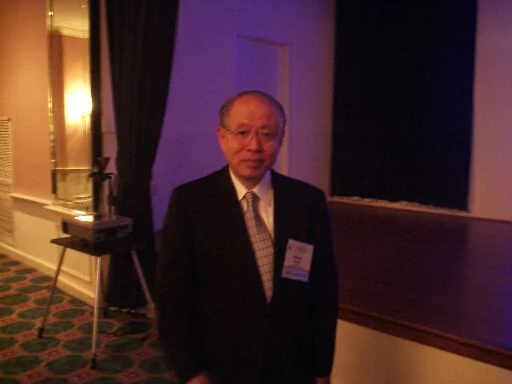
Ryoji Noyori
Organic chemist and research leaderRyoji Noyori developed asymmetric catalysis through decades of work on chiral metal complexes, collaborative synthesis and the demands of useful chemical production.Read biographyQuick answers
Common questions
- Does 99% ee mean 99% conversion?
- No. The fictional B example has 99% ee and 50% conversion.
- Are the batch amounts measured Noyori results?
- No. They are explicitly invented teaching data with stated assumptions.
Primary and institutional sources
How this history was checked
The records below distinguish original research, later recollection, institutional summaries and the independent learning exercise. This article was reviewed on 29 October 2026.