
The short answer
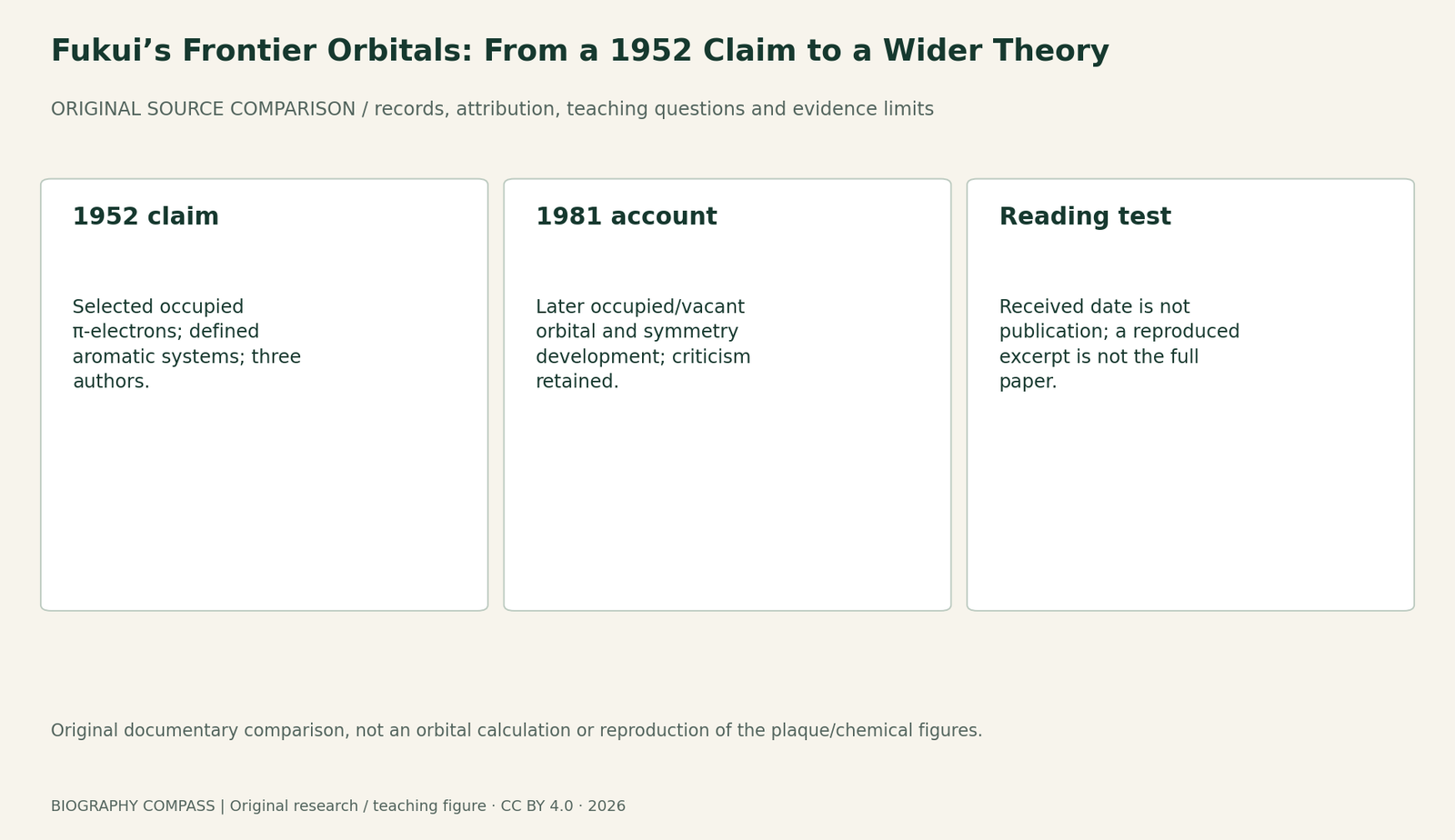
The familiar HOMO–LUMO explanation grew through several stages. Comparing a reproduced passage from the 1952 paper with Fukui’s later lecture shows what changed, what the early evidence addressed and which claims go beyond it.
Read the evidence
What each record can establish
Compare what each record establishes with the claim being made.
| Record | Supports | Does not establish |
|---|---|---|
| 1952 passage | A specific frontier-electron claim and three-author credit | A universal prediction for all reactions |
| 1981 lecture | Development, criticism and a wider orbital account | That every later concept was already in the first paper |
| 2021 plaque | A preserved excerpt and its bibliographic identification | Inspection of the complete original publication |
Chronology
A timeline of the turning points
Manuscript received
A handling date shown in the reproduced record.
Paper published
The original journal volume date.
Nobel lecture
A retrospective account of a much broader programme.
Commemorative plaque
A later reproduction with its own purpose.
Start with the document you actually have
The ACS’s 2021 commemorative plaque reproduces a passage and diagrams from the 1952 paper by Kenichi Fukui, Teijiro Yonezawa and Haruo Shingu. It identifies the original journal issue and a received date in 1951. The plaque is useful evidence of the cited passage and credit; it is not the whole four-page paper.
Those dates describe different events. A manuscript received in 1951 can appear in a 1952 volume. Neither date makes the plaque itself a 1950s object. A reader should retain the document type and its later commemorative purpose when using it as a source.
Sources for this section: [1]
The early claim had a defined scope
The reproduced passage selects the highest occupied orbital’s pair of π-electrons and discusses differences in reactivity at positions within a molecule. It initially addresses unsubstituted aromatic hydrocarbons and reserves substituent effects for further work. That is narrower than a complete rule for every organic reaction.
Fukui’s 1981 lecture uses the preferred substitution position in naphthalene to explain the problem that motivated the approach. The account contrasts total electron density with the distribution associated with selected frontier electrons. This is an explanation of a model and its evidence, not a new calculation performed for this article.
Later theory should not be backdated
The lecture describes subsequent attention to occupied and vacant orbitals, molecular interactions and symmetry. It acknowledges criticism of the early foundation as well as the contributions of other researchers. Reading that development backwards into every sentence of the 1952 passage would erase the history of the idea.
The later theory’s usefulness does not make a single descriptor a complete prediction of rates, products or experimental conditions. An argument about orbital interactions still needs a defined chemical system and an appropriate evidential setting. This is a limit on what the records establish, not a claim that the theory lacks value.
Document-comparison exercise and answer
Question: a note says that the 1952 authors predicted every reaction solely from total charge, and that the three-author paper must have been published in 1951 because of its received date. Identify two problems using the records above.
Answer: the reproduced claim selects frontier electrons rather than treating total charge as sufficient, and its stated initial subject is a limited class of hydrocarbons. A received date records submission handling, not the year of the journal volume. The evidence also requires keeping all three authors in the credit; the later Nobel award is a different record.
Continue the chronology
Related history guides
Noyori’s Asymmetric Catalysis: Conversion and Enantiomeric Excess
Learn why conversion and enantiomeric excess differ through Noyori’s records and a worked fictional example, with clear assumptions and reference answers.
Read the timeline1977–2010Suzuki and Negishi Cross-Coupling: Partners, Papers and Credit
Compare Suzuki and Negishi cross-coupling records, organoboron and organozinc partners, original author lists and what the 2010 Nobel citation does not prove.
Read the timeline1980–1991Yoshino’s Lithium-Ion Battery: Prototype, Patent and Commercial Launch
Compare Yoshino’s battery account, corporate patent dates and commercial history to distinguish the 1983 experiment, 1985 milestone and 1991 launch.
Read the timelineBiography context
Explore Japan through connected lives
Connected biographies
People behind the records
1918–1998
Kenichi Fukui
Theoretical and industrial chemistKenichi Fukui connected molecular orbitals with chemical reactivity, developing ideas through a Kyoto research group that combined theory and experiment.Read biographyQuick answers
Common questions
- Is HOMO–LUMO terminology the entire 1952 claim?
- No. The reproduced early passage focuses on selected occupied π-electrons in a defined class; the later lecture explains subsequent development.
- Does the 1951 received date change the publication year?
- No. Receipt and journal publication are different events.
Primary and institutional sources
How this history was checked
The records below distinguish original research, later recollection, institutional summaries and the independent learning exercise. This article was reviewed on 29 October 2026.