
The short answer
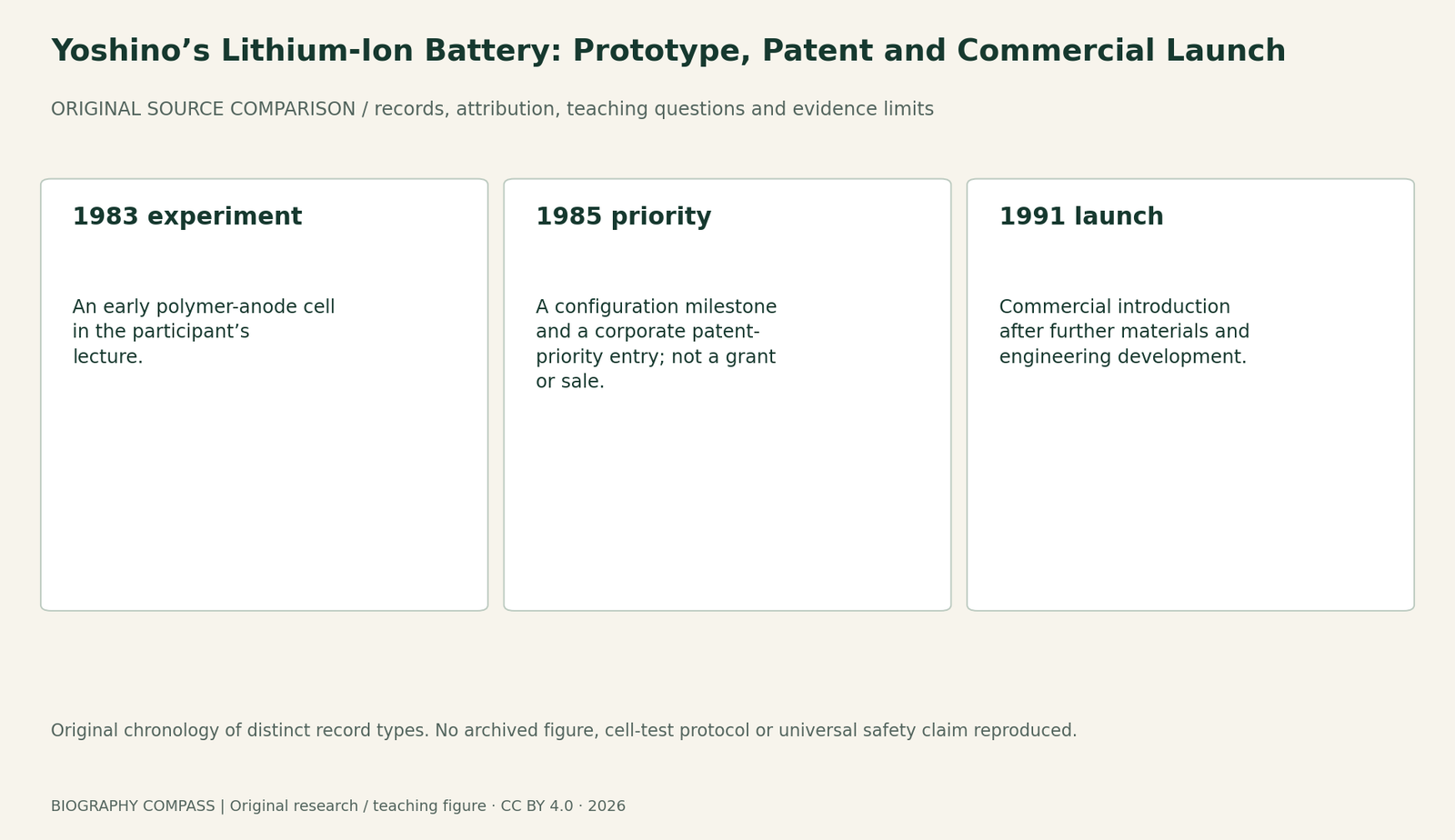
An invention history becomes misleading when prototype, patent and sale are treated as one event. Yoshino’s first-person account and the corporate records preserve several different milestones, with distinct collaborators and materials.
Read the evidence
What each record can establish
Compare what each record establishes with the claim being made.
| Evidence | Establishes | Does not establish |
|---|---|---|
| Lecture | The participant’s account of experiments and development | Independent replication of every experimental detail |
| Patent table | Named inventors and differentiated dates in a corporate record | Complete file history or product sales |
| Launch account | A commercial milestone in1991 | That every subsequent cell is identical or risk-free |
Chronology
A timeline of the turning points
Cathode research
The earlier Goodenough-group work discussed in Yoshino’s lecture.
Early cell
Polyacetylene-anode experiment.
Carbon-material and patent milestone
Not a consumer launch date.
US grant
A different patent-record event.
Commercial introduction
A later manufacturing milestone.
The materials research came before the product
Yoshino’s lecture describes the importance of earlier work: Goodenough’s group’s lithium cobalt oxide, Shirakawa’s conducting polymer research and the theoretical background associated with Fukui. His 1981 programme did not begin with a ready-made commercial battery.
The lecture dates an early polyacetylene-anode cell to 1983. An electrode that appears promising on its own still has to work with the other components in an assembled device. This stage is evidence of a particular experimental arrangement, not of consumer sales.
Carbon materials mark a further development
Polyacetylene presented practical limitations. The longer account discusses vapor-grown carbon fibre during the search for a better negative electrode, while the short Nobel facts account identifies petroleum coke in the 1985 development. These are different levels of description; this article does not claim they identify an identical sample.
The important common distinction is the move from the early polymer-anode arrangement towards a carbonaceous negative electrode paired with lithium cobalt oxide. A general description of that architecture should not be expanded into a claim that every modern cell has the same carbon material or performance.
Priority, grant and launch are separate records
Asahi Kasei’s table lists 10 May 1985 as a priority date for a battery patent naming Yoshino, Kenichi Sanechika and Takayuki Nakajima. It separately lists a 1987 US grant and a 1995 Japanese grant. The table is a corporate record; the underlying patent files and their complete legal histories have not been independently examined for this article.
Yoshino’s lecture places the first commercial lithium-ion batteries in Japan in 1991. The company’s account identifies Sony’s introduction and later manufacture through its venture with Toshiba. Neither the priority date nor a grant date is a substitute for evidence of a product launch.
Source-comparison questions and answers
Question: a timeline calls 1985 the year Sony started selling these batteries because it appears beside “Secondary Battery” in the patent table. Is that supported? Answer: no. That entry records priority, and the commercial chronology identifies 1991. The timeline has changed the type of event without evidence.
Question: can the earliest prototype or a safety test prove that every later lithium-ion battery is risk-free? Answer: no. The records describe particular materials and development stages. They support a history of engineering progress, not a universal safety guarantee or instructions for testing cells at home.
Continue the chronology
Related history guides
Fukui’s Frontier Orbitals: From a 1952 Claim to a Wider Theory
Compare Fukui’s 1952 research claim with his 1981 lecture, preserve the collaborators’ credit and practise separating a model’s scope from a universal prediction.
Read the timeline1966–2001Noyori’s Asymmetric Catalysis: Conversion and Enantiomeric Excess
Learn why conversion and enantiomeric excess differ through Noyori’s records and a worked fictional example, with clear assumptions and reference answers.
Read the timeline1977–2010Suzuki and Negishi Cross-Coupling: Partners, Papers and Credit
Compare Suzuki and Negishi cross-coupling records, organoboron and organozinc partners, original author lists and what the 2010 Nobel citation does not prove.
Read the timelineBiography context
Explore Japan through connected lives
Akira Yoshino
Akira Yoshino helped develop a practical lithium-ion battery by bringing polymer research, electrode materials and engineering needs into a sustained industrial programme.
Explore the biographiesBiographyHideki Shirakawa
Hideki Shirakawa helped transform research on polyacetylene into the field of conducting polymers, linking materials preparation with collaborative electrical measurements.
Explore the biographiesBiographyKenichi Fukui
Kenichi Fukui connected molecular orbitals with chemical reactivity, developing ideas through a Kyoto research group that combined theory and experiment.
Explore the biographiesConnected biographies
People behind the records
1948–
Akira Yoshino
Chemist and battery researcherAkira Yoshino helped develop a practical lithium-ion battery by bringing polymer research, electrode materials and engineering needs into a sustained industrial programme.Read biography1936–2026
Hideki Shirakawa
Polymer chemistHideki Shirakawa helped transform research on polyacetylene into the field of conducting polymers, linking materials preparation with collaborative electrical measurements.Read biography1918–1998
Kenichi Fukui
Theoretical and industrial chemistKenichi Fukui connected molecular orbitals with chemical reactivity, developing ideas through a Kyoto research group that combined theory and experiment.Read biographyQuick answers
Common questions
- Does the 1985 patent priority mean commercial launch?
- No. The records distinguish the priority/configuration milestone from commercial introduction in 1991.
- Was conducting polyacetylene the final material in every commercial battery?
- No. The development moved towards carbonaceous negative-electrode materials; modern cells require their own specifications.
Primary and institutional sources
How this history was checked
The records below distinguish original research, later recollection, institutional summaries and the independent learning exercise. This article was reviewed on 29 October 2026.