
The short answer
What did calcium-dependent lipid binding establish, and what functional evidence was still needed to identify a physiological release sensor?
Read the evidence
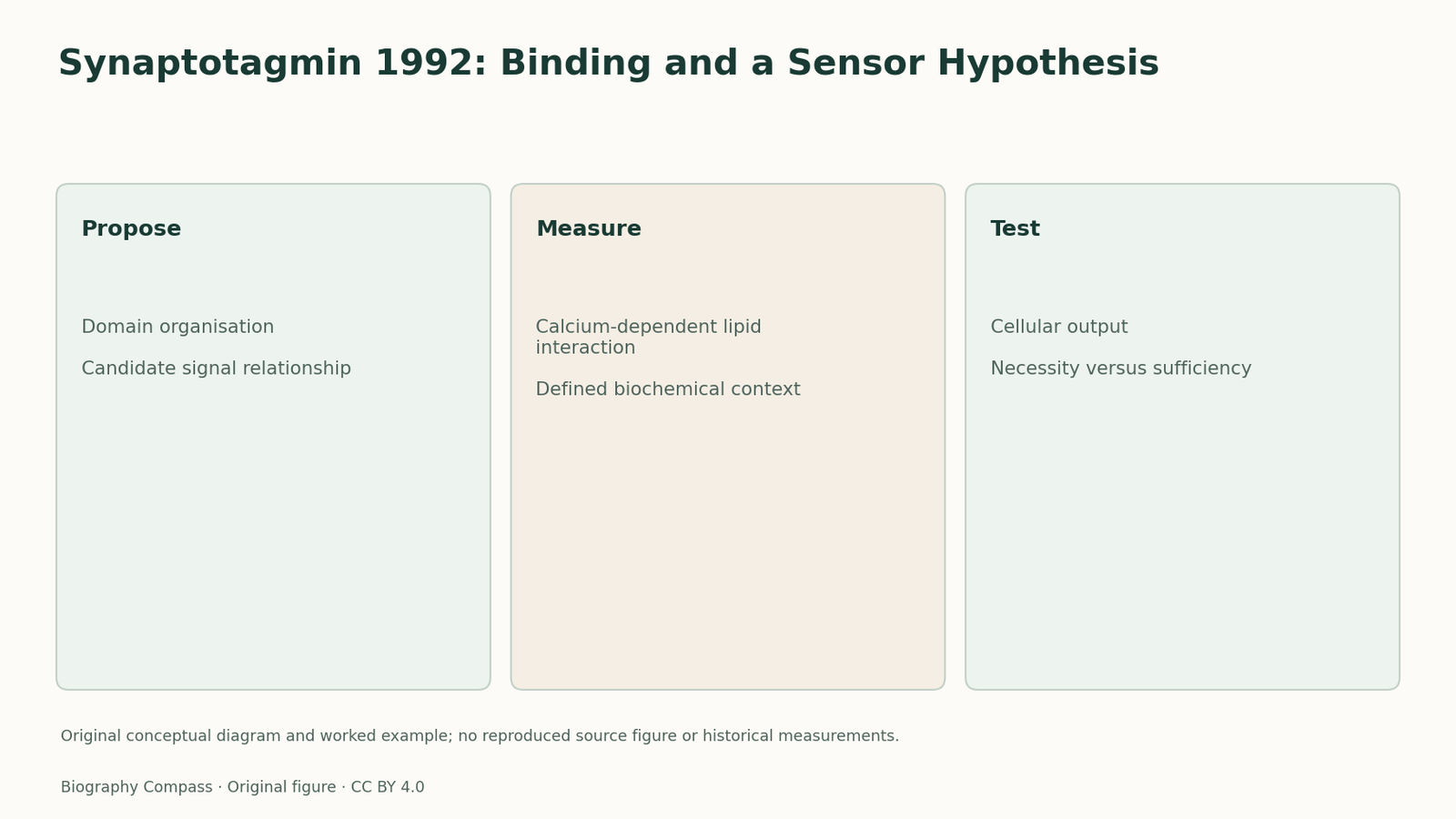
Different records within the same investigation
The following comparison distinguishes the specific questions answered by the inspected records.
| Record or test | What it establishes | What remains different |
|---|---|---|
| Domain similarity | Suggests a candidate biochemical question. | Does not itself measure the proposed function. |
| Binding result | Establishes an interaction in a defined preparation. | Does not alone demonstrate physiological control. |
| Functional evidence | Connects a component or property with cellular output. | Necessity and sufficiency remain different claims. |
A plausible calcium sensor needed more than a familiar domain
Synaptic release was known to depend on calcium, but identifying the molecular link required specific evidence. The 1991 domain paper described synaptotagmin’s organisation, including internal regions related to protein-kinase-C regulatory sequences. Such resemblance can suggest a question about binding or regulation; it is not itself a direct measurement of calcium sensing during neurotransmitter release. The concrete problem is how to move from a candidate protein’s architecture to evidence about its biochemical properties and then its role in a functioning cell.
Sources for this section: [2]
The 1992 report measured a particular molecular interaction
Brose, Petrenko, Südhof and Jahn reported that synaptotagmin bound calcium in a complex with negatively charged phospholipids. The abstract identifies the cytoplasmic domain and discusses calcium specificity and dependence on intact oligomeric structure in the tested preparation. These are concrete constraints on a candidate mechanism. They should not be rewritten as a direct recording of vesicle fusion itself. Binding is an experimentally meaningful property, but the physiological process contains other components and events that the binding measurement alone does not exhaustively observe.
Sources for this section: [1]
The authors framed a receptor interpretation
The 1992 abstract concludes that the results suggested synaptotagmin as a cooperative calcium receptor in exocytosis. Keeping that inferential wording is historically useful. A proposed receptor needs properties appropriate to the signal, but it also needs a demonstrated relationship to the output. Südhof’s own account describes a broader programme that identified vesicle proteins before working out their functions. The strength of that approach lay in further tests, not in assuming that every purified calcium-binding protein must control the same release process.
Later recognition should not collapse the evidence ladder
The 2013 Nobel record recognises machinery regulating vesicle traffic, a broader programme than one binding assay. It also places Südhof’s career across Dallas and Stanford. A clear account can connect the later achievement with the early candidate evidence while preserving their dates. Domain similarity, calcium-dependent lipid binding and physiological control answer different questions. This guide compares those evidential levels without claiming that a single experiment in 1991 or 1992 independently settled every interaction or every mode of neurotransmitter release.
An original candidate test and answer
Imagine a fictional protein Z with a domain resembling a known signal-binding region. Purified Z binds signal S, but no experiment has yet changed Z in the relevant cells. Which conclusion is best supported? Z is a stronger candidate for involvement in an S-regulated process, but its physiological necessity has not yet been established. These labels are invented, not an experimental plan or a historical data set. An informative functional comparison would ask whether changing the relevant property changes the output while checking that the rest of the system remains interpretable. The answer also separates necessity from sufficiency: disrupting one component can impair a process without proving that the component alone can recreate the whole event. Each claim needs evidence at the level it names.
Continue the chronology
Related history guides
Secretory Traffic: Following a Label in Time
Follow Jamieson and Palade’s pancreatic studies through labelled cohorts, compartments and timing, with an exercise distinguishing a pathway from a live film.
Read the timeline1971–1999Protein Targeting 1975: Timing the Membrane
Compare Blobel and Dobberstein’s 1975 transfer studies through precursor processing, protected location and different products, with a membrane-transfer exercise.
Read the timelineBiography context
Explore United States through connected lives
Connected biographies
Researchers and related approaches
1955–
Thomas C. Südhof
Neuroscientist and synaptic-release researcherThomas Südhof investigated synaptic-vesicle proteins and calcium-dependent neurotransmitter release, connecting biochemical properties with tests of neuronal function.Read biography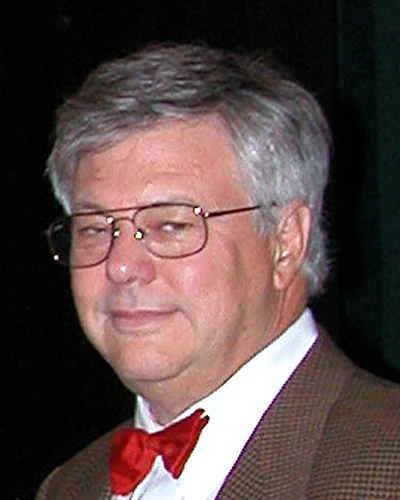
1941–
Michael S. Brown
Physician and molecular-genetics researcherBrown and Goldstein began their familial-hypercholesterolaemia programme in 1972.Read biographyQuick answers
Common questions
- Is the calcium-sensor paper from 1991?
- No. The study discussed here was published in 1992; the earlier domain paper addressed a different question.
- Does calcium binding alone prove a complete release mechanism?
- No. Physiological roles require additional functional evidence.
Primary and institutional sources
How this history was checked
The references below distinguish the original study from later explanations. The worked exercise and comparison are newly written for this article. This article was reviewed on 8 November 2026.
- Brose, Petrenko, Südhof and Jahn, Science, 1992Synaptotagmin: a calcium sensor on the synaptic vesicle surface
- Perin, Brose, Jahn and Südhof, Journal of Biological Chemistry, 1991Domain structure of synaptotagmin (p65)
- Nobel Prize OutreachThomas C. Südhof — Facts
- Nobel Prize OutreachThomas C. Südhof — Biographical