
The short answer
What did adding microsomal membranes during or after translation establish about secretory-protein translocation?
Read the evidence
Different records within the same investigation
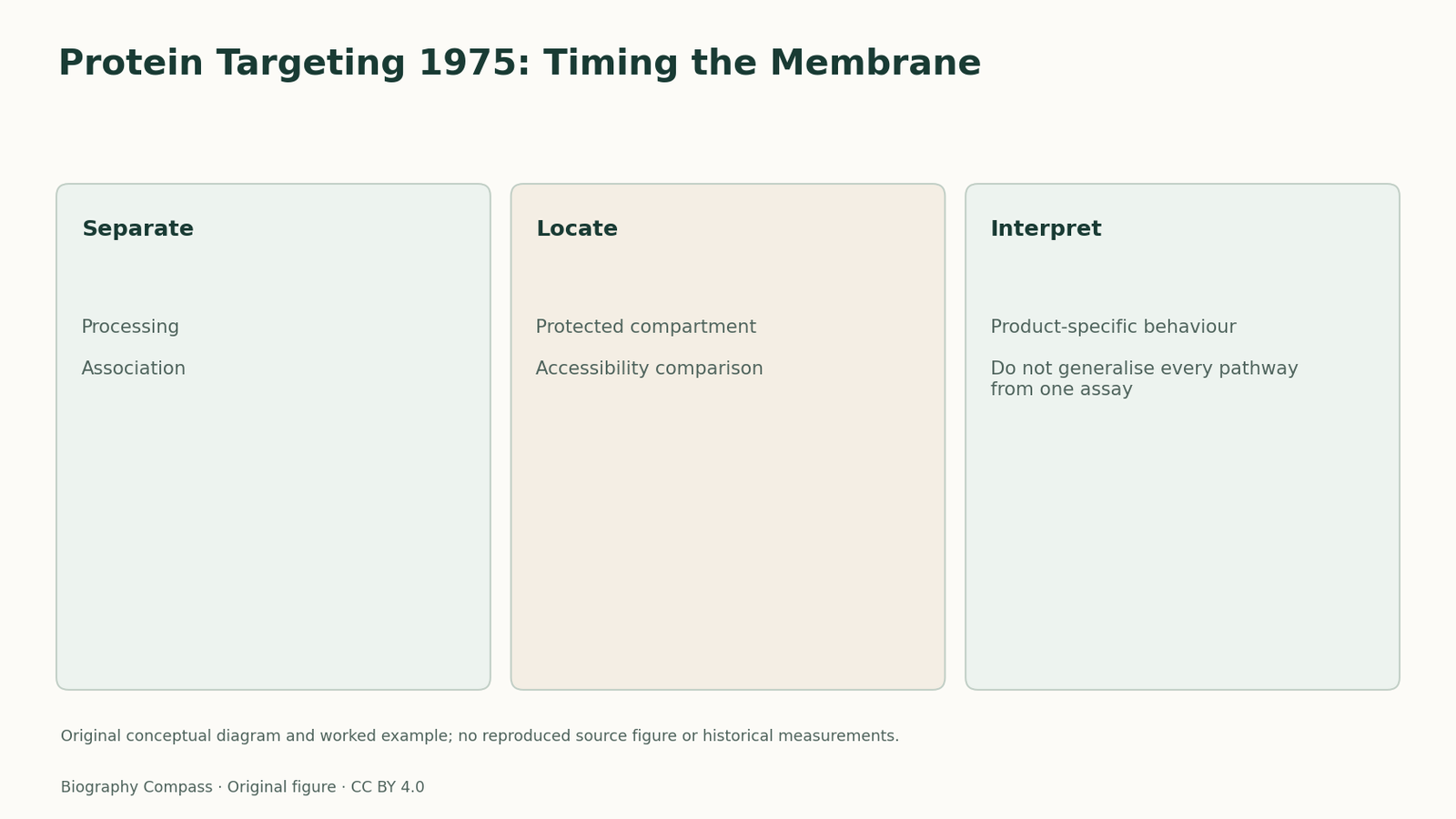
The following comparison distinguishes the specific questions answered by the inspected records.
| Record or test | What it establishes | What remains different |
|---|---|---|
| Processing | Detects a change in the translated product. | Does not alone establish its location. |
| Membrane association | Places product with a membrane-containing fraction. | Can differ from protected transfer. |
| Protected segregation | Tests access from the surrounding medium. | Needs context and suitable comparison. |
A targeting hypothesis needed a testable system
The protein-transfer question was not simply whether membranes and proteins occupied the same cell. Blobel and Dobberstein investigated how particular newly synthesised proteins could cross a membrane and become segregated from the surrounding medium. Their 1975 papers used cell-free comparisons and separated components to test relationships that a static cellular image could not establish. The concrete question is what reconstitution adds: can selected components reproduce a defined behaviour, and which product or system changes alter that outcome?
Precursor processing supplied one kind of evidence
The first paper distinguished processed and unprocessed nascent immunoglobulin light chains. Its abstract explicitly addressed whether a larger product made in vitro was merely an artefact of a heterologous translation system. Evidence from membrane-bound material helped connect the precursor question with the biological preparation. However, a size change alone is not identical to proving where a product ended up. Processing, synthesis and location are related questions that require appropriate measurements rather than one label applied to all of them.
Sources for this section: [1]
Protected segregation and a different product strengthened the comparison
The second paper’s abstract reports segregation of the light-chain product into a proteolysis-resistant space in a reconstructed system. Globin did not show the same behaviour. This supplied a meaningful comparison between products, rather than a claim that every translated protein entered any available membrane. Protection is also an operational observation whose interpretation depends on the integrity and accessibility of the system. It should be connected with the other evidence, not treated as an unlimited guarantee about all proteins or all cellular destinations.
Sources for this section: [2]
A specific assay and a broader principle should stay distinct
The Nobel award recognised intrinsic protein signals governing transport and localisation. Blobel’s autobiography places the work within Palade’s laboratory and the transition from cell-level pathways to molecular questions. That broader principle rests on a programme of research, not on the assertion that one light-chain experiment exhaustively represented every targeting mechanism. A useful account keeps the product, membrane context and measured endpoint visible. This guide discusses experimental logic and credit without reproducing a biochemical preparation protocol or source figure.
An original three-observation exercise and answer
Imagine a fictional product P that becomes smaller, associates with a membrane fraction and resists an external degrading agent. Product Q lacks the last behaviour under a matched comparison. Which observation most directly addresses protected location? Resistance to the external agent, interpreted with suitable accessibility controls. Does that make the size change irrelevant? No: it answers a different processing question. These invented products and observations are not historical data. Association alone could describe attachment without transfer, while a processing change need not identify the final compartment. The answer should combine the observations only after stating what each establishes. It should also ask whether the protective boundary remains intact and whether a different product tests the proposed specificity rather than merely changing several variables at once.
Continue the chronology
Related history guides
Secretory Traffic: Following a Label in Time
Follow Jamieson and Palade’s pancreatic studies through labelled cohorts, compartments and timing, with an exercise distinguishing a pathway from a live film.
Read the timeline1951–1974Lysosomes 1955: Why Enzyme Activity Was Hidden
Examine de Duve’s lysosome inference through latent activity, distribution patterns and later structural evidence, with an original accessibility-versus-absence exercise.
Read the timelineBiography context
Explore United States through connected lives
Connected biographies
Researchers and related approaches
1936–2018
Günter Blobel
Cell biologist and protein-targeting researcherGünter Blobel investigated how proteins reach cellular destinations, using biochemical reconstitution to test signal-dependent transfer across membranes.Read biography
1922–2011
Har Gobind Khorana
Biochemist and chemical biologistHar Gobind Khorana used chemical synthesis to investigate the genetic code, then extended his research to synthetic genes, membranes and visual signalling.Read biographyQuick answers
Common questions
- Does membrane association prove translocation?
- Not by itself. Attachment and protected segregation are different observations.
- Did every product behave like the light chain?
- No. Globin supplied a contrasting product in the second report.
Primary and institutional sources
How this history was checked
The references below distinguish the original study from later explanations. The worked exercise and comparison are newly written for this article. This article was reviewed on 8 November 2026.
- Günter Blobel and Bernhard Dobberstein, Journal of Cell Biology, 1975Transfer of proteins across membranes. I. Presence of proteolytically processed and unprocessed nascent immunoglobulin light chains
- Günter Blobel and Bernhard Dobberstein, Journal of Cell Biology, 1975Transfer of proteins across membranes. II. Reconstitution of functional rough microsomes from heterologous components
- Nobel Prize OutreachGünter Blobel — Facts
- Nobel Prize OutreachGünter Blobel — Biographical