
The short answer
On 15 May 1911, the U.S. Supreme Court upheld the dissolution of Standard Oil’s unlawful combination, with modifications to the remedy. The decision concerned a corporate system, not simply the reputation of John D. Rockefeller. This guide separates the business’s organizational changes, the federal lawsuit, the ruling and its implementation.
Keep the stages separate
Four different events behind the phrase “Standard Oil breakup”
A lawsuit, a judgment and its implementation do not all occur on the same day.
| Stage | Date | What it establishes |
|---|---|---|
| Federal complaint | 15 November 1906 | The government began the case during Roosevelt’s presidency. |
| Lower-court decree | 20 November 1909 | Dissolution was ordered before the Supreme Court appeal was decided. |
| Supreme Court opinion | 15 May 1911 | The finding was sustained, with modifications to the remedy. |
| Modified decree | 29 July 1911 | The lower-court implementation record followed the appellate decision. |
Chronology
A timeline of the turning points
Standard Oil Company organized
Rockefeller and his partners created the Ohio company; this was not yet the later trust agreement.
The trust centralized control
Trustees held interests in multiple businesses on behalf of certificate holders.
A New Jersey holding-company structure developed
Subsidiary share ownership consolidated control in a parent corporation, a different arrangement from the original trust.
The United States filed its case
Federal officials sued during Theodore Roosevelt’s presidency under the Sherman Act.
The lower court ordered dissolution
The decree preceded the Supreme Court’s consideration of the appeal.
The Supreme Court affirmed with modifications
The Court sustained the finding of an unlawful combination but changed parts of the remedy and execution schedule.
A modified decree followed
The Justice Department’s case record separately lists the lower-court modification, distinguishing implementation from the May opinion.
A company, a trust and a holding company were different arrangements
Standard Oil began as an Ohio company organized in 1870 by Rockefeller and business partners. Its growth joined refining with transportation, storage and distribution, while acquisitions brought competitors into a larger system. Understanding that structure matters: the later lawsuit concerned the organization and exercise of economic power, not a claim that every efficient refinery or large business was automatically unlawful.
The 1882 trust placed control of multiple enterprises with trustees, while owners received trust certificates. After an Ohio court challenged that arrangement, the business developed a New Jersey holding-company structure, consolidated in 1899. The Supreme Court reviewed this history when evaluating the combination before it. Calling all three stages “the founding of the trust” obscures how an organization could change its legal form while retaining coordinated control.
The federal case began under Roosevelt and reached judgment under Taft
The Sherman Act, approved in 1890, addressed restraints of interstate and foreign commerce and monopolization. It provided for federal proceedings to prevent and restrain violations. On 15 November 1906, the government filed the Standard Oil case. That date places the lawsuit’s start during Theodore Roosevelt’s presidency, rather than after William Howard Taft entered office.
The lower court’s dissolution decree was dated 20 November 1909. The Supreme Court decided the appeal on 15 May 1911, during Taft’s presidency. Those were separate institutional acts involving government lawyers, trial judges and appellate justices. Roosevelt’s association with trust-busting does not mean that he personally issued the 1911 order. Nor does the decision date mean that Taft’s administration originated every step of the litigation.
The Court examined exclusionary control, not size alone
Chief Justice Edward Douglass White’s opinion considered the combination’s development, acquisitions and control over petroleum commerce. The record discussed practices including railway arrangements, suppression of competition and the coordination of nominally separate businesses. The opinion’s opening account of the government’s allegations should not be confused with the Court’s later evaluation of the evidence; accusations and findings have different functions in a reported case.
The Court concluded that the combination violated the Sherman Act. Its reasoning treated the history and operation of the business together, rather than making a single market-share percentage the whole test. This distinction also limits what can be inferred about an individual: the dissolution judgment was not a criminal conviction of Rockefeller, a prison sentence or a judicial calculation of his personal wealth.
Sources for this section: [1]
The rule of reason was important and contested
The majority read the statute as prohibiting unreasonable or undue restraints of trade. This approach is associated with the rule of reason. In plain terms, its interpretation required deciding whether a restraint fell within the law’s prohibition, not assuming that every agreement affecting commerce had the same legal character. The Court nevertheless found this particular combination unlawful; interpretive qualification did not rescue Standard Oil.
Justice John Marshall Harlan agreed that the combination violated the law, but objected to parts of the majority’s reasoning and modifications. He argued that the Court was adding qualifications Congress had not written. His separate opinion therefore cannot accurately be described as support for Standard Oil’s conduct or rejection of dissolution. The disagreement was partly about how courts should interpret and enforce the statute, even when the justices agreed that the combination before them was illegal.
Dissolution separated control without closing every refinery
The remedy attacked the corporate combination. The Court described transferring subsidiary shares back to the shareholders entitled to them and preventing the parent from continuing to exercise the same control through those holdings. Shareholders could therefore hold interests in separate businesses after dissolution; the judgment was not a confiscation of all their property or a direction to destroy the physical petroleum industry.
Implementation was not instantaneous. The Court found the lower decree’s thirty-day execution period too short and allowed at least six months. It also removed a provision that could have halted the subsidiaries’ interstate trade before stock transfers were completed, recognizing possible injury to the public. The lower court retained jurisdiction to enforce compliance. The Justice Department separately records a modified decree on 29 July 1911, illustrating why an opinion date and an implementation record should not be treated as interchangeable.
Successor companies and Rockefeller’s ownership require careful reading
The Library of Congress summarizes the breakup as producing thirty-four independent companies. Corporate histories can count different entities: the Rockefeller Archive Center’s biography describes thirty-eight controlled companies, rather than using the Library’s successor-company total. Those figures should not be silently substituted for one another. They concern differently described groups; this guide does not claim to reconstruct a complete share-distribution register from either short institutional summary.
Rockefeller had stepped away from daily management before the judgment, while retaining his title and a substantial ownership interest. Dissolution changed how the business was controlled, not the fact that its shareholders owned assets. Later mergers and corporate renamings also mean that a modern company is not a one-to-one reproduction of its 1911 predecessor. The case’s lasting historical question is how to dismantle unlawful concentrated control while preserving lawful commerce. It is not a shortcut for judging a present-day company or giving current antitrust advice.
Biography context
Explore United States through connected lives
Connected biographies
Read the lives behind the business and enforcement history
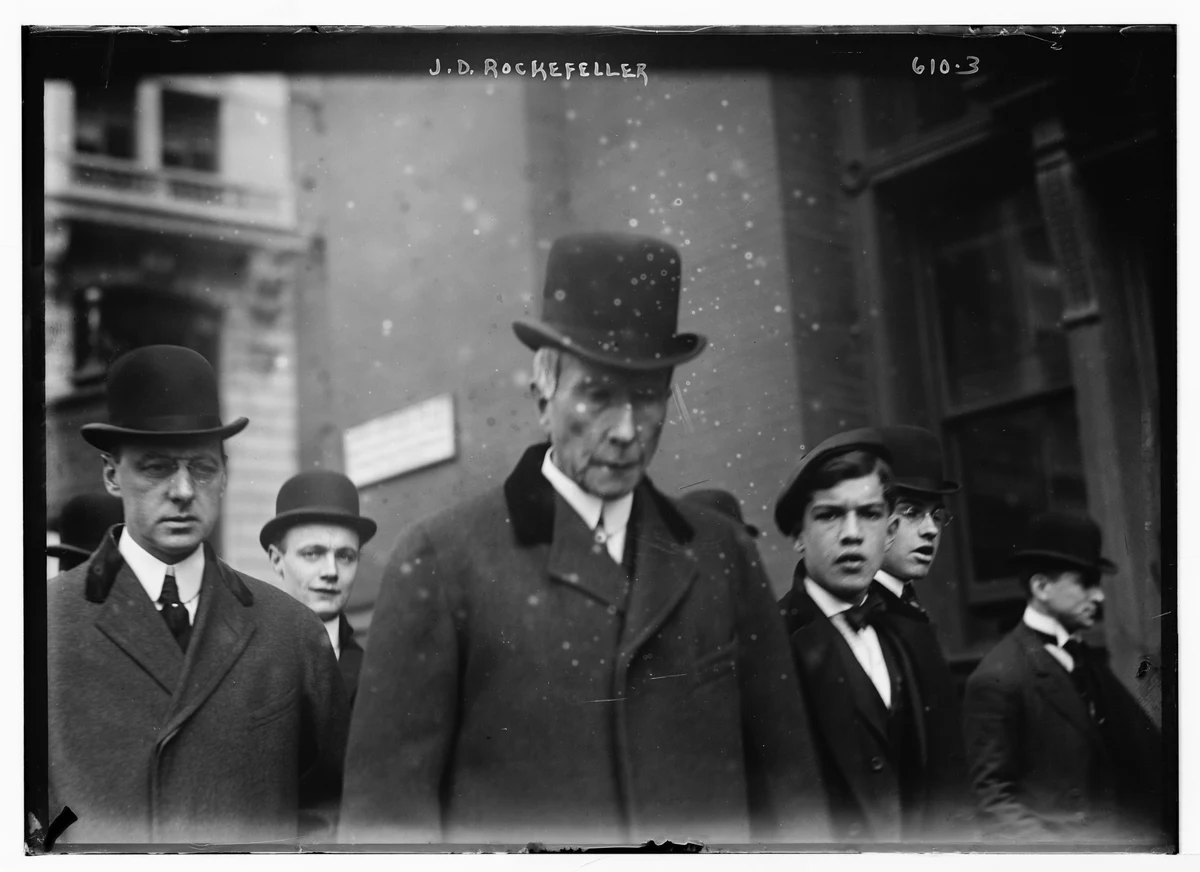
1839–1937
John D. Rockefeller
Oil entrepreneur and institutional philanthropistAn American oil businessman whose Standard Oil organization became a focus of antitrust action and whose fortune funded enduring philanthropic institutions.Read biography
1858–1919
Theodore Roosevelt
26th president of the United StatesTheodore Roosevelt served as U.S. president from 1901 to 1909, expanding federal action on corporate power, consumer protection and conservation. His energetic reform agenda coexisted with military intervention abroad and racial injustice at home.Read biography
1857–1944
Ida Tarbell
Investigative journalist, historian and biographerIda Tarbell was an American journalist and biographer whose investigation of Standard Oil made corporate organization and railway discrimination subjects of public scrutiny. Her career also included historical biography, magazine editing and writing about business and women’s roles.Read biographyQuick answers
Common questions
- Why was Standard Oil broken up in 1911?
- The Supreme Court found that the corporate combination violated the Sherman Act through unlawful restraint and monopolization of interstate petroleum commerce. It sustained dissolution, with changes to how the remedy would operate.
- Did Theodore Roosevelt order the 1911 breakup?
- The government filed the case during Roosevelt’s presidency in 1906. The Supreme Court issued its decision in May 1911, during Taft’s presidency. A presidential enforcement policy and a judicial dissolution order are different acts.
- Was Standard Oil split into thirty-four companies?
- That is the Library of Congress’s summary of the successor companies. Other institutional accounts describe differently counted controlled entities. The successor-company total should not be confused with every subsidiary or defendant mentioned in the litigation.
- Did the decision send Rockefeller to prison or take all his shares?
- No. This was a dissolution proceeding directed at an unlawful corporate combination, not a criminal sentence against Rockefeller. The remedy contemplated distributing subsidiary shares to the shareholders entitled to them.
- Does the rule of reason mean all business restraints are allowed?
- No. The majority interpreted the Sherman Act to prohibit unreasonable or undue restraints and held Standard Oil’s combination unlawful. This historical explanation is not a statement of every rule governing present-day antitrust disputes.
Primary and institutional sources
How this history was checked
The original report’s filing history, majority reasoning, remedy and Harlan’s separate opinion were read selectively, not the complete trial record. The 1911 decision date is taken from the report itself, not its 1910 term label. DOJ supplies distinct decree dates. The two institutional company totals describe differently framed groups; no new distribution-register reconstruction or modern legal advice is claimed. The Library’s inconsistent Rockefeller death age and differing retirement year are not repeated. The portrait reuses the exact already-published Bain image after an independent collection-rights check. This article was reviewed on 21 October 2026.
- U.S. Supreme Court / Library of CongressStandard Oil Co. of New Jersey v. United States, 221 U.S. 1, decided 15 May 1911
- National ArchivesSherman Anti-Trust Act (1890): original text and historical introduction
- U.S. Department of JusticeLegacy Antitrust Judgment: Standard Oil Company of New Jersey, et al.
- Library of CongressStandard Oil Established: This Month in Business History
- Rockefeller Archive CenterJohn D. Rockefeller, 1839–1937