In this biography
Quick facts
- Born
- 8 July 1839
- Died
- 23 May 1937
- Birthplace
- Richford, New York, United States
- Country
- United States
- Nationality
- American
- Known for
- Building Standard Oil with business partners and supporting educational, medical-research and philanthropic institutions
- Birth
- 8 July 1839 in Richford, New York
- Early oil business
- Entered Cleveland refining with partners in 1863
- Standard Oil Company
- Organized in 1870 with William Rockefeller, Samuel Andrews, Henry Flagler and others
- Standard Oil Trust
- Trust agreement established in 1882
- Supreme Court decision
- Standard Oil Co. of New Jersey v. United States, decided 15 May 1911
- Rockefeller Foundation
- Chartered in New York on 14 May 1913
- Death
- 23 May 1937 at Ormond Beach, Florida
Why this life matters
His career connects the growth of large industrial combinations, debates over competitive power and the creation of organized philanthropy through universities, research institutes and foundations.
Timeline
Key moments
From Richford to bookkeeping
Born on 8 July 1839; began working for Cleveland commission merchants Hewitt and Tuttle in 1855.
Refining and Standard Oil
Entered oil refining with partners in 1863 and helped organize Standard Oil in 1870.
Trust agreement
The Standard Oil Trust centralized control of interests in a group of businesses.
University and medical research
Supported the University of Chicago, incorporated in 1890, and established the Rockefeller Institute for Medical Research in 1901.
Antitrust judgment and foundation
The Supreme Court upheld dissolution of the unlawful Standard Oil combination in 1911; the Rockefeller Foundation was chartered in 1913.
Death in Florida
Died at Ormond Beach on 23 May, aged ninety-seven.
Bookkeeping and the Cleveland oil economy
John Davison Rockefeller was born in Richford, New York, on 8 July 1839. His family moved to Ohio during his youth. After taking a commercial course, he became an assistant bookkeeper for the Cleveland commission merchants Hewitt and Tuttle in 1855. His early work concerned accounts, shipments and the organization of trade.
In 1859 he entered a commission-business partnership with Maurice Clark. The expanding petroleum industry soon offered another opportunity, and in 1863 Rockefeller, Clark and Samuel Andrews entered refining. Rockefeller subsequently bought out Clark's interest and continued with Andrews. The sequence matters: he developed as a merchant and refiner rather than making his fortune through the discovery of one oil well.
Sources for this section: [1]
A company and then a trust
Rockefeller helped organize the Standard Oil Company in 1870 with partners including his brother William, Samuel Andrews and Henry Flagler. The enterprise expanded through acquisitions and through facilities for refining, storage, packaging and distribution. Its strength depended on a coordinated organization, the work of managers and workers, and control over linked stages of the business.
The 1882 trust agreement represented another step. Shareholders placed interests in constituent businesses under trustees who could exercise centralized control. The company of 1870 and the trust of 1882 were therefore different organizational milestones. Later changes, including the New Jersey holding-company structure, altered the legal form without ending the concentration of business interests that courts and critics scrutinized.
Public criticism and the antitrust judgment
Standard Oil's methods became a subject of sustained public criticism. Journalist Ida Tarbell investigated the organization in a series for McClure's Magazine, followed by her 1904 book, The History of the Standard Oil Company. Her account challenged the practices through which the business had accumulated power. Investigative reporting and judicial findings, however, were separate forms of scrutiny.
On 15 May 1911, the U.S. Supreme Court decided Standard Oil Co. of New Jersey v. United States. It held that the defendants' combination imposed an unreasonable restraint on interstate petroleum commerce under the Sherman Act and upheld dissolution, with modifications to the lower court's decree. This was a legal judgment about an unlawful combination, rather than a general ruling against every large company or every Rockefeller investment.
Giving through institutions and advisers
Rockefeller increasingly directed resources toward organized philanthropy. His backing, together with the American Baptist Education Society and other donors, helped establish the University of Chicago, incorporated in 1890 and opened for classes in 1892. Its library records that he preferred the president and trustees to take responsibility for management, distinguishing a founding donor's financial support from daily academic administration.
Medical research became another major field. In 1901 he established the Rockefeller Institute for Medical Research after discussions with adviser Frederick T. Gates and his son, John D. Rockefeller Jr. The institution's history shows how donor money, advisers, researchers and administrators combined to create a research organization. Its scientific achievements belonged to the people conducting that research.
A foundation and a contested legacy
The Rockefeller Foundation received its New York charter on 14 May 1913. Its original charter named several incorporators, including Rockefeller, his son and Gates, and authorized broad charitable, educational and research activity. The document demonstrates that institutional giving required a legal organization, governance and decisions about how resources would be used, beyond an individual's willingness to donate.
Rockefeller died at Ormond Beach, Florida, on 23 May 1937. The oil enterprise and the philanthropic institutions remain different parts of his historical record. Documented benefits of educational and medical support do not settle the criticism of Standard Oil's competitive conduct. Reading those records together allows his organizational ability, extraordinary influence and the conflicts surrounding concentrated private power to remain visible.
Quick answers
Frequently asked questions about John D. Rockefeller
- Which John D. Rockefeller is this biography about?
- It covers John Davison Rockefeller Sr., born in 1839, the Standard Oil businessman and philanthropist. His son John D. Rockefeller Jr. and grandson John D. Rockefeller III were different people with their own careers.
- Did Standard Oil begin as a trust in 1870?
- The Standard Oil Company was organized in 1870. The trust agreement followed in 1882 and centralized control of interests across a group of businesses. These are separate milestones.
- Why did the Supreme Court order Standard Oil's breakup?
- In its 1911 decision the Court found the defendants' combination an unreasonable restraint of interstate commerce under the Sherman Act. It upheld dissolution, while modifying details of the lower court's decree.
- Did Rockefeller personally run the University of Chicago?
- He supplied crucial founding and subsequent financial support, alongside other donors. The university's library documents his preference for its president and trustees to exercise management responsibility.
Keep exploring
Lives connected to this story
- Thomas Edison
Compare two industrial organizations that connected technical work, finance and distribution, while facing different questions about market power.
- George Eastman
Compare another manufacturer whose business success funded educational and cultural philanthropy.
- Henry Ford
Compare the organization of large industrial enterprises and the influence of their founders.
Sources and further reading
Explore the evidence
These references support the biography and offer further reading. Official records, first-person accounts and independent reporting provide different perspectives; image records document attribution and licensing.
- 1. Rockefeller Archive CenterJohn D. Rockefeller, 1839–1937
The family archive supplies early biographical and organizational details. Institutional accounts differ in counting the companies involved in the 1911 breakup; the biography avoids an unnecessary numeric total and uses the original court report for the judgment.
- 2. U.S. Supreme Court / Library of CongressStandard Oil Co. of New Jersey v. United States, 221 U.S. 1, decided 15 May 1911
The report is headed October Term 1910 but explicitly gives a decision date of 15 May 1911. The biography distinguishes the Court's holding from Tarbell's criticism and does not convert allegations recited in the opinion into independent findings.
- 3. Library of CongressBooks That Shaped America: Ida Tarbell, The History of Standard Oil
- 4. University of ChicagoHistoric Achievements: Incorporation in 1890 and Opening in 1892
- 5. University of Chicago LibraryBuilding for a Long Future: John D. Rockefeller
- 6. The Rockefeller UniversityOur History
- 7. The Rockefeller FoundationAnnual Report 1913–1914: Charter and Organization
- 8. Library of CongressJ.D. Rockefeller [New York]: Original Bain Negative, LCCN 2014682944
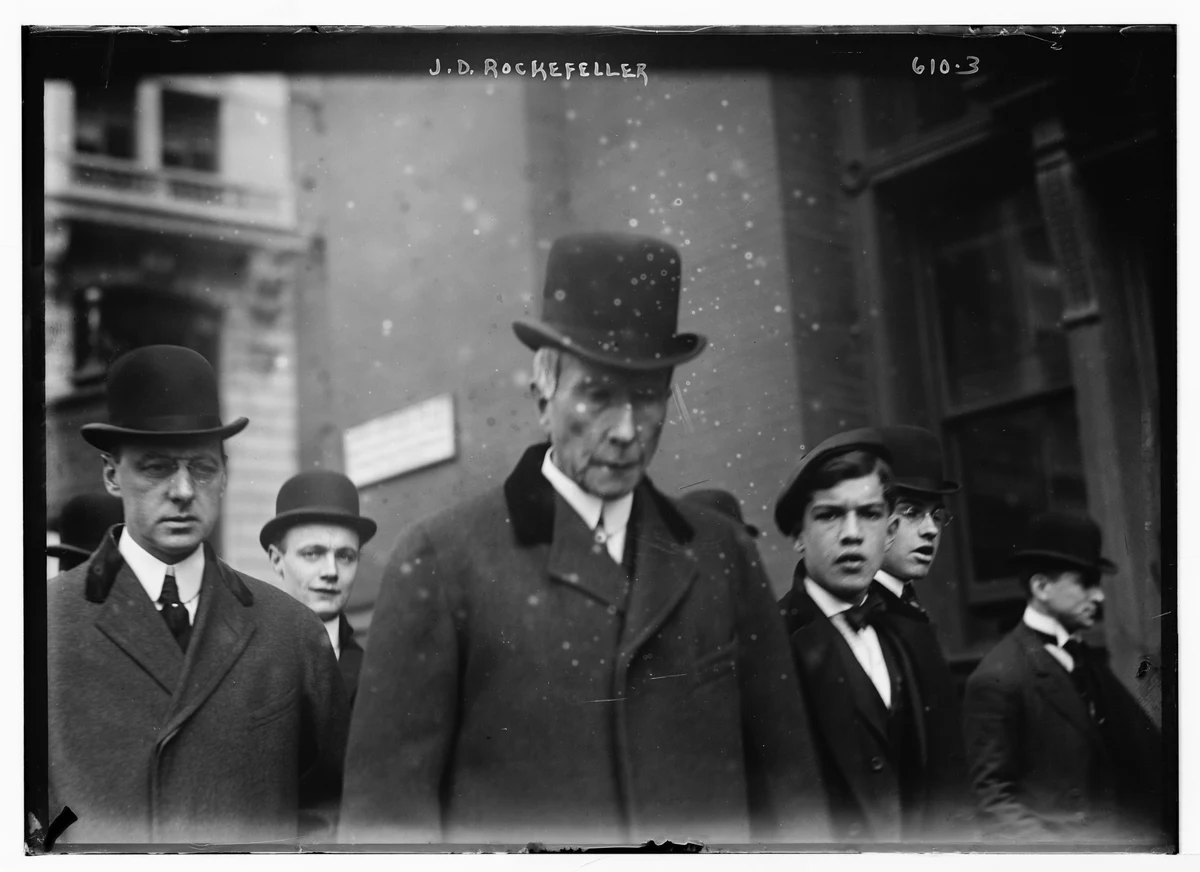
The item identifies Bain News Service, original-negative digital ID ggbain.02949 and a specific no-known-restrictions advisory. Its date is cataloged as 18 November 1908, created or published later by Bain; no exact first-publication date is inferred. The matching Bain Collection rights statement independently covers publication and distribution.
- 9. Library of CongressGeorge Grantham Bain Collection: Rights and Restrictions
- 10. Library of Congress / Wikimedia CommonsComplete Original TIFF: J.D. Rockefeller (New York), LCCN 2014682944