
The short answer
What makes a restriction enzyme a reproducible sequence-specific tool?
Evidence comparison
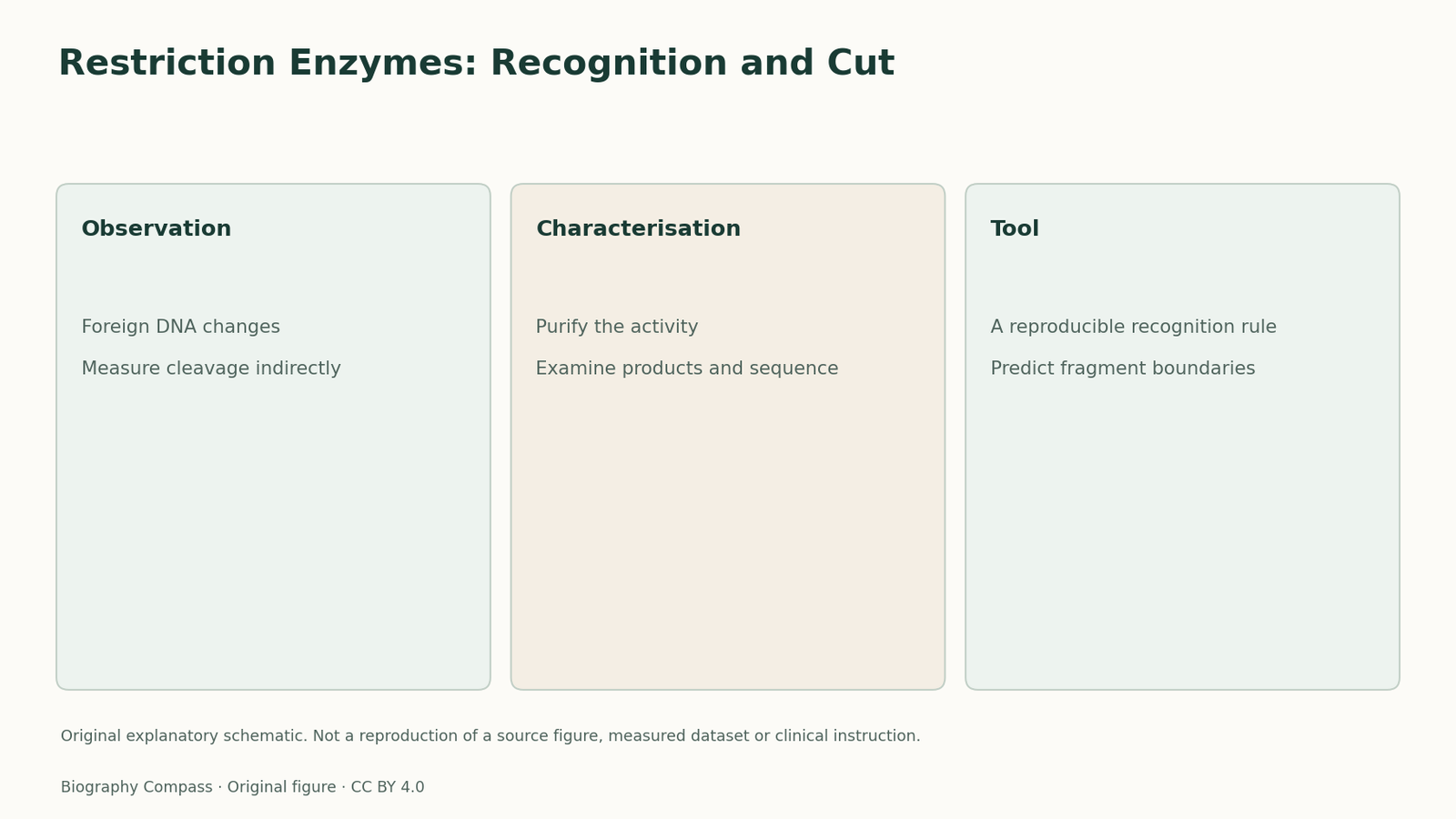
Restriction Enzymes: Recognition and Cut
Compare the observations with the narrower conclusions they support.
| Record or observation | What it supports | What remains separate |
|---|---|---|
| Viscosity decreases | Evidence that DNA molecules have been cleaved | Does not specify every recognition sequence |
| Reproducible sequence-related cleavage | Produces predictable boundaries and fragments | Requires evidence beyond merely counting broken pieces |
Recognition makes a cut informative
Smith's Nobel lecture distinguishes cleavage-site-specific restriction enzymes from the broader fact that enzymes can degrade DNA. A reproducible recognition rule allows the same DNA sequence to yield a characteristic fragment set. A cutting activity without a predictable relation between recognition and break position may demonstrate degradation while being much less useful for mapping. That difference connects the molecular properties of an enzyme with the questions a geneticist can ask using it.
Read the first observation at its proper scale
Smith and Kent Wilcox initially used viscosity as a sensitive indication that DNA had been cleaved. In the lecture, foreign P22 DNA and Haemophilus DNA responded differently to bacterial extracts. This was a useful lead, not yet a complete description of a recognition sequence. Purification, examination of products and sequence analysis supplied increasingly specific evidence about what the enzyme did.
Sources for this section: [3]
An original rule-based cutting exercise
Write the invented string ABCDABCD and define a classroom rule that cuts only after each AB. Mark the two permitted boundaries. Then compare an unspecified instruction to make two cuts anywhere. Both can yield three fragments in a linear string, but only the first is reproducible from a recognition rule. The letters and rule are fictional; they illustrate why a count of fragments alone does not identify an actual enzyme or establish its specificity.
Sources for this section: [3]
Keep biological protection and laboratory use connected
Restriction and modification concern how bacteria handle DNA. Purified enzymes can then be used under chosen laboratory conditions for mapping and molecular construction. These contexts are related but not identical. A paper exercise cannot establish cofactor requirements, methylation effects or the performance of a preparation; those require the biochemical experiments that made the original tool dependable.
Continue the chronology
Related history guides
Biography context
Explore United States through connected lives
Connected biographies
Researchers and related questions

1931–2025
Hamilton O. Smith
Molecular biologist and restriction-enzyme researcherAt Johns Hopkins, Smith and graduate student Kent Wilcox investigated the bacterium Haemophilus influenzae.Read biography
1928–1999
Daniel Nathans
Molecular biologist and restriction-mapping researcherNathans became interested in tumour viruses and spent part of 1969 at the Weizmann Institute.Read biography1918–2007
Arthur Kornberg
Biochemist and DNA-replication researcherKornberg's group isolated DNA polymerase from bacteria in 1956.Read biographyQuick answers
Common questions
- What makes a restriction enzyme a reproducible sequence-specific tool?
- Evidence that DNA molecules have been cleaved. Does not specify every recognition sequence.
- Are the classroom examples historical measurements?
- No. Invented examples are labelled as classroom models; the source-based discussion identifies the historical evidence separately.
Primary and institutional sources
How this history was checked
Official biographical and award records are read alongside the researcher’s technical account. Source scope and hypothetical examples remain distinct. This article was reviewed on 7 November 2026.