
The short answer
How could restriction fragments become a map of a viral genome?
Evidence comparison
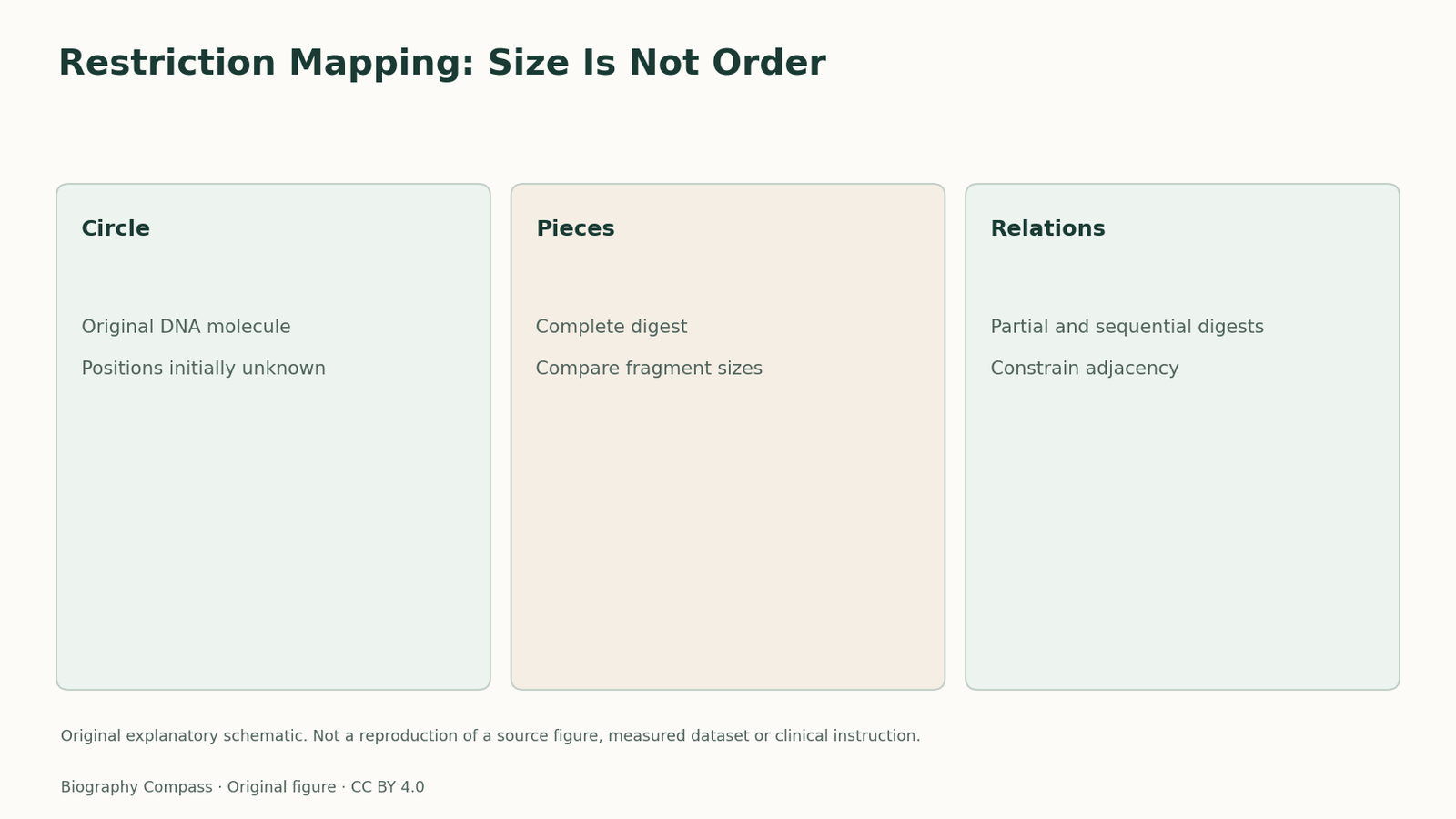
Restriction Mapping: Size Is Not Order
Compare the observations with the narrower conclusions they support.
| Record or observation | What it supports | What remains separate |
|---|---|---|
| Complete restriction digest | Supplies a characteristic set of fragment sizes | Size order on a gel is not genomic adjacency |
| Partial or sequential digest | Adds relationships between fragments | A cleavage map is still not a full nucleotide sequence |
A digest produces pieces, not an ordered map
Treating a DNA molecule with a site-specific restriction enzyme can produce a reproducible set of fragments. Nathans used this property to investigate the circular SV40 genome. A gel can help distinguish fragment sizes, but the collection of sizes does not automatically tell a reader which fragments were adjacent in the original molecule. A mapping argument needs evidence that reconnects pieces to positions.
Compare complete and partial digestion
Nathans's lecture credits Kathleen Danna and George Sack with establishing fragment order through analysis that included partial-digest products and sequential treatment with different enzymes. A partially cut molecule can retain neighbouring fragments together. Comparing those larger products with the complete digest can therefore constrain adjacency. The logic differs from simply arranging gel bands by their positions in a lane, which orders their migration rather than their original places on the chromosome.
Sources for this section: [3]
Solve an invented circular puzzle
Imagine a circular molecule cut into fragments of two, three and five units. A complete digest supplies those sizes but allows more than one drawing. Now add a partial product known to consist of the two-unit and three-unit fragments joined together. Mark their adjacency and explain what information the added observation contributes. With only three fragments, much circular order remains equivalent under rotation or reversal; use that fact as the answer to a second question about what the toy puzzle cannot distinguish.
Sources for this section: [3]
Do not turn a map into a sequence
A cleavage map locates cutting sites and fragments relative to one another. It does not, by itself, list every nucleotide or prove what every region does. Comparing Nathans with Smith clarifies the distinction: sequence-specific cutting makes the map reproducible, while further positional and functional experiments make the pieces biologically informative.
Continue the chronology
Related history guides
Biography context
Explore United States through connected lives
Connected biographies
Researchers and related questions
1928–1999
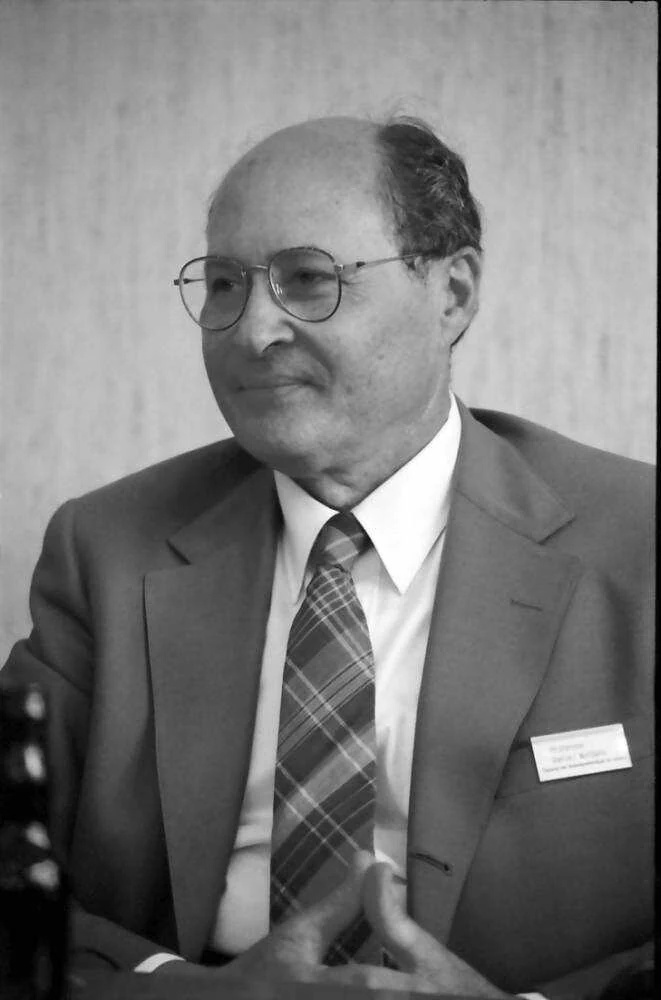
Daniel Nathans
Molecular biologist and restriction-mapping researcherNathans became interested in tumour viruses and spent part of 1969 at the Weizmann Institute.Read biography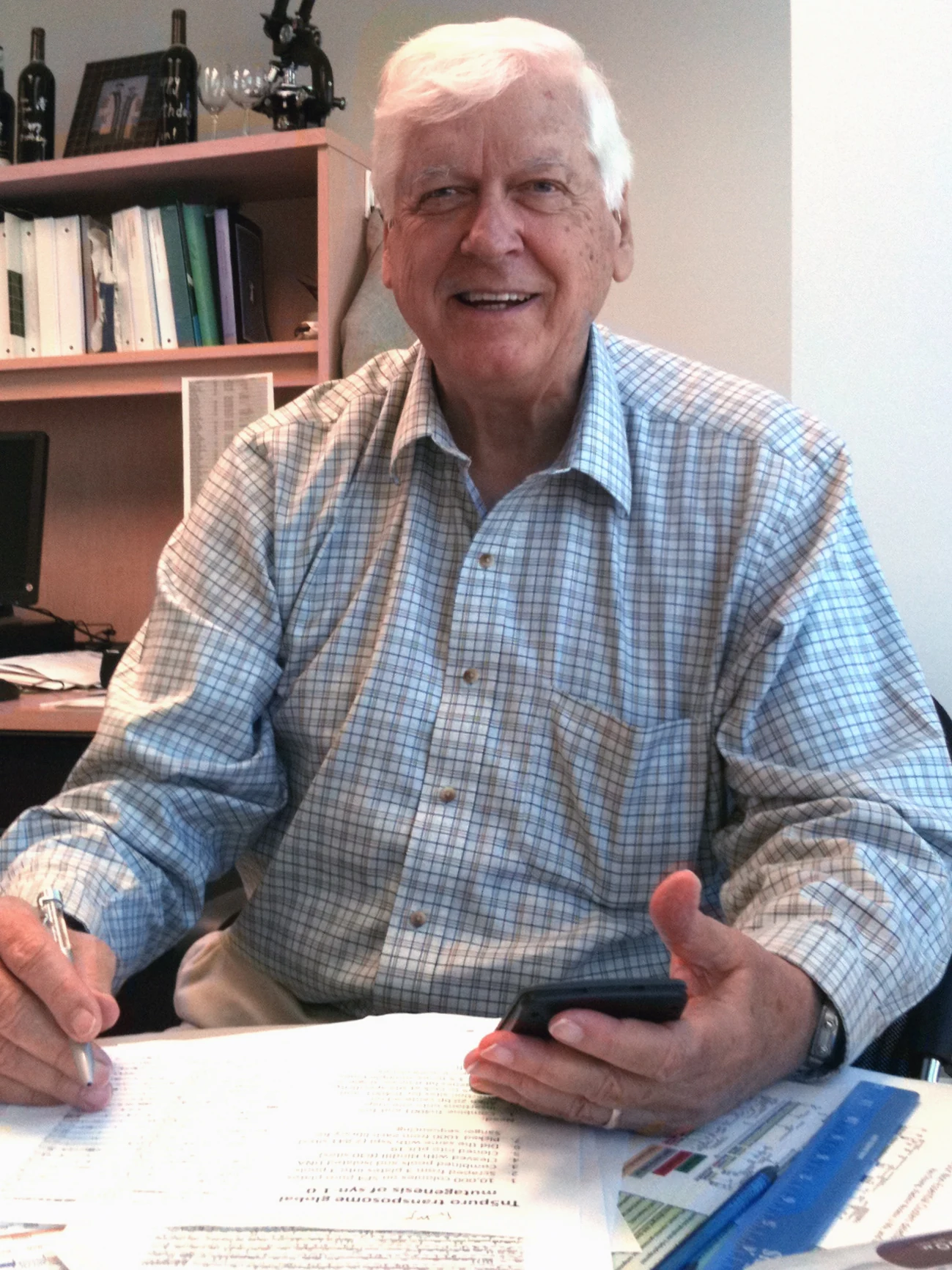
1931–2025
Hamilton O. Smith
Molecular biologist and restriction-enzyme researcherAt Johns Hopkins, Smith and graduate student Kent Wilcox investigated the bacterium Haemophilus influenzae.Read biography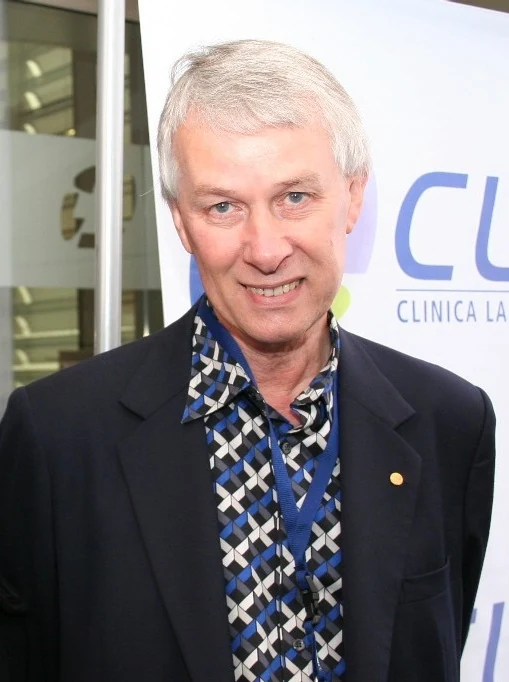
1943–
Richard J. Roberts
Biochemist and molecular-biology researcherRoberts shared the 1993 medicine prize with Phillip Sharp for the discovery of split genes.Read biographyQuick answers
Common questions
- How could restriction fragments become a map of a viral genome?
- Supplies a characteristic set of fragment sizes. Size order on a gel is not genomic adjacency.
- Are the classroom examples historical measurements?
- No. Invented examples are labelled as classroom models; the source-based discussion identifies the historical evidence separately.
Primary and institutional sources
How this history was checked
Official biographical and award records are read alongside the researcher’s technical account. Source scope and hypothetical examples remain distinct. This article was reviewed on 7 November 2026.