
The short answer
How did UvrABC experiments distinguish damage recognition, incision and the later completion of repair?
Read the evidence
Different records within the same investigation
The following comparison distinguishes the specific questions answered by the inspected records.
| Record or test | What it establishes | What remains different |
|---|---|---|
| Genetic requirement | Connects a factor with damage recovery. | Does not specify every reaction it enables. |
| Dual-incision product | Shows removal bounded on both sides of damage. | Is not yet a completely restored strand. |
| Repair completion | Requires later synthesis and joining. | Must be distinguished from excision alone. |
A survival effect is not yet a reaction mechanism
Genes required for recovery from DNA damage identify a biological requirement, but they do not by themselves show how the damage is removed. Sancar’s lecture describes the purification of the E. coli UvrA, UvrB and UvrC proteins and the reconstruction of their activity. This shifted the question toward an observable biochemical process: what cuts were made in a damaged DNA substrate, and what material was produced as a result?
The 1983 paper reported cuts on both sides
The primary abstract describes a reconstituted enzyme acting on specified damaged substrates. With UV-damaged DNA, it made two incisions on the damaged strand, one on either side of the affected region. A fragment containing the damaged bases was released. This gave a particular explanation of excision, distinct from a single cut followed by progressive digestion. The report concerned a bacterial system, so its exact product dimensions should not be silently applied to every other organism. The paper also reports activity on cis-platinum and psoralen-treated substrates, while its detailed incision description concerns UV damage.
Sources for this section: [1]
Excision and completed repair remain different stages
The lecture’s pathway diagrams place resynthesis and joining after removal of the damaged segment. It also compares bacterial and human excision systems, which share the broad dual-incision logic while using different protein factors and product lengths. This comparison is useful because it preserves both a mechanistic relationship and a biological difference. A damaged fragment leaving a substrate is evidence for excision; restoration of a continuous, correctly synthesised strand requires additional reactions and appropriate measurements.
Sources for this section: [2]
An original product-classification exercise
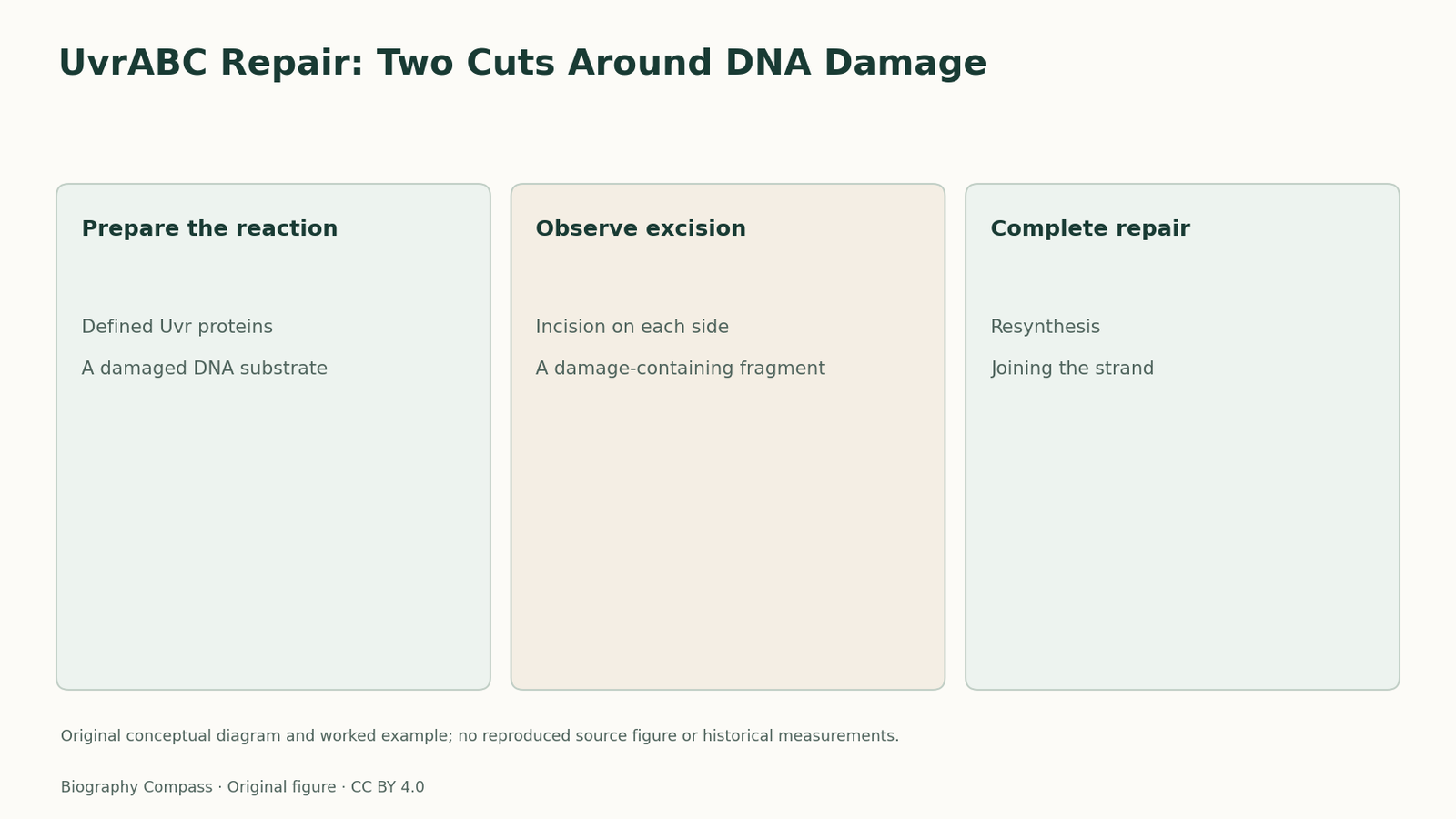
Imagine a fictional repair assay yielding three possible products: a strand nicked only before a lesion, a released fragment containing the lesion with boundaries on both sides, and a fully restored strand. Which product most directly supports the dual-incision excision account? The middle one. The first leaves the proposed second incision unestablished, while the third combines several reactions into a final outcome. Now ask whether detecting the released fragment proves that synthesis and ligation have also occurred. It does not; those require their own evidence. These examples contain no copied sequence, historical incision distances or invented human-repair data. Their supported answer identifies what each product can establish and why a completed pathway must be built from more than a survival result or one final image.
Continue the chronology
Related history guides
Uracil in DNA: Damage Recognition and Repair
Read Lindahl’s 1974 uracil-DNA glycosylase result beside later repair diagrams, using a worked exercise that separates base removal from complete DNA repair.
Read the timeline1989Mismatch Repair: Which DNA Strand Changes?
Examine the 1989 defined mismatch-repair system, using a worked strand-choice exercise to separate detecting an error from deciding which sequence to replace.
Read the timelineBiography context
Explore United States through connected lives
Connected biographies
Researchers and related approaches
1946–
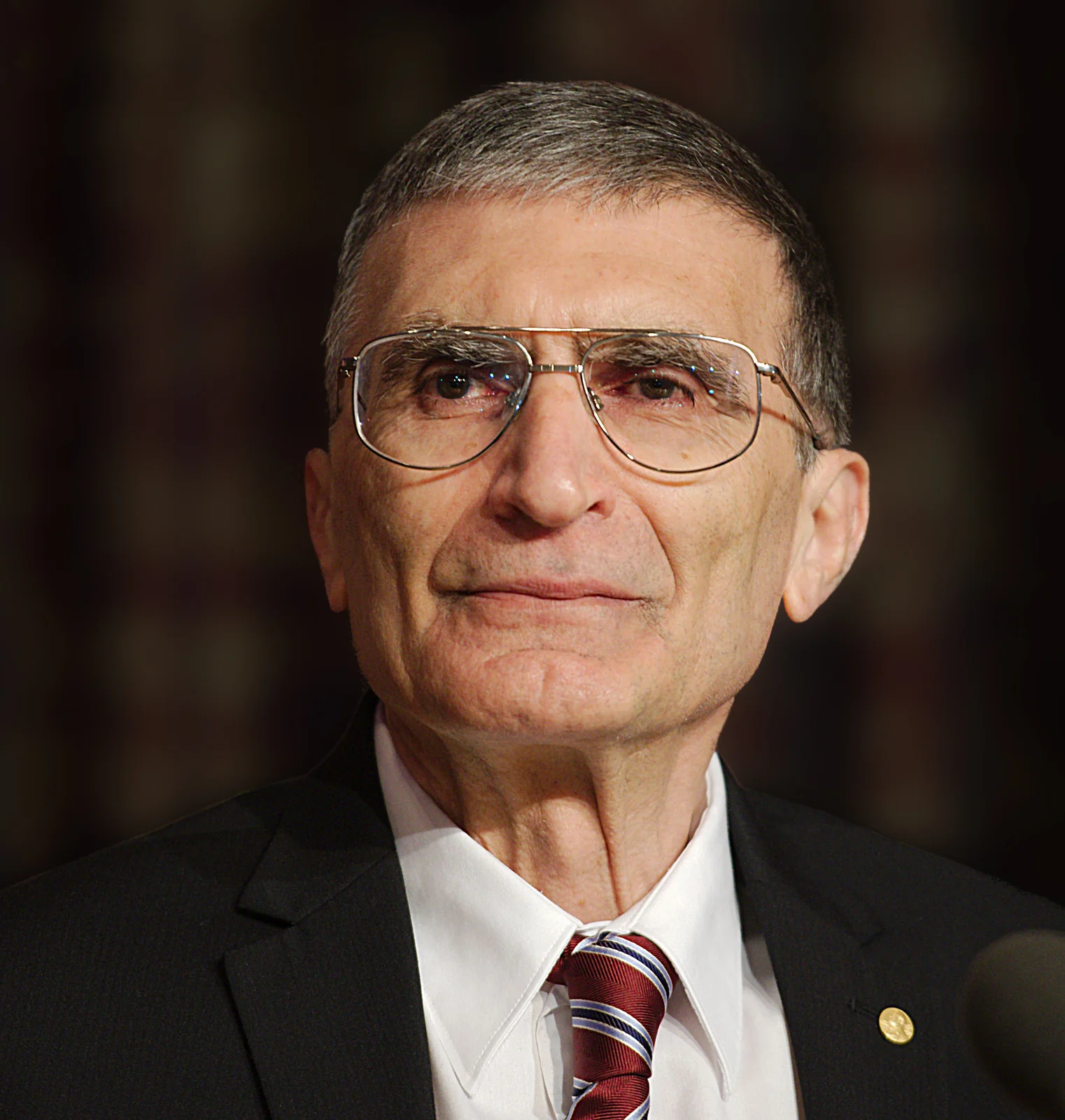
Aziz Sancar
Physician-scientist and DNA-repair biochemistAziz Sancar moved from medical training in Turkey to DNA-repair research, identifying how defined proteins recognise and excise damaged DNA.Read biography1944–
Michael Rosbash
Molecular biologist and circadian-clock researcherMichael Rosbash brought RNA biology to the study of biological clocks, working with Jeffrey Hall and colleagues to connect daily behaviour with gene regulation.Read biographyQuick answers
Common questions
- What made the result mechanistically specific?
- The defined system produced incisions on both sides and a released damage-containing fragment.
- Are bacterial and human fragment lengths identical?
- No. The lecture explicitly distinguishes their systems even while comparing the shared excision logic.
Primary and institutional sources
How this history was checked
The references below distinguish the original study from later explanations. The worked exercise and comparison are newly written for this article. This article was reviewed on 8 November 2026.