
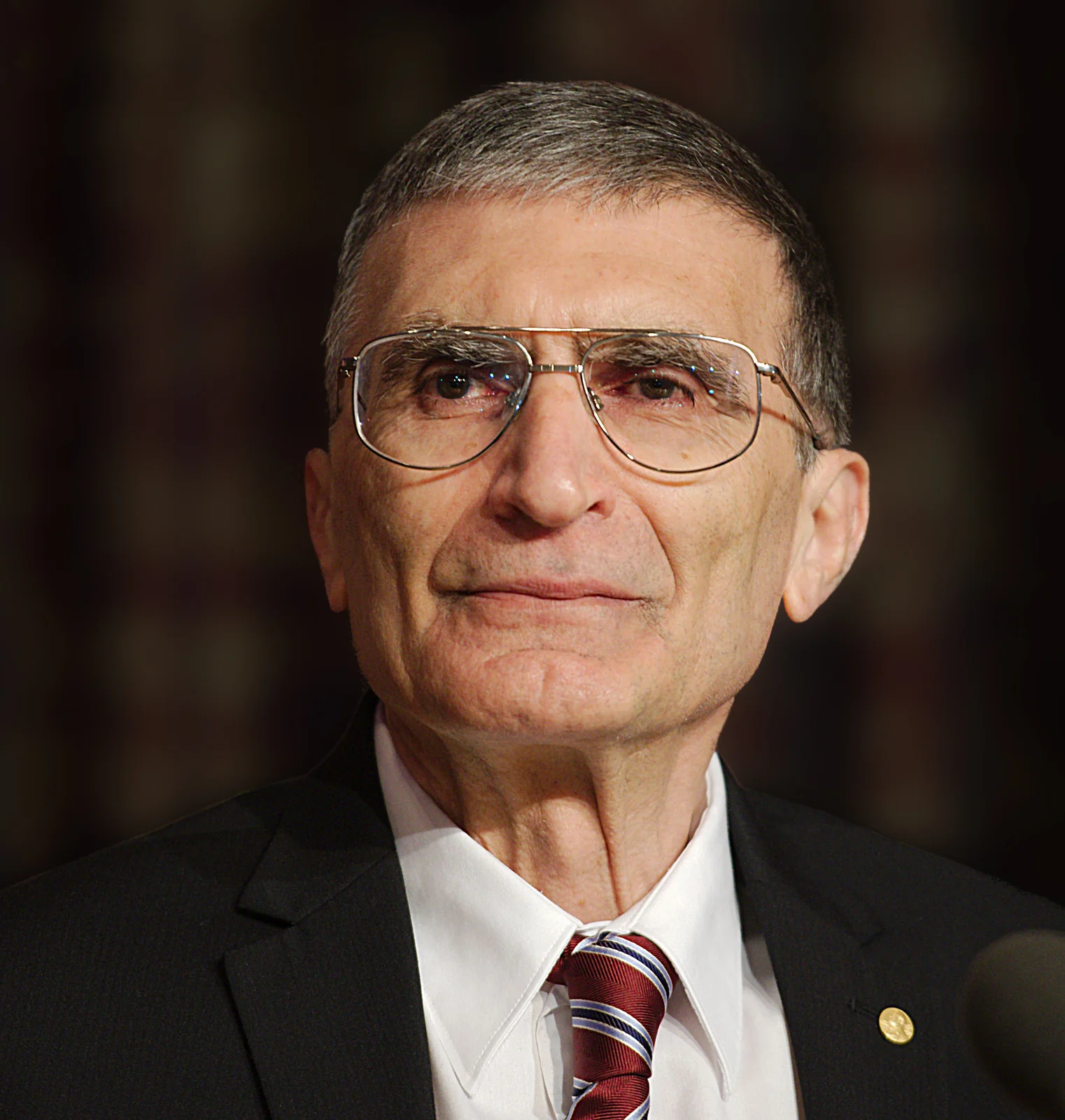
In this biography
Quick facts
- Born
- 8 September 1946
- Birthplace
- Savur, Turkey
- Country
- United States
- Nationality
- Not independently established
- Known for
- Elucidating photolyase and nucleotide-excision repair mechanisms
Why this life matters
Elucidating photolyase and nucleotide-excision repair mechanisms
Timeline
Key moments
Birth
Aziz Sancar was born in Savur, Turkey.
Dual-incision paper
Published the UvrABC excision mechanism with W. Dean Rupp.
Nobel recognition
Received Nobel recognition for the work described in the official award record.
Medicine before molecular research
Aziz Sancar was born in Savur, Turkey, in 1946. He studied medicine at Istanbul University before turning toward biochemical research. His autobiography describes a difficult transition into English-language laboratory work and his acceptance at the University of Texas at Dallas in 1973. He joined Claud Rupert’s laboratory the following year and completed his doctorate in 1977. Photolyase, an enzyme involved in light-dependent repair of UV damage, provided a concrete molecular problem through which his research career developed.
Cloning and purification made mechanisms accessible
Rupert’s laboratory investigated how photolyase absorbed light and repaired damaged DNA. Sancar used emerging cloning methods to obtain material for biochemical study. He then joined W. Dean Rupp’s laboratory at Yale, where another set of repair proteins, UvrA, UvrB and UvrC, became a focus. His work connected genetic identification with purification: knowing that a gene mattered for repair was different from reconstructing the reaction performed by its product. Obtaining defined proteins made the mechanistic question experimentally approachable.
Two incisions changed an earlier model
Sancar’s autobiographical account dates the key reconstituted UvrABC observation to 1982; the paper with Rupp appeared in 1983. The purified system cut damaged DNA on both sides of the affected region, generating a damage-containing fragment. This differed from the earlier picture of one incision followed by gradual removal from an end. The work became a foundation for understanding nucleotide-excision repair. The distinction is visible at the level of products and bond-breaking events, rather than only in whether a cell survived UV exposure.
A wider programme in repair and biological time
Sancar’s career at the University of North Carolina included investigations of photolyase, excision repair and later connections with circadian regulation. His Nobel lecture distinguishes bacterial and human repair systems and also discusses cryptochrome-related work. He shared the 2015 Nobel Prize in Chemistry with Tomas Lindahl and Paul Modrich. The common recognition joined different mechanisms under one larger problem: how cells maintain genetic material despite continuing damage. His contribution is especially clear in the experimental reconstruction of reactions with defined molecular participants.
Quick answers
Frequently asked questions about Aziz Sancar
- Was the key UvrABC observation made in 1983?
- Sancar’s account places the observation in 1982;1983 is the publication year of the paper with Rupp.
- Is photolyase the same mechanism as UvrABC excision?
- No. They are different repair processes, investigated through distinct reactions and protein systems.
Keep exploring
Lives connected to this story
- Michael Rosbash
Compare distinct molecular programmes, including Sancar’s later interest in connections between repair and circadian biology.
- Paul Modrich
Compare excision around a lesion with the separate strand-choice problem in mismatch repair.
Sources and further reading
Explore the evidence
These references support the biography and offer further reading. Official records, first-person accounts and independent reporting provide different perspectives; image records document attribution and licensing.
- 1. Aziz Sancar and W. Dean Rupp / Cell, 1983A novel repair enzyme: UVRABC excision nuclease of Escherichia coli cuts a DNA strand on both sides of the damaged region
The 1982 observation and 1983 paper are different events. Excision is also kept separate from later synthesis and ligation.
- 2. Nobel Prize OutreachAziz Sancar — Nobel lecture
- 3. Nobel Prize OutreachAziz Sancar — Facts
- 4. Nobel Prize OutreachAziz Sancar — Biographical