
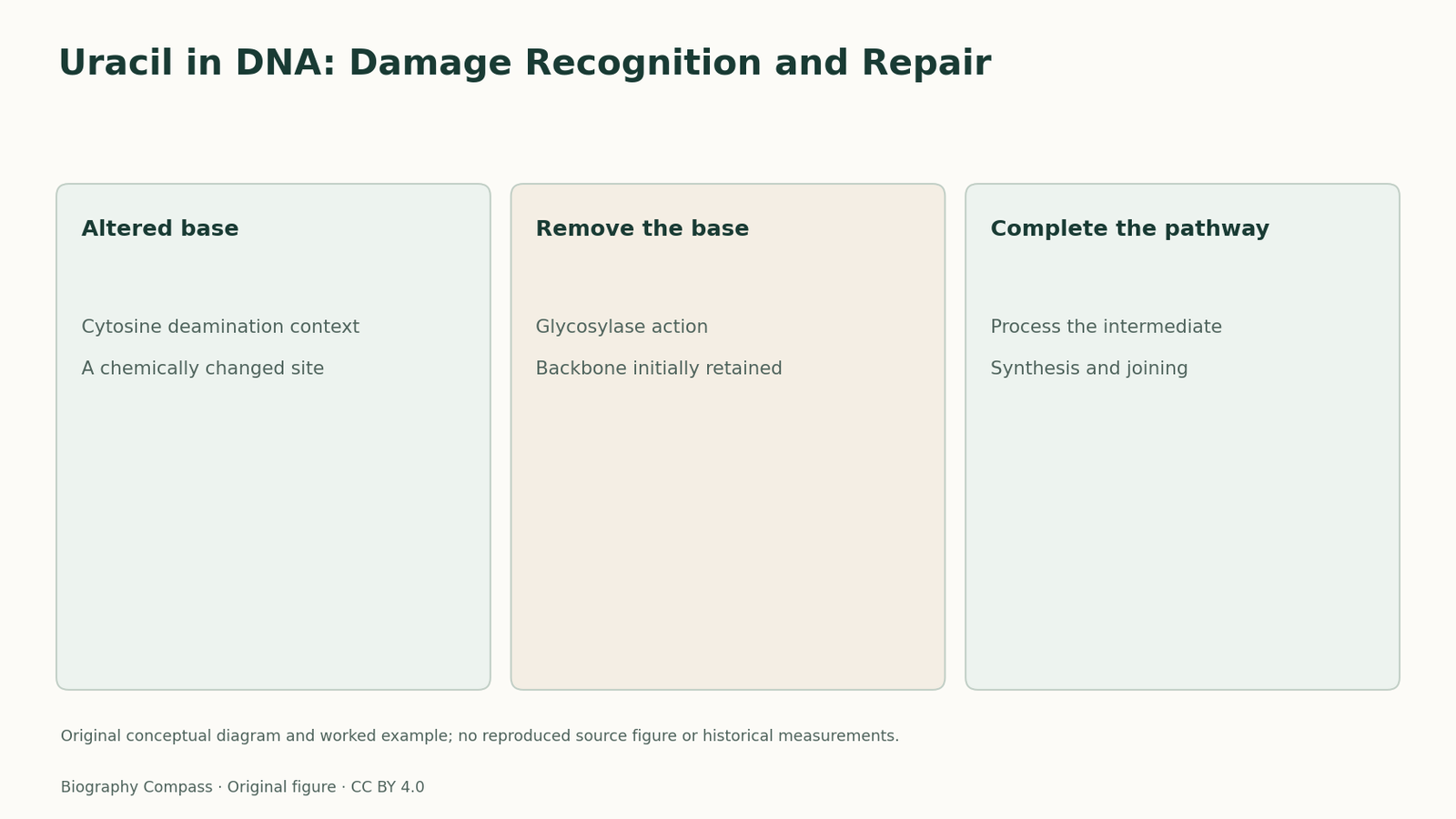
The short answer
How did uracil-DNA glycosylase separate damaged-base removal from completing DNA repair?
Read the evidence
Different records within the same investigation
The following comparison distinguishes the specific questions answered by the inspected records.
| Record or test | What it establishes | What remains different |
|---|---|---|
| Damaged-base recognition | Identifies an altered chemical feature. | Does not itself describe the complete repair sequence. |
| Glycosylase reaction | Removes a base and leaves an abasic site. | Does not automatically sever or restore the backbone. |
| Completed base-excision repair | Connects processing, synthesis and joining steps. | Is a pathway beyond the initiating enzyme alone. |
A chemical change can alter a genetic message
Lindahl’s lecture identifies cytosine deamination as one form of DNA instability. A changed base can create a problem for preserving sequence information even when the overall molecule remains present. This gave repair research a precise chemical question: could a cell recognise and remove an altered base selectively? The 1974 study addressed that question through an E. coli enzyme acting on uracil-containing DNA, rather than measuring every possible kind of damage at once.
The reaction did not sever the backbone
The primary abstract explicitly separates cleavage of the base’s N-glycosidic bond from cleavage of phosphodiester bonds. Uracil was released while DNA strands retained their chain length and contained apyrimidinic, or abasic, sites. This distinction matters because removing the offending base does not yet restore a normal nucleotide. It produces an intermediate that requires further processing. The experimental finding therefore identifies a specific initiating reaction rather than a single enzyme completing the entire repair pathway.
Sources for this section: [1]
Later pathway diagrams contain additional steps
Lindahl’s lecture places glycosylase action before processes involving an AP endonuclease, further processing, a polymerase and a ligase. Those later diagrams help explain the fate of the intermediate, but they should not be read as if all their reactions were established by the 1974 enzyme experiment alone. The sequence is informative precisely because the steps have different chemical jobs. A base can be absent while the chain remains continuous, and a repaired chain requires more than removal of the original problem.
Sources for this section: [2]
An original intermediate-state exercise
Imagine three fictional DNA records. In A, an altered base remains attached to the chain. In B, that base is gone but an empty site remains in a backbone of unchanged length. In C, the site has been processed and a normal nucleotide restored. Which record corresponds most directly to glycosylase action? B. Calling it C would silently add later repair reactions. Now suppose an assay detects released uracil but does not examine the DNA product. What additional measurement would test whether the chain was also cut? A separate assessment of the backbone is needed. This exercise uses no historical assay values or invented enzyme rates. Its supported answer distinguishes the chemical bond broken, the intermediate formed and the later steps required for complete restoration.
Continue the chronology
Related history guides
Mismatch Repair: Which DNA Strand Changes?
Examine the 1989 defined mismatch-repair system, using a worked strand-choice exercise to separate detecting an error from deciding which sequence to replace.
Read the timeline1982–1983UvrABC Repair: Two Cuts Around DNA Damage
Compare the 1983 UvrABC result with the earlier repair model, using an original exercise on recognition, two incisions and the separate completion of repair.
Read the timelineBiography context
Explore Stockholm, Sweden through connected lives
Connected biographies
Researchers and related approaches
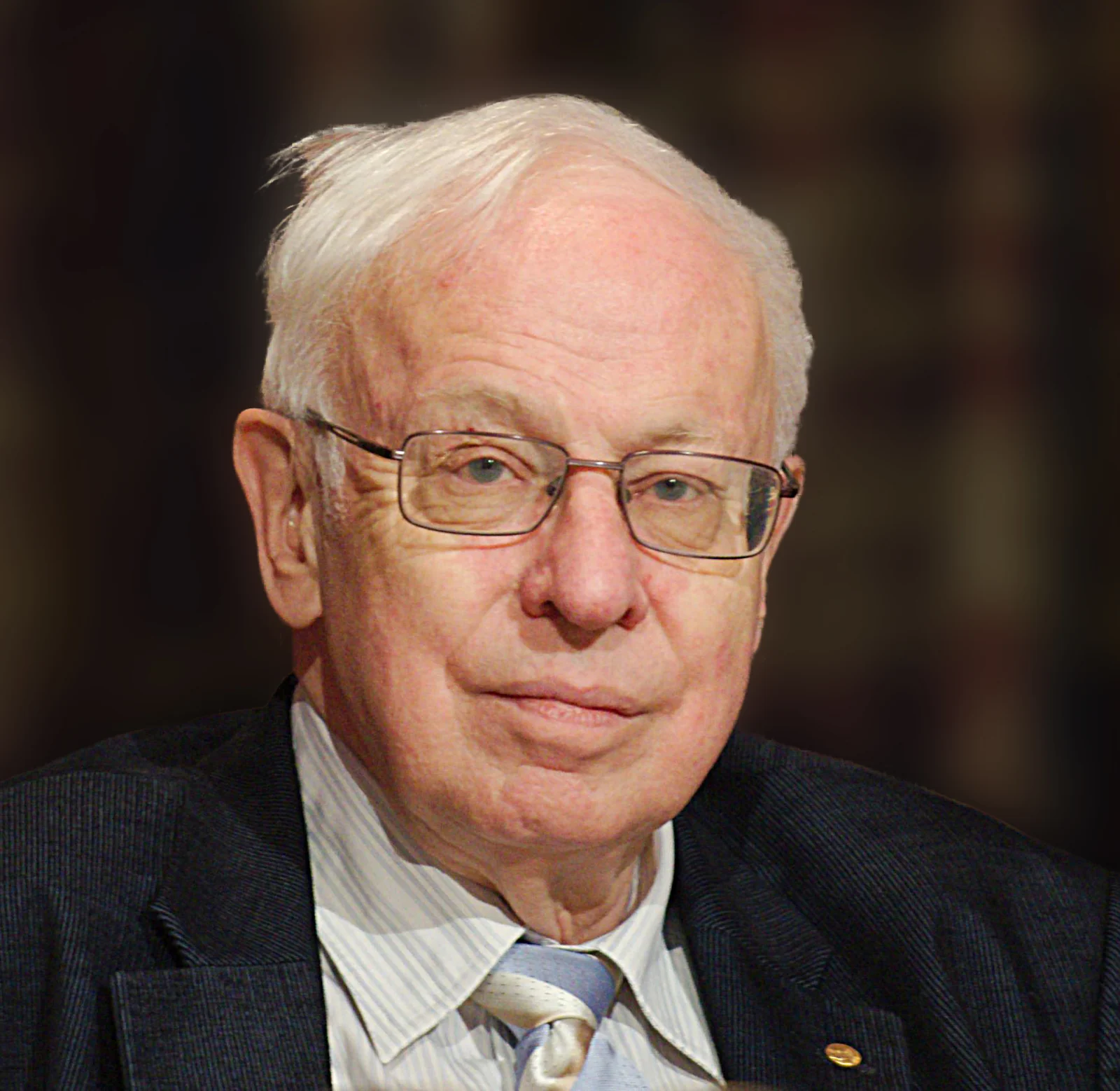
1938–
Tomas Lindahl
Biochemist and DNA-repair researcherTomas Lindahl investigated DNA’s chemical instability and the repair enzymes that counter it, developing a research career in Sweden and the United Kingdom.Read biography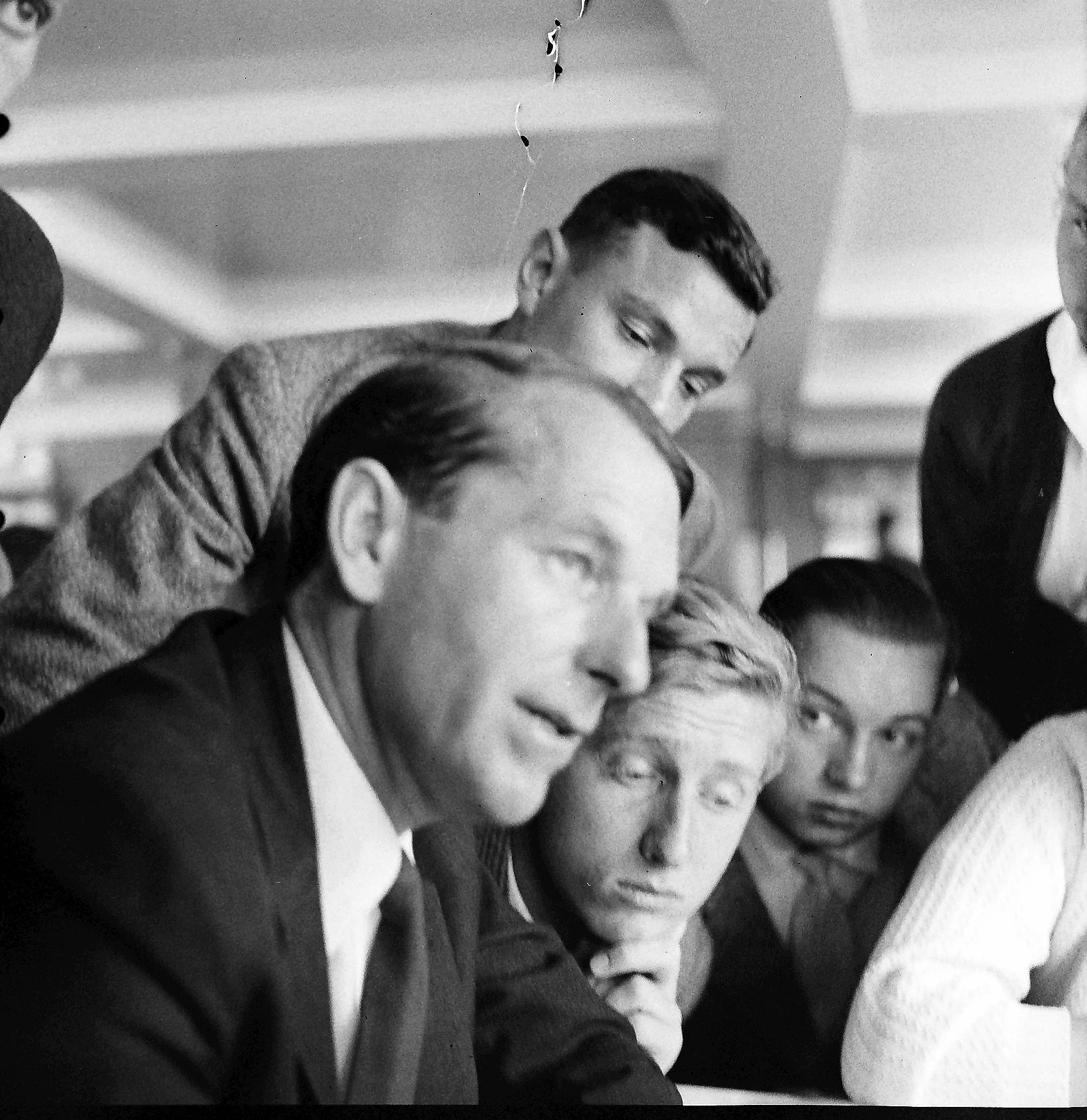
1918–2013
Frederick Sanger
Biochemist and sequencing-method researcherFrederick Sanger developed ways to determine the order of components in proteins and nucleic acids. His two chemistry Nobel Prizes mark different stages of a research career whose continuity was the problem of sequence and whose methods depended on many collaborators.Read biographyQuick answers
Common questions
- Why is an abasic site an intermediate?
- The original base has been removed, but the DNA has not yet been restored to a normal nucleotide arrangement.
- Why distinguish two kinds of chemical bond?
- Breaking a base–sugar bond is a different reaction from cutting the phosphodiester backbone.
Primary and institutional sources
How this history was checked
The references below distinguish the original study from later explanations. The worked exercise and comparison are newly written for this article. This article was reviewed on 8 November 2026.