
The short answer
How did strand-directed repair experiments distinguish mismatch detection from choosing the strand to replace?
Read the evidence
Different records within the same investigation
The following comparison distinguishes the specific questions answered by the inspected records.
| Record or test | What it establishes | What remains different |
|---|---|---|
| Mismatch recognition | Identifies an incompatible pairing. | Does not by itself select the strand to replace. |
| Strand-directed processing | Connects an error with a directional signal. | Depends on the particular repair system. |
| Corrected product | Records the final pairing outcome. | Does not alone reveal every intermediate step. |
A mismatch does not identify its own correction
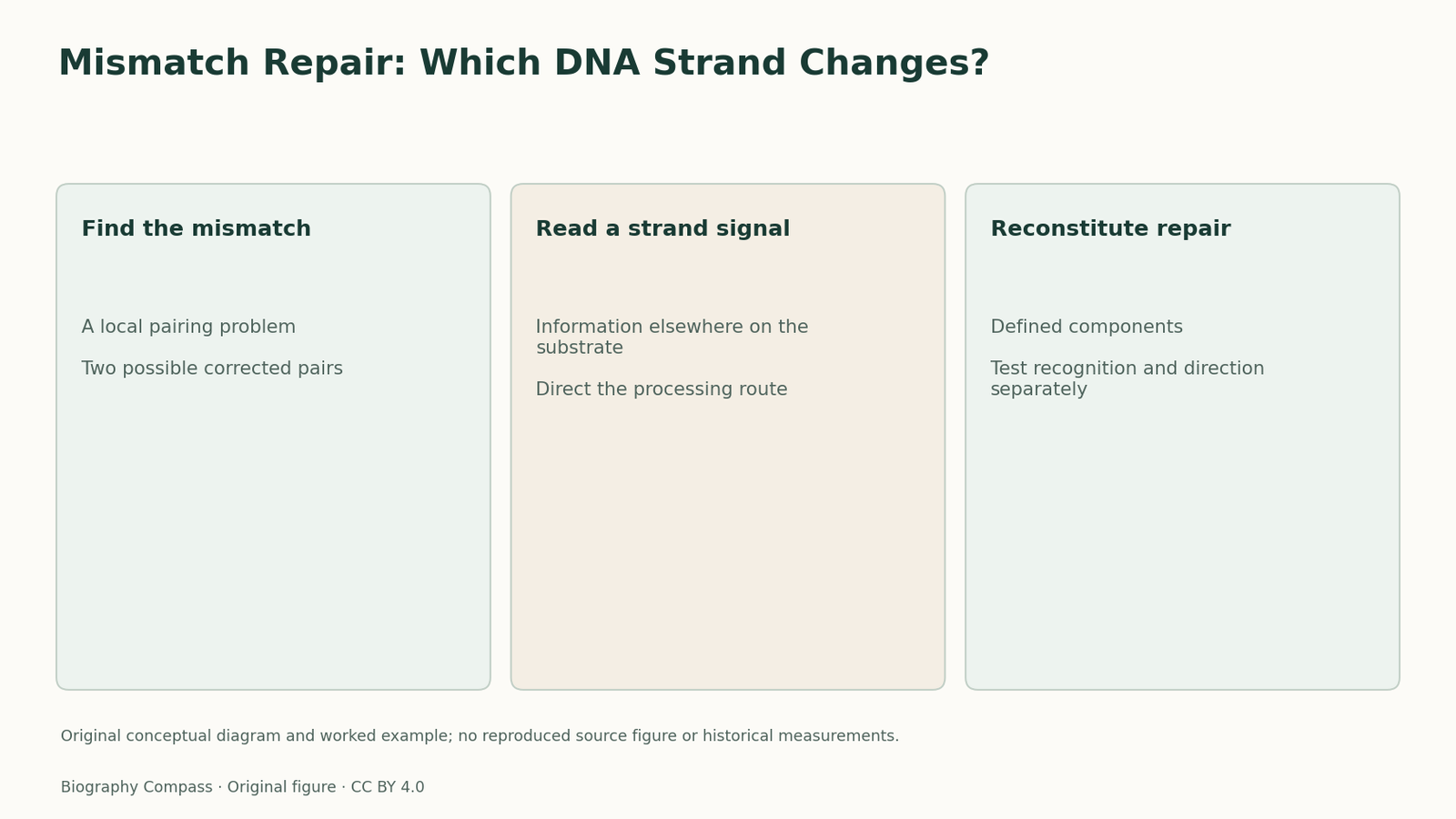
A pair of DNA bases can be incompatible without revealing which member carries the newly introduced error. Repair therefore has two related tasks: recognise the mismatch and choose an appropriate strand for processing. The 1989 defined-system paper makes strand specificity explicit. A final correctly paired molecule is only the endpoint; the mechanistic question is how the reaction gets there while preserving the intended genetic information.
Sources for this section: [1]
A distant mark supplied directional information
The E. coli reaction was reconstituted with purified proteins, including MutH, MutL and MutS alongside other required components. Methylation at a GATC sequence directed the reaction even when that site was separated from the mismatch. The result therefore connected two kinds of molecular information: the local pairing error and a strand signal elsewhere on the DNA. It is more specific than saying that damaged DNA attracts a repair protein. Coordination across the substrate was part of the problem being solved.
Sources for this section: [1]
A defined system makes separate questions accessible
Modrich’s broader accounts distinguish mismatch recognition and processing from the specific way a bacterial system directs repair. His lecture also places bacterial and human mechanisms side by side. The lesson is not that every organism uses an identical methylation signal, but that repair direction must be explained in the appropriate system. Reconstituting a reaction allows experiments to change particular components and test their contribution. That is a different kind of evidence from simply observing that a cell population contains fewer mutations.
An original strand-choice exercise
Imagine a fictional duplex with a G on one strand opposite a T on the other. Merely replacing either member can create a conventionally paired result: G–C or A–T. Which outcome preserves the original information? The mismatch alone cannot answer that question. Add a separate record identifying which strand was newly copied, and the interpretation changes: a repair process can use that information to target the appropriate side. Now remove one component from a defined reaction and find that recognition remains but correction loses its direction. That would distinguish detecting an error from choosing its processing route. These are original reasoning examples, not measurements from the 1989 paper. Their supported answer is to identify the informational task of each stage before treating a corrected endpoint as a complete explanation.
Continue the chronology
Related history guides
Uracil in DNA: Damage Recognition and Repair
Read Lindahl’s 1974 uracil-DNA glycosylase result beside later repair diagrams, using a worked exercise that separates base removal from complete DNA repair.
Read the timeline1982–1983UvrABC Repair: Two Cuts Around DNA Damage
Compare the 1983 UvrABC result with the earlier repair model, using an original exercise on recognition, two incisions and the separate completion of repair.
Read the timelineBiography context
Explore United States through connected lives
Connected biographies
Researchers and related approaches
1946–
Paul Modrich
Biochemist and DNA-repair researcherPaul Modrich traced DNA-repair mechanisms through purified biochemical systems, connecting recognition of a mismatch with the choice of strand to replace.Read biography1947–
Roger Kornberg
Structural biologist and transcription researcherRoger Kornberg moved from chemical physics into chromatin and transcription research, combining biochemical systems with structural work at Stanford.Read biographyQuick answers
Common questions
- Can both replacement choices produce paired DNA?
- Yes. That is why pairing compatibility alone does not identify which original sequence should be preserved.
- Should bacterial methylation rules be assumed for every organism?
- No. The direction signal and machinery must be specified for the system being discussed.
Primary and institutional sources
How this history was checked
The references below distinguish the original study from later explanations. The worked exercise and comparison are newly written for this article. This article was reviewed on 8 November 2026.
- Lahue, Au and Modrich / Science, 1989DNA mismatch correction in a defined system
- Paul Modrich / Journal of Biological Chemistry, 1989Methyl-directed DNA mismatch correction
- Nobel Prize OutreachPaul Modrich — Nobel lecture
- Nobel Prize OutreachPaul Modrich — Facts
- Nobel Prize OutreachPaul Modrich — Biographical