
The short answer
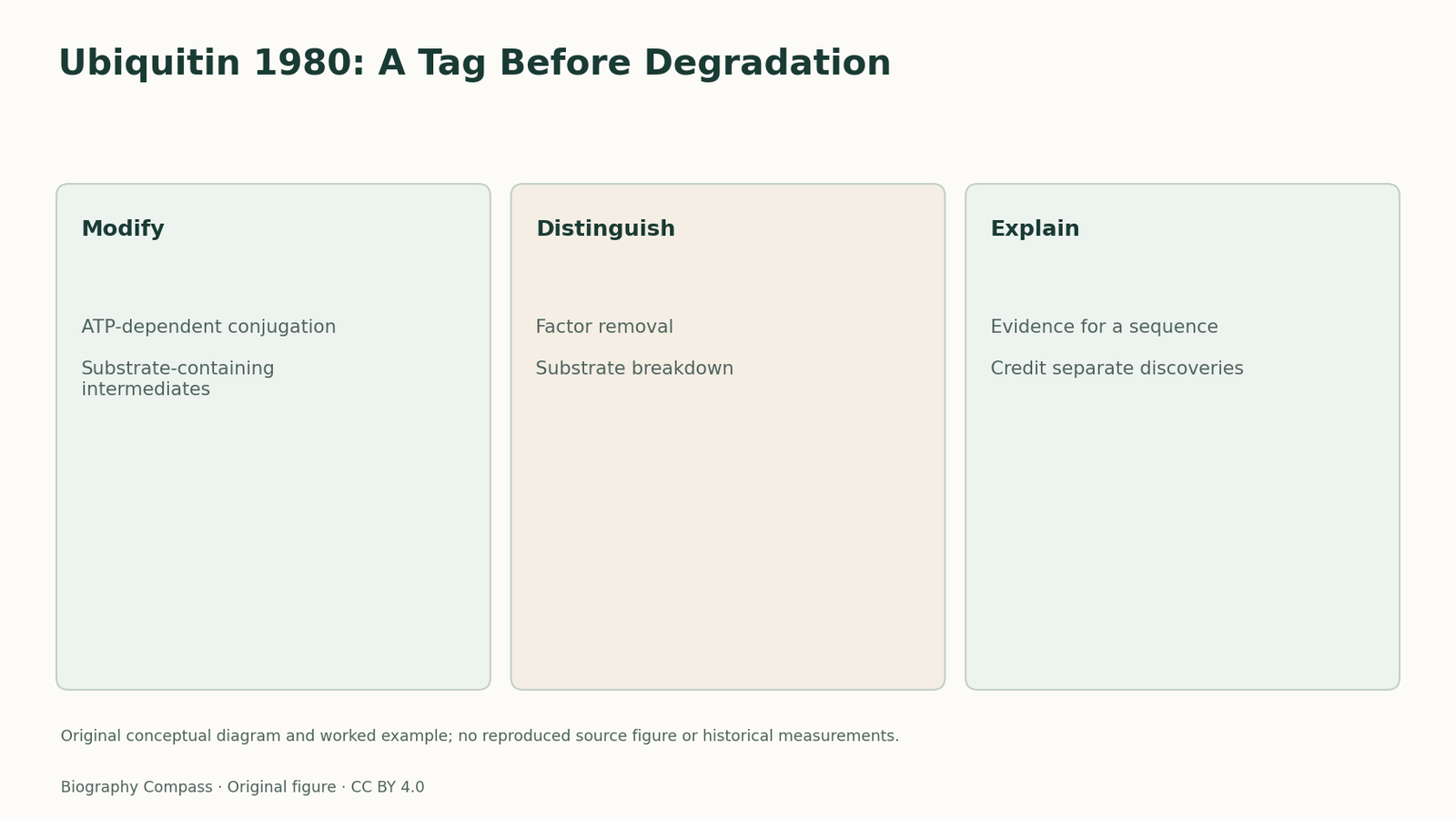
How did ATP-dependent conjugation distinguish substrate tagging from the subsequent act of protein breakdown?
Read the evidence
Different records within the same investigation
The following comparison distinguishes the specific questions answered by the inspected records.
| Record or test | What it establishes | What remains different |
|---|---|---|
| Conjugation | Links a factor with a substrate protein. | Is not already complete substrate breakdown. |
| Factor removal | Can regenerate the free factor. | Must be distinguished from destruction. |
| Degradation | Measures loss of the substrate through breakdown. | Requires an endpoint beyond a tagged intermediate. |
The question was why protein breakdown required energy
Protein degradation breaks material down, yet the reticulocyte system required ATP. The 1980 paper investigated the role of a small factor then called APF-1. It reported ATP-requiring covalent conjugates with substrate proteins and proposed a sequence connecting those conjugates with breakdown. The concrete question is where energy-dependent tagging fits within the overall process. A demand for ATP does not automatically reveal which step uses it or make every reaction in the system the same event.
Sources for this section: [1]
Conjugates supplied evidence for a prior modification
The primary abstract describes multiple linked forms containing different amounts of the factor per substrate molecule. This supported an interpretation in which a substrate could become modified before subsequent disposal. It is different from merely finding the factor near a protein in a mixture. The chemical linkage and distribution among forms constrained a model. Nevertheless, observing a tagged species is not identical to observing that the entire substrate has already been degraded; intermediate and endpoint need different measurements.
Sources for this section: [1]
Tag removal and substrate destruction were distinct possibilities
The paper also described regeneration of the factor after ATP removal and proposed competing routes involving removal or proteolysis. Its interpretation should retain the authors’ proposed sequence rather than treating a tagged band as an automatic guarantee of irreversible destruction. Rose’s lecture places these results within the collaborative search for the pathway and the identification of APF-1 as ubiquitin. The historical terminology can be explained without retroactively giving the early study every later detail of proteasome regulation.
The preparation depended on contributions made before and during collaboration
Rose explicitly credited Hershko and Ciechanover’s recognition of the heat-stable factor before their Fox Chase work. He also identified Wilkinson, Haas and Urban in the molecular-identity connection. This is a useful evidence-and-credit comparison: detecting a required activity, identifying the material and assigning a step within a pathway are related but distinguishable achievements. The Nobel award joins the major contributions, while the first-person account and original authorship preserve a more detailed team. No purification procedure or source gel is reproduced in this guide.
An original intermediate exercise and answer
Imagine a fictional substrate P that appears in linked forms P–T and P–T–T before a later loss of intact P. A student claims that seeing P–T means degradation is already complete. What is wrong? The linked form still represents a substrate-containing intermediate in the description; an added tag and a destroyed substrate are different measured states. These invented symbols are not a historical molecular structure. They also do not establish that a single tag is sufficient for every disposal pathway. A better answer asks whether tagged material proceeds to breakdown, can lose the tag or enters another fate under the tested conditions. It separates the order suggested by the model from the observations needed to establish each transition and its energy requirements.
Continue the chronology
Related history guides
Cyclin 1983: Accumulation and Destruction
Examine the original cyclin paper through labelled protein patterns, periodic disappearance and developmental timing, with an original exercise on synthesis and turnover.
Read the timeline1951–1974Lysosomes 1955: Why Enzyme Activity Was Hidden
Examine de Duve’s lysosome inference through latent activity, distribution patterns and later structural evidence, with an original accessibility-versus-absence exercise.
Read the timelineBiography context
Explore United States through connected lives
Connected biographies
Researchers and related approaches
1926–2015
Irwin Rose
Biochemist and enzyme-mechanism researcherIrwin Rose investigated enzyme mechanisms and ATP-dependent protein breakdown, collaborating in the work that connected ubiquitin conjugation with degradation.Read biography1918–2007
Arthur Kornberg
Biochemist and DNA-replication researcherKornberg's group isolated DNA polymerase from bacteria in 1956.Read biographyQuick answers
Common questions
- Does a tagged band prove complete degradation?
- No. It can represent an intermediate.
- Was the 1980 model already every later proteasome detail?
- No. It was an experimentally supported proposal developed by further work.
Primary and institutional sources
How this history was checked
The references below distinguish the original study from later explanations. The worked exercise and comparison are newly written for this article. This article was reviewed on 8 November 2026.
- Hershko, Ciechanover, Heller, Haas and Rose, PNAS, 1980Proposed role of ATP in protein breakdown: conjugation of protein with multiple chains of the polypeptide of ATP-dependent proteolysis
- Janet Wilson, UC Irvine News, 2 June 2015Nobel laureate Irwin Rose dead at 88
- Nobel Prize OutreachIrwin Rose — Nobel lecture
- Nobel Prize OutreachIrwin Rose — Facts
- Nobel Prize OutreachIrwin Rose — Biographical