
The short answer
How did enzyme latency and membrane disruption support a particle-bound hydrolase compartment rather than an absent enzyme?
Read the evidence
Different records within the same investigation
The following comparison distinguishes the specific questions answered by the inspected records.
| Record or test | What it establishes | What remains different |
|---|---|---|
| Low measured activity | Describes an assay outcome under specified conditions. | Does not automatically mean enzyme absence. |
| Latent activity | Becomes detectable after an appropriate change. | Requires checking what the change affects. |
| Compartment identity | Combines distribution and structural evidence. | Is stronger than one restoration observation. |
A weak assay result had more than one explanation
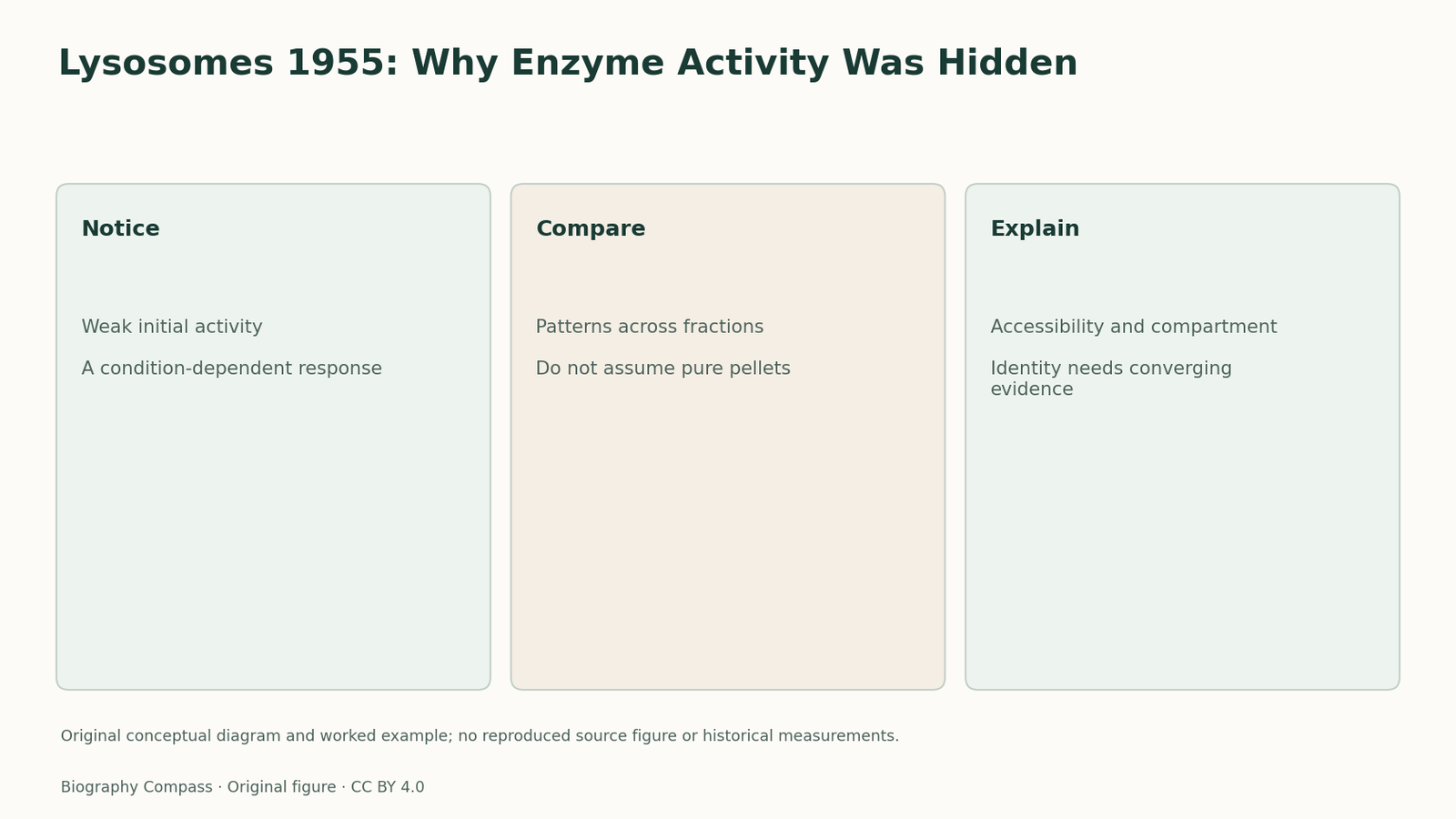
De Duve’s programme encountered acid-phosphatase activity that was much more apparent after further treatment of the preparation. His biography describes this latency as an unexpected finding during work initially directed toward insulin and liver metabolism. The concrete question was why material could contain an enzyme while initially giving a weak activity signal. Absence, irreversible damage and restricted access are different explanations. Treating the first measurement as a complete inventory would have hidden the possibility that cellular organisation affected what the assay detected.
Distribution patterns challenged familiar fraction labels
The 1955 paper compared intracellular enzyme distributions. De Duve’s retrospective specifically criticised the assumptions that crude fractions were pure and that the cytoplasm contained only the already familiar particle classes. Similar distribution patterns could help identify a group of activities behaving together, while differences could challenge an overly simple mitochondrial assignment. The inference relied on patterns across a separation, not merely finding one positive pellet and giving it the name of a known organelle.
Latency connected a biochemical property with a boundary
Rockefeller’s institutional history describes initially low acid-phosphatase activity in fresh homogenates and much greater detectable activity after further processing. A compartmental explanation made that change meaningful: the preparation’s organisation could limit access to enzyme activity until a boundary was disturbed. This supported a new way to interpret biochemical observations, but a positive disruption response alone would not determine every structural feature. The enzymatic inference and subsequent microscopy supplied different, complementary kinds of evidence about the proposed compartment.
Sources for this section: [3]
A biochemical discovery did not require an initial perfect image
De Duve’s first-person account emphasises the decision to propose a new particle on biochemical grounds. The Nobel facts later identifies lysosomes as a cellular discovery, while the biography records the programme’s movement between Louvain and Rockefeller. Chronology matters: later structural confirmation should not be described as an image that already existed at the moment of the original biochemical clue. Equally, the early inference should retain its specific enzyme and preparation context rather than becoming a rule that every hidden assay signal proves a lysosome.
An original accessibility exercise and answer
Imagine a fictional preparation with little measured activity in condition A and substantially more in condition B after a treatment that preserves the enzyme’s catalytic capability. A student concludes that B manufactured new enzyme during the measurement. Is that the only explanation? No. The treatment may have changed accessibility to enzyme already present. These are conceptual conditions, not a tissue-disruption procedure or historical measurement. A careful answer asks what the treatment affects, whether the assay itself remains comparable and whether enzyme preservation was checked. It also distinguishes evidence for restricted accessibility from a complete organelle identity. To name a particular compartment, additional distribution and structural comparisons would still be needed. The exercise turns an initially negative reading into a question about measurement conditions.
Continue the chronology
Related history guides
Cell Fractionation: A Pellet Is Not Purity
Examine Claude’s liver-cell fractionation studies through operational separation, biochemical activity and microscopy, with an original enrichment-versus-purity exercise.
Read the timeline1964–1974Secretory Traffic: Following a Label in Time
Follow Jamieson and Palade’s pancreatic studies through labelled cohorts, compartments and timing, with an exercise distinguishing a pathway from a live film.
Read the timelineBiography context
Explore Louvain, Belgium through connected lives
Connected biographies
Researchers and related approaches
1917–2013
Christian de Duve
Biochemist and cell-compartment researcherChristian de Duve used biochemical evidence to investigate cellular compartments, identifying lysosomes through enzyme distribution and latent activity.Read biography1918–2007
Arthur Kornberg
Biochemist and DNA-replication researcherKornberg's group isolated DNA polymerase from bacteria in 1956.Read biographyQuick answers
Common questions
- Does a negative assay establish absence?
- No. Accessibility and measurement conditions can matter.
- Was lysosome identification based on one perfectly pure pellet?
- No. Distribution patterns and later structural evidence were important.
Primary and institutional sources
How this history was checked
The references below distinguish the original study from later explanations. The worked exercise and comparison are newly written for this article. This article was reviewed on 8 November 2026.
- de Duve, Pressman, Gianetto, Wattiaux and Appelmans, Biochemical Journal, 1955Tissue fractionation studies. 6. Intracellular distribution patterns of enzymes in rat-liver tissue
- Christian de Duve, first-person retrospective, 1977Citation Classic: Tissue fractionation studies. 6
- The Rockefeller University Hospital CentennialExploring Cells with a Centrifuge
- Nobel Prize OutreachChristian de Duve — Facts
- Nobel Prize OutreachChristian de Duve — Biographical