
The short answer
What did repeated protein disappearance during embryonic divisions establish about cyclin regulation beyond a steady synthesis measurement?
Read the evidence
Different records within the same investigation
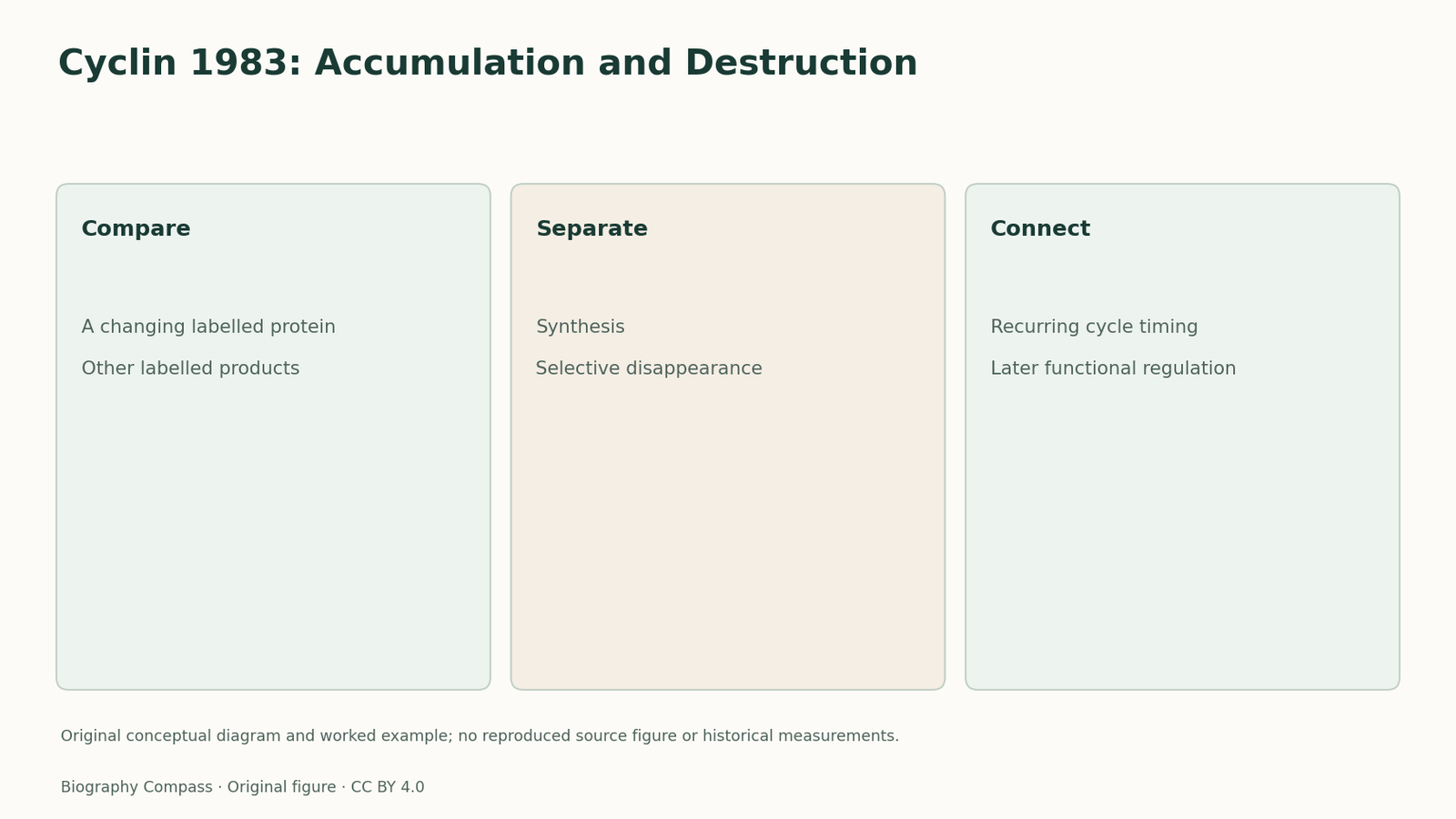
The following comparison distinguishes the specific questions answered by the inspected records.
| Record or test | What it establishes | What remains different |
|---|---|---|
| Synthesis | Adds protein or new label to a pool. | Is not identical to total abundance. |
| Selective disappearance | Requires a product-specific explanation. | Needs checks on recovery and detection. |
| Periodic relation | Connects a pattern with cycle timing. | Does not alone prove the full causal mechanism. |
The unexpected result concerned a particular protein
The 1983 cyclin report examined proteins made after fertilisation in marine eggs and embryos. Its abstract describes a product destroyed when cells divided, alongside other abundant proteins produced from stored maternal messages. The concrete question is why a disappearing protein required an explanation beyond a general change in synthesis. The comparison among products mattered: one signal declined while others persisted or increased. A specific pattern can point toward regulated turnover in a way that a single total-protein measurement cannot.
Sources for this section: [1]
A time series supplied more than one before-and-after image
Hunt’s autobiographical account places the first striking observation in July 1982 and describes following the changing band through division. The subsequent publication gave the discovery a documented record in 1983. Keeping those dates distinct avoids treating recollection and publication as the same event. A recurring relation between the signal and cell-cycle stages also differs from one unexplained loss in a damaged sample. The pattern motivated a biological interpretation because its timing could be compared with the ongoing developmental process.
Production and disappearance contribute differently to abundance
The primary paper distinguishes synthesis after fertilisation from destruction at particular cycle points. A protein’s measured amount or label depends on more than whether translation has begun. A product can continue to be made while removal changes its abundance. This is a conceptual distinction, not a claim that one original experiment determined every synthesis and degradation rate separately. The measured pattern constrained possible explanations and suggested a regulated component, while further functional work was needed to connect that component with the machinery controlling division.
The collaboration linked marine biology with cell-cycle regulation
The MBL history identifies marine species, teaching and research interactions as part of the discovery setting. The original paper credits Evans, Rosenthal, Youngblom, Distel and Hunt. The later Nobel award connected the biochemical contribution with Hartwell’s and Nurse’s genetic programmes. These links make the history more informative than a solitary eureka story. They also clarify scope: observing periodic destruction, naming cyclins and establishing their detailed regulatory relationships were connected achievements that accumulated across studies. No original gel image or numerical trace is reproduced here.
An original turnover exercise and answer
Imagine a fictional labelled protein whose signal rises, falls sharply near a recurring event and then rises again, while two comparison proteins continue accumulating. Does a complete shutdown of all protein production explain that selective drop by itself? No. The comparison makes a product-specific removal process a relevant hypothesis. These invented signals are not historical gel measurements. They do not alone distinguish degradation from every alternative such as recovery or detection changes, so interpretation needs appropriate checks. A useful answer separates total abundance, newly incorporated label and synthesis rate. It also resists concluding that periodicity by itself proves the protein causes the event: timed association motivates functional tests but is not identical to a complete control mechanism.
Continue the chronology
Related history guides
Cell-Cycle Mutants: Arrest or Heat Damage?
Examine Hartwell’s conditional-mutant logic and 1974 event-dependency model, with an original exercise distinguishing a specific arrest pattern from general failure.
Read the timeline1977–2004Ubiquitin 1980: A Tag Before Degradation
Examine the 1980 protein-conjugation model through ATP use, linked forms and later breakdown, with an original exercise distinguishing a tag from a completed outcome.
Read the timelineBiography context
Explore Woods Hole, Massachusetts, United States through connected lives
Connected biographies
Researchers and related approaches
1943–
Tim Hunt
Biochemist and cell-cycle researcherTim Hunt investigated protein synthesis and discovered cyclins through their periodic destruction, connecting biochemical observations with the control of cell division.Read biography
born 1949
Paul Nurse
Cell-cycle geneticistNurse used fission yeast to study how cells decide when to divide.Read biographyQuick answers
Common questions
- Does a fall in one protein mean all synthesis stopped?
- No. The comparison with other proteins is important.
- Does periodic destruction alone establish every regulatory role?
- No. Functional relationships require further evidence.
Primary and institutional sources
How this history was checked
The references below distinguish the original study from later explanations. The worked exercise and comparison are newly written for this article. This article was reviewed on 8 November 2026.
- Evans, Rosenthal, Youngblom, Distel and Hunt, Cell, 1983Cyclin: A protein specified by maternal mRNA in sea urchin eggs that is destroyed at each cleavage division
- Alexis Abboud, Marine Biological Laboratory History Project, 2015Cyclins at the MBL
- Nobel Prize OutreachTim Hunt — Facts
- Nobel Prize OutreachTim Hunt — Biographical