
The short answer
How did Ricardo’s engine work connect fuel comparison, testing and industrial application?
Read the records together
Evidence, functions and interpretation
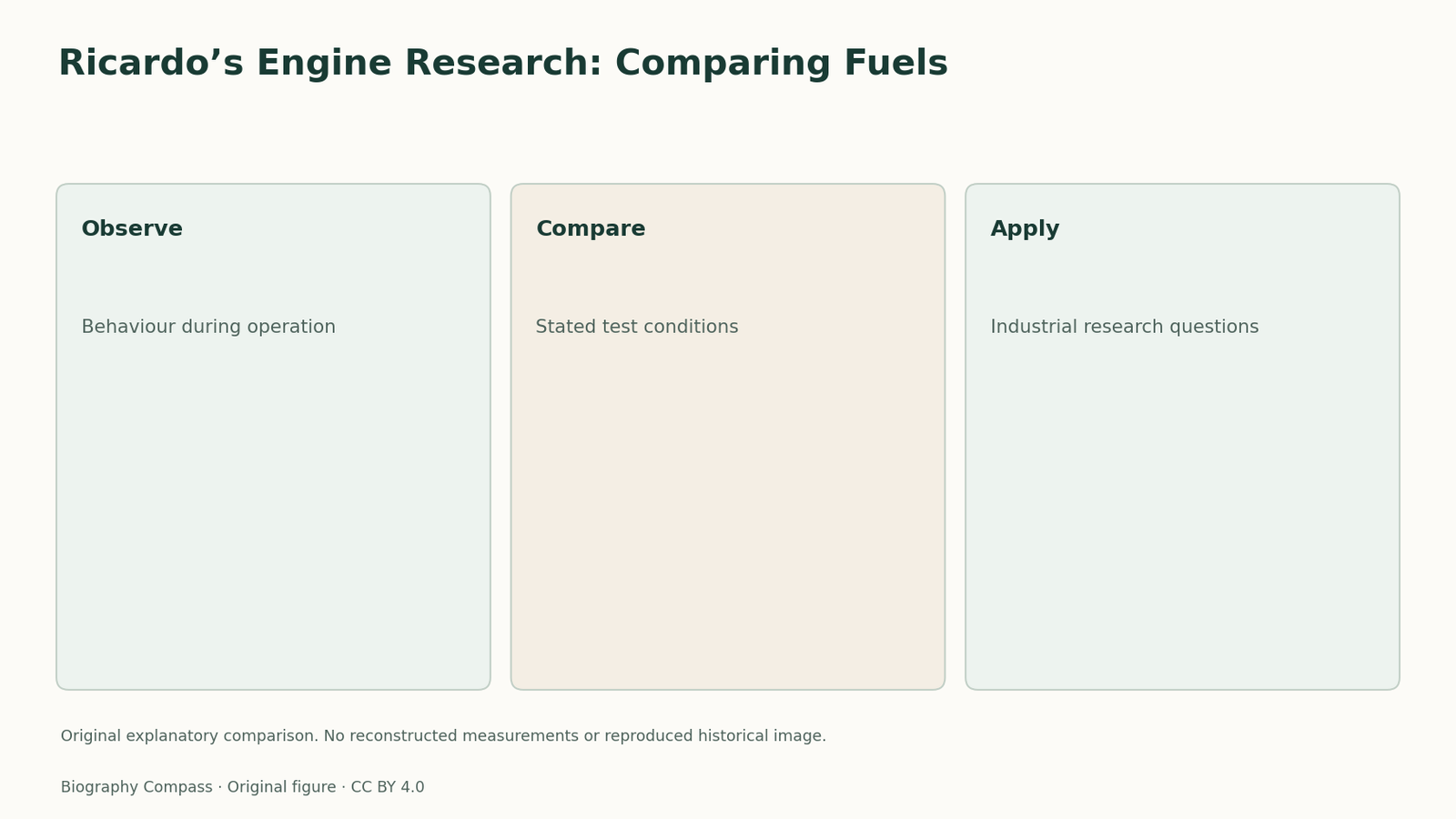
Compare the particular records and mechanisms discussed in this study.
| Record or mechanism | What it establishes | The distinct question |
|---|---|---|
| Cambridge history | Connects observation with an operating engine. | A historical explanation is not a complete modern diagnostic protocol. |
| SAE retrospective abstract | Names the E35 and several stages of Ricardo’s work. | The full paper and its data were not inspected. |
| Industrial and lecture accounts | Connect client research with comparing knock tendency. | No individual experiment is converted into every later fuel standard. |
Start with behaviour, not a single performance number
Early engine development involved reliability, fuel consumption, power and combustion abnormalities. Cambridge’s history describes Ricardo and Hopkinson using an optical indicator to observe processes during operation. Such observation helped turn a driver’s report that an engine ran badly into a question that could be investigated. Different symptoms still call for different explanations. Pre-ignition and knock are not interchangeable labels, and the historical account should not be treated as a complete modern diagnostic manual. The relevant contribution was making the engine a repeatable object of examination.
Sources for this section: [2]
A fuel comparison needed an adjustable test setting
The 1935 lecture notice identifies evaluating knock tendency with a variable-compression engine. Ricardo’s later SAE abstract names the E35 among his company’s developments. Adjustability mattered because fuels could be compared through their behaviour under controlled changes, rather than simply by asking which vehicle happened to travel farther on a particular journey. The sources establish the testing principle and named equipment, not a fresh table of experimental readings. A rating method requires specified conditions; without those, a number detached from its test setting has little comparative meaning.
The industrial contract gave the experiments a purpose
The archives initiative describes the Asiatic Petroleum contract and the establishment of a Shoreham laboratory. IMechE’s account connects that early business with commercial-fuel analysis and later standard rating. These were related but distinct stages: a client supported investigation, a laboratory provided the setting, and comparison methods made the results useful beyond one trial. The connection helps explain why Ricardo built a consulting organisation. A company producing fuel needed a way to describe and compare it, while engine manufacturers needed information about the behaviour of fuels they would encounter.
The retrospective record has a defined scope
Ricardo’s SAE abstract ranges from university experiments and the Dolphin to government work and later company developments. It confirms that he himself presented these as connected parts of an engineering career. It does not provide the full experimental protocol or all results. Read alongside the institutional histories, it supports a specific account of the relationship between observation, adjustable equipment and industrial use. The actual contribution need not be enlarged into a claim that one person alone devised every later fuel standard or that a familiar commercial rating was already complete at the start.
An original comparison exercise
Imagine that two fuels are tried in the same adjustable test engine. Record the fuel identity, the chosen setting and the observed behaviour separately. If both the fuel and the setting change between trials, can the resulting difference be assigned to the fuel alone? The checked answer is no: the comparison changed more than one condition. A second question asks whether a useful ranking in one stated test proves identical performance in every road vehicle. Again no; the claim must retain its test conditions. This original example explains why controlled comparison mattered, without inventing Ricardo’s measurements or prescribing an operating procedure.
Continue the chronology
Related history guides
Lanchester’s Notebook: Tests, Tools and Production
Explore the named subjects in Lanchester’s 1899–1901 managerial notebook, connecting test runs, material specifications, gauges and manufacturing tools.
Read the timeline1931–1935Bentley in 1931: A Company Sold, a Designer Continued
Examine Bentley’s 1931 receivership and sale to Rolls-Royce, distinguishing the company, production location, surviving brand and W. O. Bentley’s later work.
Read the timelineBiography context
Explore United Kingdom through connected lives
Harry Ricardo
Harry Ricardo was an engine designer and consulting engineer, known for developing practical engine research, fuel-comparison methods and a consulting business serving manufacturers.
Explore the biographiesWider contextHenry Royce
Read Henry Royce’s electrical and mechanical engineer, manufacturer and rolls-royce co-founder career as a separate contextual comparison.
Explore the biographiesConnected biographies
People and wider context
1885–1974
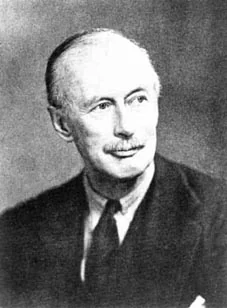
Harry Ricardo
Engine designer and consulting engineerHarry Ricardo was an engine designer and consulting engineer, known for developing practical engine research, fuel-comparison methods and a consulting business serving manufacturers.Read biography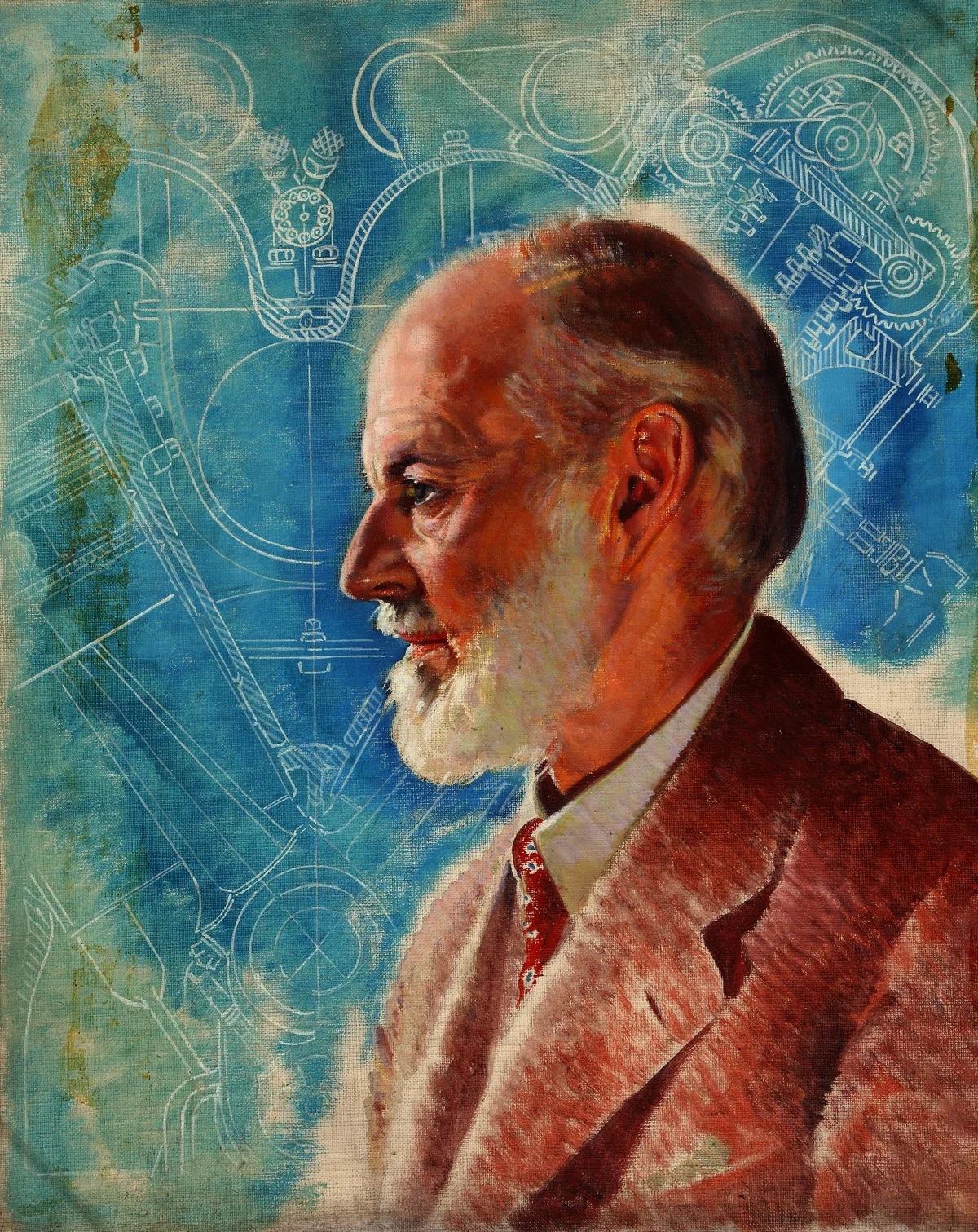
1863–1933
Henry Royce
Electrical and mechanical engineer, manufacturer and Rolls-Royce co-founderHenry Royce built an electrical-engineering business before making his first cars. His 1904 partnership with Charles Rolls joined manufacturing with a sales network. He led an exacting design practice whose later work included the 40/50-horsepower car and aero engines.Read biography1823–1883
William Siemens
Engineer, metallurgist and industrial entrepreneurWilliam Siemens is remembered for developing regenerative heating and steelmaking through family partnerships and industrial experiments.Read biographyQuick answers
Common questions
- Was Ricardo only a vehicle manufacturer?
- No. His later business combined engine design, experimental research and consulting services for outside manufacturers.
- Why use a variable-compression engine to compare fuels?
- It supplied an adjustable test setting in which behaviour could be compared under stated conditions rather than through uncontrolled journeys.
Primary and institutional sources
How this history was checked
Primary records, institutional catalogues and historical interpretation answer different questions. The comparison and worked example are original editorial analysis. This article was reviewed on 8 November 2026.
- Institution of Mechanical EngineersSir Harry Ralph Ricardo, 1944 president
- University of Cambridge Department of EngineeringHarry Ricardo
- Aviation and Aerospace Archives InitiativeRicardo, Sir Harry Ralph
- Harry Ricardo / SAE InternationalSome Early Reminiscences, paper 550282
- Nature, 1935 lecture noticeThe Internal Combustion Engine and its Fuel