
The short answer
What happened in Bentley’s 1931 sale, and how did ownership change differ from the founder’s continuing work?
Read the records together
Evidence, functions and interpretation
Compare the particular records and mechanisms discussed in this study.
| Record or mechanism | What it establishes | The distinct question |
|---|---|---|
| Museum corporate history | Records 1931 receivership, acquisition and Derby production. | Sporting results and business survival describe different outcomes. |
| Bonhams feature | Reports the named bidding vehicle and acquisition figure. | The underlying sealed-bid papers were not inspected. |
| Designer’s career record | Places Rolls-Royce employment before Lagonda in 1935. | A transferred brand is not an employment record for its founder. |
Receivership followed a difficult luxury-car market
The Science Museum Group places Bentley’s 1931 receivership within the contraction in demand for expensive cars during the Great Depression. Its cars had recently won repeatedly at Le Mans, yet the company could not simply convert sporting reputation into the funds needed to continue. The historical sequence is therefore more informative than a story in which winning meant permanent commercial security. A race result concerned a vehicle and team on a particular occasion; receivership concerned the continuing business and its obligations. Both can be true without one cancelling the other.
The sale introduced a new owner
Ed Wiseman’s Bonhams centenary account describes a sealed bid made in the name of British Central Equitable Trust for Rolls-Royce. It reports a figure of 125,275 pounds. This adds a concrete business mechanism to the museum’s shorter statement that Rolls-Royce acquired Bentley. The account is a later exhibition feature, not a transcript of the original proceedings. Its useful contribution here is identifying the acquisition vehicle and bidding arrangement. It need not be expanded into an uninspected explanation of every bidder’s private strategy or a claim that only one commercial motive existed.
The company and its products could continue differently
The museum records the creation of Bentley Motors (1931) Limited and the move of production to Derby. The company’s location and ownership changed, while the name continued on vehicles. Such continuity was selective. It did not mean that every earlier chassis, workshop method or management arrangement remained in place. Conversely, a changed owner did not make all later Bentleys anonymous objects without a history. The surviving brand and the new production setting must be placed on the same timeline rather than choosing either complete disappearance or complete continuity as the only possible account.
The founder’s employment was another question
The archives initiative records Bentley continuing at Rolls-Royce until 1935 and then moving to Lagonda. The transition shows why ownership and a person’s technical work require separate dates. A buyer could acquire the company while the founder’s future responsibilities were determined through a different working relationship. At Lagonda, his role became technical director; later moves extended the career again. This is substantive continuity of expertise across firms, rather than an assumption that a surname on a car always identified its current designer or that a company sale meant immediate retirement.
Sources for this section: [2]
An original continuity test
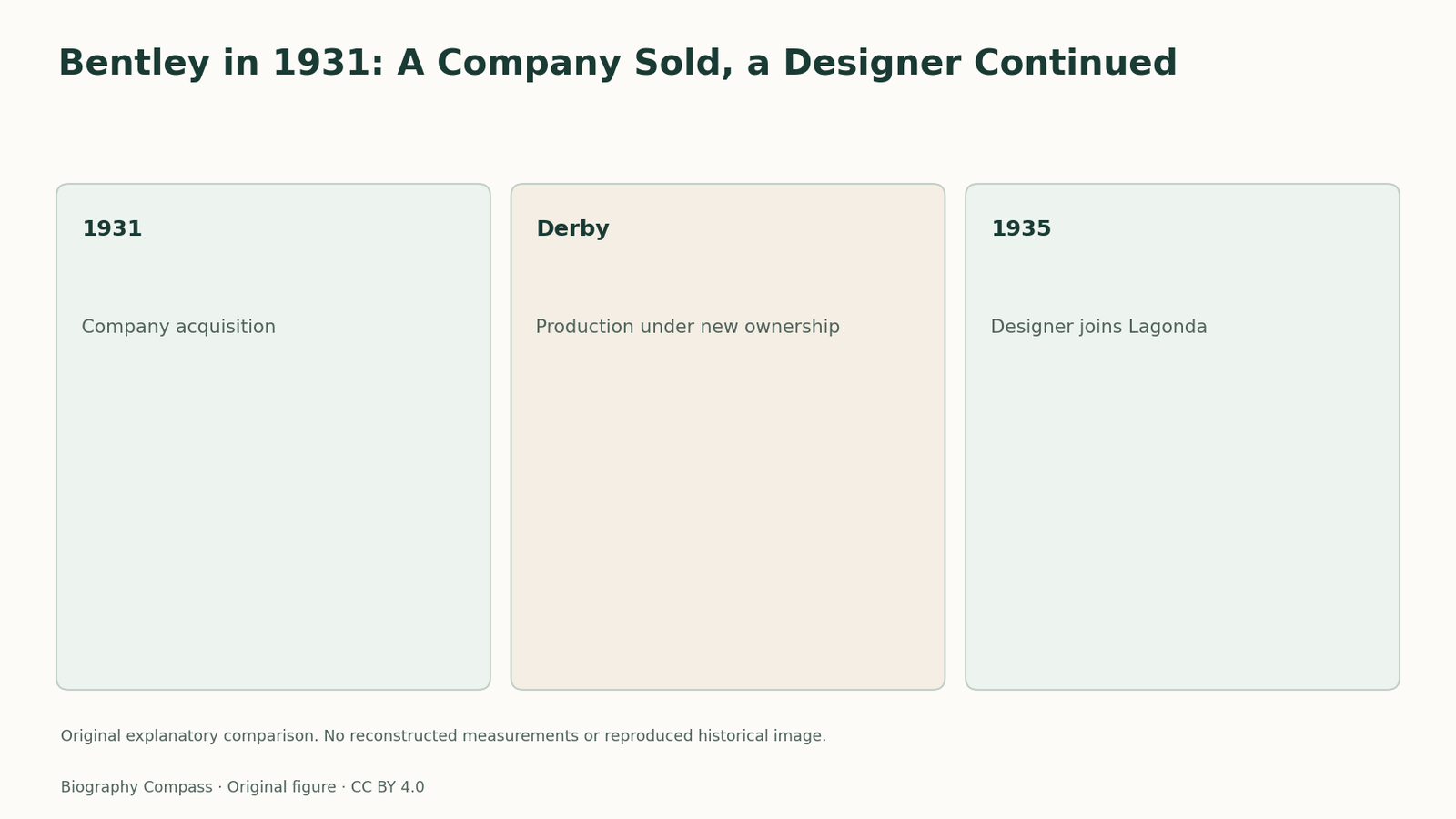
Create three dated lines: ownership of the business, location of production and the designer’s employment. Place the 1931 sale on the first, Derby on the second and the 1935 Lagonda appointment on the third. Now test two statements: the 1931 sale ended Bentley cars, and it immediately ended W. O.’s engineering career. The cited records reject both. A better answer specifies what changed and what continued on each line. This original comparison explains a business transition without inventing a balance sheet, a court finding or a psychological account of the participants.
Continue the chronology
Related history guides
Ricardo’s Engine Research: Comparing Fuels
Understand how Ricardo’s work connected observed engine behaviour, variable-compression testing and commercial fuel comparison without inventing a test dataset.
Read the timeline1906–1907Rolls-Royce in 1907: A Trial and a Public Claim
Compare the 1907 Silver Ghost’s observed road trials with later endurance publicity, separating an individual demonstration car from the wider model name.
Read the timelineBiography context
Explore United Kingdom through connected lives
W. O. Bentley
W. O. Bentley was an automotive and aircraft-engine designer, known for founding Bentley Motors and continuing an engineering career through Rolls-Royce, Lagonda and Armstrong Siddeley.
Explore the biographiesWider contextHenry Royce
Read Henry Royce’s electrical and mechanical engineer, manufacturer and rolls-royce co-founder career as a separate contextual comparison.
Explore the biographiesConnected biographies
People and wider context
1888–1971
W. O. Bentley
Automotive and aircraft-engine designerW. O. Bentley was an automotive and aircraft-engine designer, known for founding Bentley Motors and continuing an engineering career through Rolls-Royce, Lagonda and Armstrong Siddeley.Read biography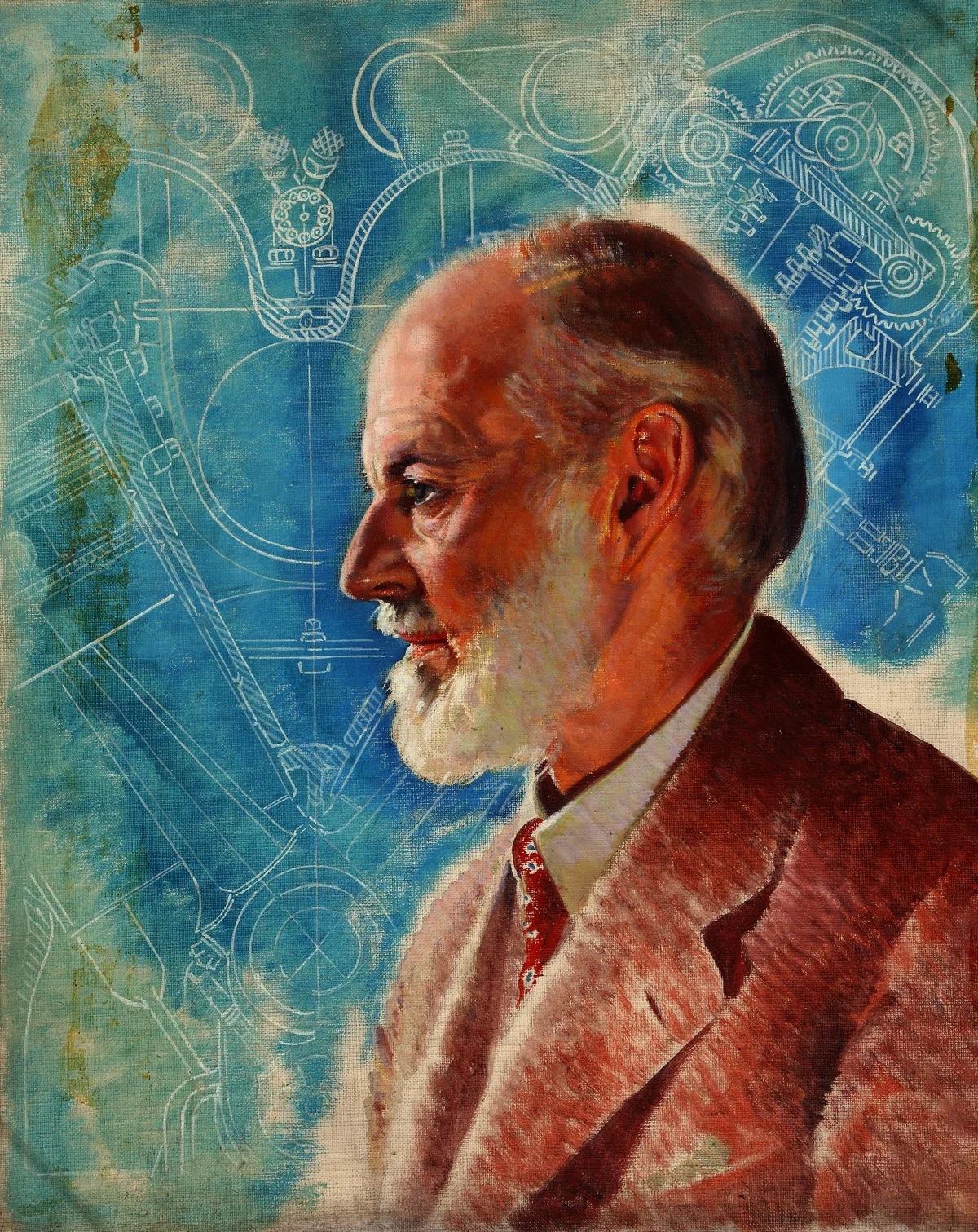
1863–1933
Henry Royce
Electrical and mechanical engineer, manufacturer and Rolls-Royce co-founderHenry Royce built an electrical-engineering business before making his first cars. His 1904 partnership with Charles Rolls joined manufacturing with a sales network. He led an exacting design practice whose later work included the 40/50-horsepower car and aero engines.Read biographyQuick answers
Common questions
- Did Bentley stop engineering after the 1931 sale?
- No. He continued at Rolls-Royce before joining Lagonda in 1935 and later Armstrong Siddeley.
- Did a change in company ownership end the Bentley name?
- No. The museum’s corporate history records continued production under the new owner, including the move to Derby.
Primary and institutional sources
How this history was checked
Primary records, institutional catalogues and historical interpretation answer different questions. The comparison and worked example are original editorial analysis. This article was reviewed on 8 November 2026.
- H. G. Pitt, Oxford Dictionary of National BiographyBentley, Walter Owen: accessible extract
- Aviation and Aerospace Archives InitiativeBentley, Walter Owen
- Science Museum GroupBentley Motors Ltd
- Bentley MotorsThe extraordinary life of W.O. Bentley
- Ed Wiseman, Bonhams MagazineBest of British, Spring 2019 Issue 58