
The short answer
What do the named notebook subjects reveal about connecting road tests with materials, tools and manufacturing control?
Read the records together
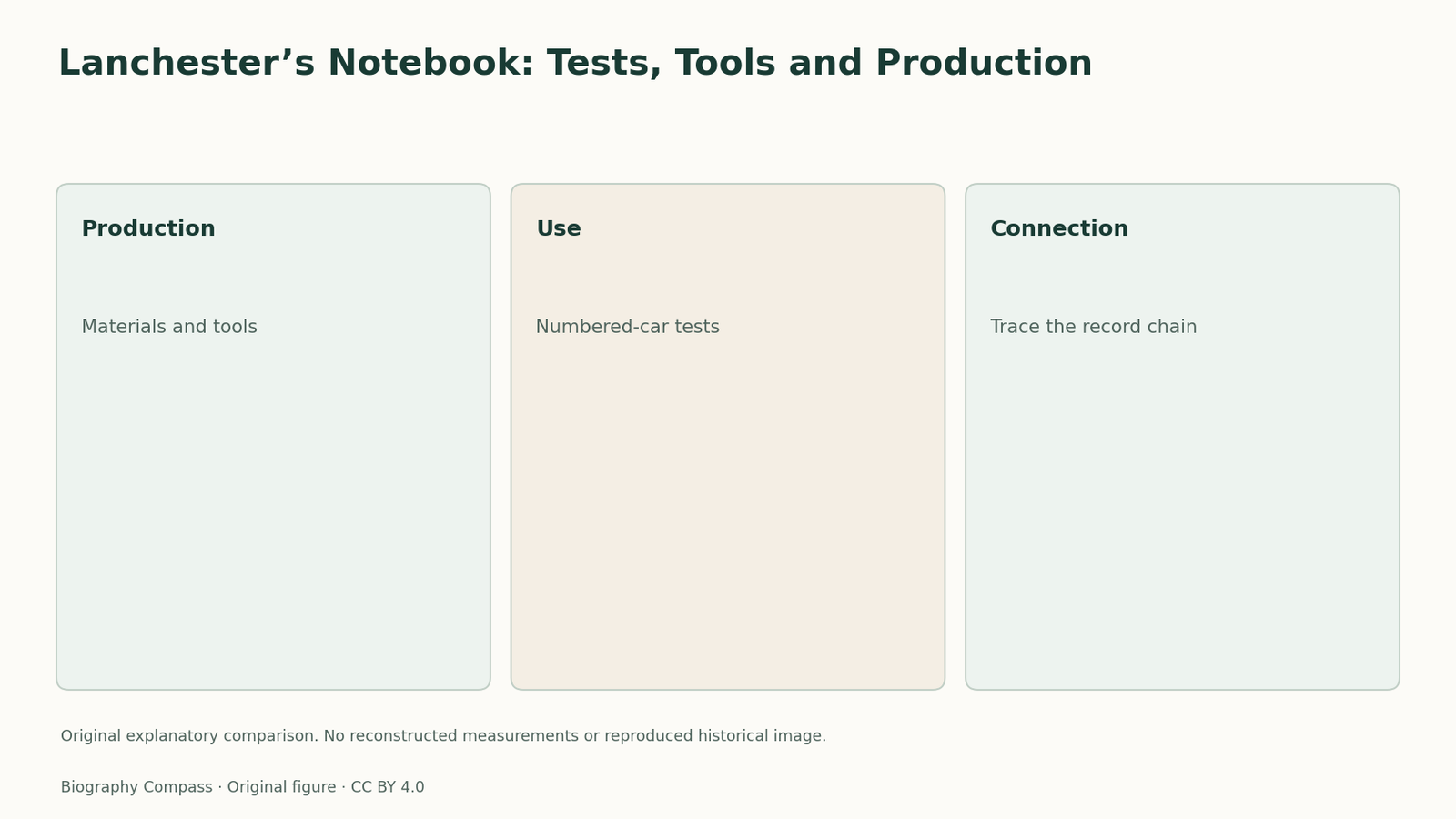
Evidence, functions and interpretation
Compare the particular records and mechanisms discussed in this study.
| Record or mechanism | What it establishes | The distinct question |
|---|---|---|
| Material and tool subjects | Connect a designed part with manufacturing and checking. | They perform a different job from reporting road behaviour. |
| Numbered-car test references | Identify observations associated with particular vehicles. | No uninspected result or diagnosis is supplied. |
| Named notebook hands | Identify Frederick, George and Sidney Pinsent. | Shared recording does not make every entry the work of one author. |
A notebook joined several kinds of engineering work
The catalogue of Lanchester’s 1899–1901 managerial notebook names an unusually broad set of subjects: a speed epicycle gearbox, material specifications, special tools, a surface grinder, a drill jig, oil-metering calculations and road-test logs. These are positive clues to the organisation of an early motor works. The notebook brought together decisions about the intended object, the means of making it and observations from its use. It was consequently more than a collection of finished vehicle drawings. Its range helps explain what had to happen between a design and repeatable production.
Sources for this section: [4]
Tools and gauges addressed the making of parts
A drill jig guides a repeated machining operation; a gauge helps check a specified feature. The catalogue’s references to jigs, gauges and special gear-cutting equipment place that manufacturing work beside the vehicle design. Their functions differ from a road test. An operator needs a controlled way to make and check a component before it can be assembled and tried. This functional explanation does not require inventing a historical tolerance. It identifies why a works would record a tooling arrangement as well as the geometry of the part that tooling helped produce.
Vehicle tests fed a different record stream
The notebook description identifies a log for car number 8 and later references to numbers 7, 8 and 9. The separate acceleration-chart series includes Lanchester, Daimler and railway tests. These records concern behaviour during use, whereas a material specification or jig concerns what should be supplied or how work should be performed. Connecting the streams would help an engineer ask whether an observed result arose from the intended design, a particular component or the conditions of a test. That is an analytical use of the record categories, not a newly recovered diagnosis of any numbered car.
Several hands could contribute to one working document
The catalogue identifies Frederick’s hand as predominant and also names George Herbert Lanchester and Sidney Pinsent, the chief draughtsman. It places the notebook probably at the Armourer Mills works in Birmingham. The qualification belongs to that location, not to a claim that the record has no useful content. Named contributors and dated subjects reveal how practical knowledge could be collected within a business. A drawing, a calculation and a test note might require different expertise while remaining relevant to the same vehicle programme.
Sources for this section: [4]
An original workshop-record exercise
Consider three hypothetical entries: a specified component dimension, a note describing the jig used to make it, and a vehicle test observation after assembly. Which entry establishes the target, which describes a production method and which reports an outcome? The checked answer assigns them in that order. If the outcome changes, the test note alone cannot identify which earlier stage changed. A useful comparison keeps all three records and asks for a traceable connection between them. This exercise uses the notebook’s documented subject categories without supplying imaginary test figures, tolerances or missing manuscript text.
Continue the chronology
Related history guides
Ricardo’s Engine Research: Comparing Fuels
Understand how Ricardo’s work connected observed engine behaviour, variable-compression testing and commercial fuel comparison without inventing a test dataset.
Read the timeline1906–1907Rolls-Royce in 1907: A Trial and a Public Claim
Compare the 1907 Silver Ghost’s observed road trials with later endurance publicity, separating an individual demonstration car from the wider model name.
Read the timelineBiography context
Explore United Kingdom through connected lives
Frederick William Lanchester
Frederick William Lanchester was an automotive engineer and engine designer, known for developing Lanchester vehicles and connecting engine design with testing, manufacturing records and a wider consulting practice.
Explore the biographiesWider contextHenry Royce
Read Henry Royce’s electrical and mechanical engineer, manufacturer and rolls-royce co-founder career as a separate contextual comparison.
Explore the biographiesConnected biographies
People and wider context
1868–1946
Frederick William Lanchester
Automotive engineer and engine designerFrederick William Lanchester was an automotive engineer and engine designer, known for developing Lanchester vehicles and connecting engine design with testing, manufacturing records and a wider consulting practice.Read biography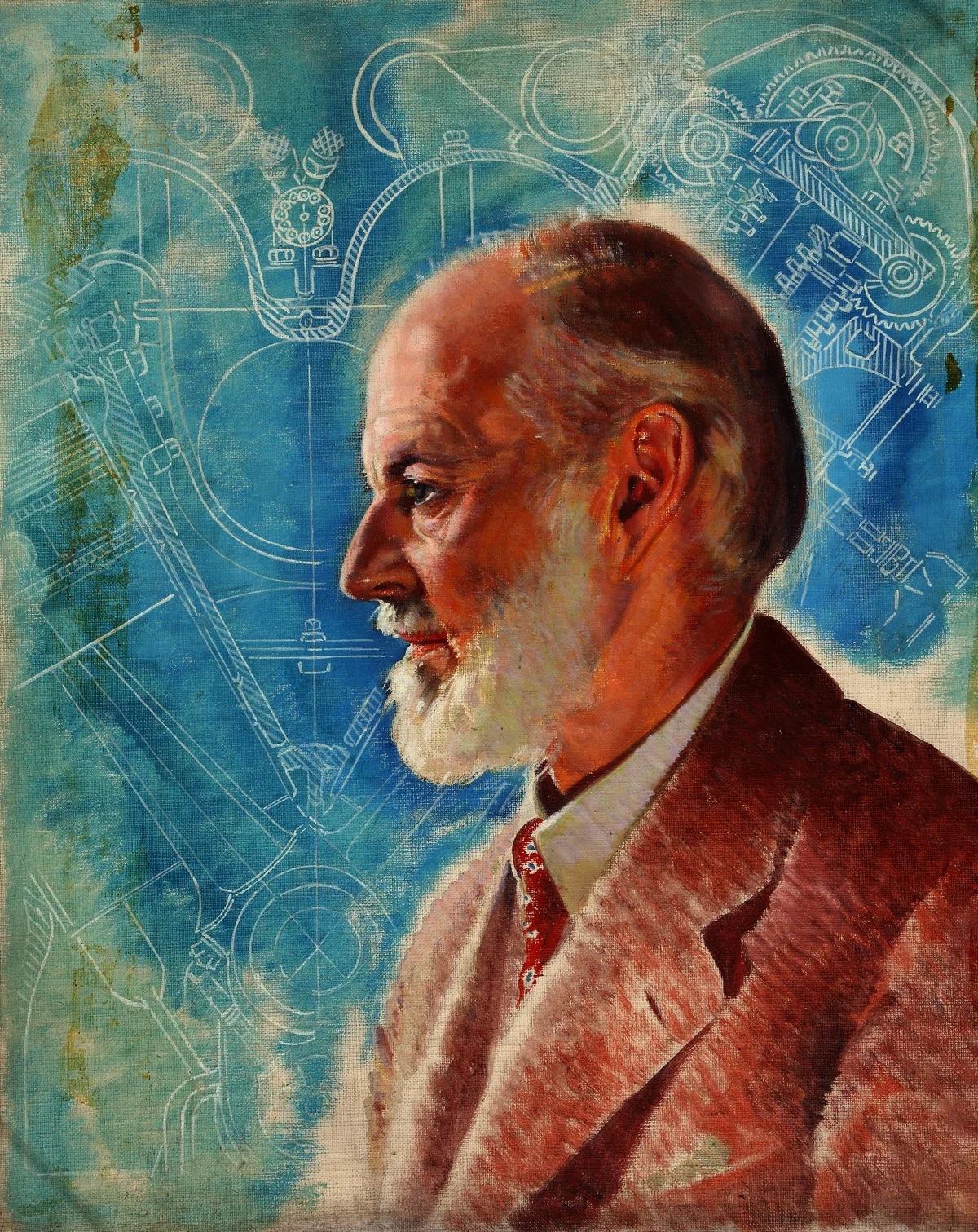
1863–1933
Henry Royce
Electrical and mechanical engineer, manufacturer and Rolls-Royce co-founderHenry Royce built an electrical-engineering business before making his first cars. His 1904 partnership with Charles Rolls joined manufacturing with a sales network. He led an exacting design practice whose later work included the 40/50-horsepower car and aero engines.Read biography1823–1883
William Siemens
Engineer, metallurgist and industrial entrepreneurWilliam Siemens is remembered for developing regenerative heating and steelmaking through family partnerships and industrial experiments.Read biographyQuick answers
Common questions
- Did Lanchester complete a university degree before his first engineering job?
- He left his early formal studies without completing the final examinations; his later honorary recognition was a different event.
- Who else contributed to the managerial notebook?
- The catalogue identifies George Herbert Lanchester and chief draughtsman Sidney Pinsent alongside Frederick.
Primary and institutional sources
How this history was checked
Primary records, institutional catalogues and historical interpretation answer different questions. The comparison and worked example are original editorial analysis. This article was reviewed on 8 November 2026.
- C. S. Clark, Oxford Dictionary of National BiographyLanchester, Frederick William: accessible extract
- Coventry UniversityLanchester Interactive Archive: Timeline
- Institution of Mechanical EngineersLanchester Motor Company
- Institution of Mechanical EngineersManager’s Notebook 1899–1901
- Institution of Mechanical EngineersAcceleration charts
- Science Museum GroupFrederick William Lanchester