
The short answer
Why did poly-U identify phenylalanine but not the whole genetic code?
Evidence comparison
Poly-U: One Codon and a Larger Code
Compare the observations with the narrower conclusions they support.
| Record or observation | What it supports | What remains separate |
|---|---|---|
| Poly-U reaction | Restricted RNA input and phenylalanine incorporation | Supports a limited coding relationship |
| Unmeasured mixed RNA | Several nucleotide combinations remain possible | Cannot be translated from the poly-U result alone |
Make the message deliberately simple
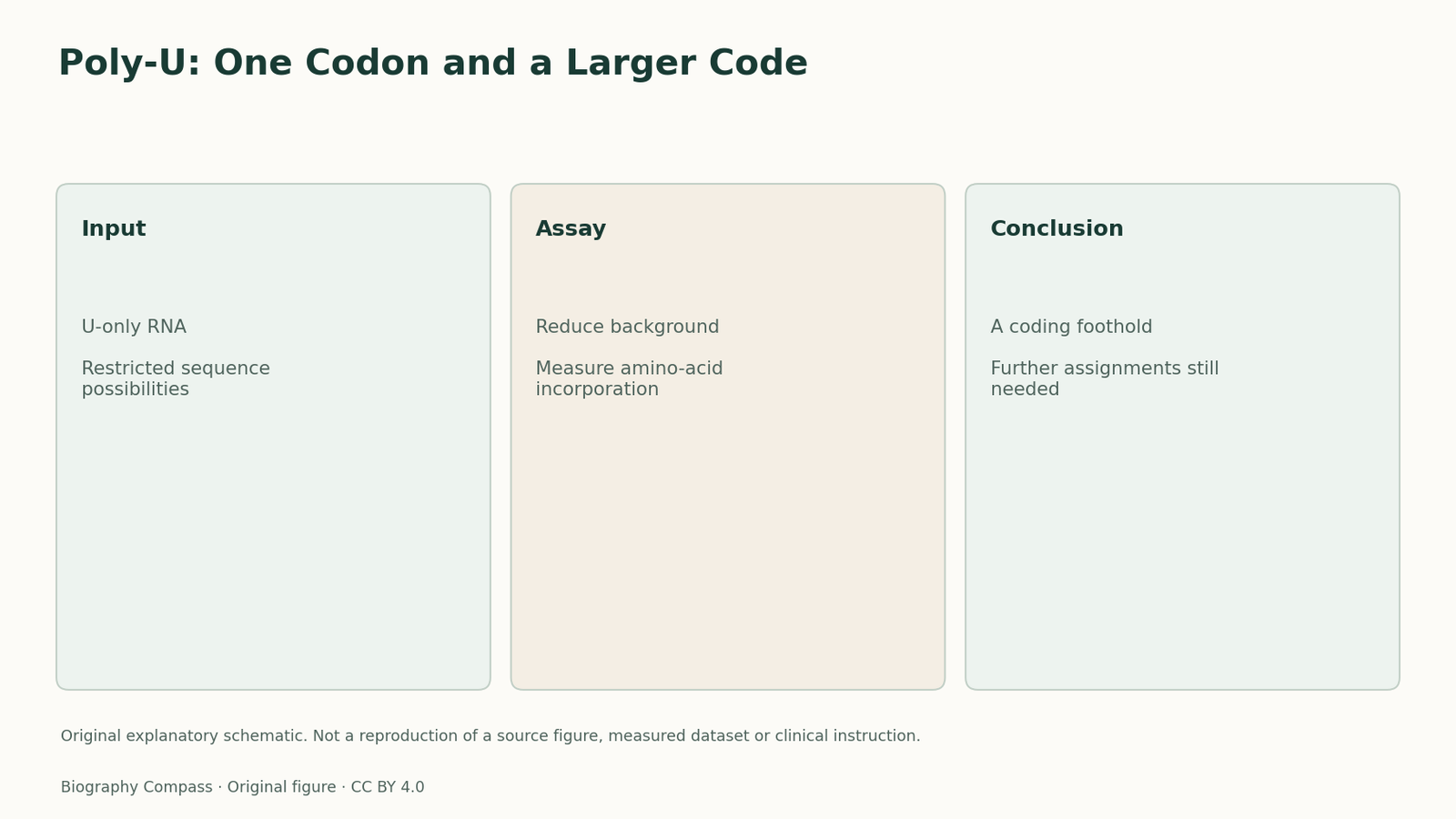
A mixed RNA sequence produces a difficult decoding problem: many nucleotide combinations and many amino acids are present together. Nirenberg and Matthaei instead supplied poly-U, an RNA consisting of repeated uracil. In the resulting cell-free reaction, phenylalanine was incorporated into a repetitive protein product. The simplicity of the input sharply limited the possible interpretation. It connected a U-only message with one amino acid without needing to infer every word of a natural gene.
The background matters
Nirenberg's Nobel lecture describes reducing endogenous template activity before testing added RNA. Otherwise, existing messages could continue to drive incorporation and obscure the experimental change. Read the outcome against two questions: what happened without the added message, and what changed when poly-U was supplied? The result supports a specific coding assignment in the established triplet framework; it is not a measurement of the whole code's completion.
Sources for this section: [3]
Test the conclusion with a counterexample
On paper, label one hypothetical tube UUUUUU and another UAUCUU. Give the first the reported phenylalanine result; leave the second unmeasured. Ask whether the first observation determines the amino-acid sequence of the second. The answer is no: the mixed message contains combinations the simple template did not test. A second answer should identify the useful positive result, namely that an intentionally restricted message made a restricted coding relationship experimentally visible.
Sources for this section: [3]
Keep three histories connected
Compare this experiment with Khorana's repeating mixed-sequence RNA and Holley's transfer-RNA analysis. Their questions overlap, but their objects differ: message assignment, sequence ambiguity and an adaptor's structure. The comparison explains why a shared Nobel award does not imply three interchangeable experiments or one investigator independently completing every step.
Continue the chronology
Related history guides
Biography context
Explore United States through connected lives
Connected biographies
Researchers and related questions
1927–2010
Marshall Nirenberg
Biochemist and genetic-code researcherWorking with Heinrich Matthaei, Nirenberg developed a cell-free system in which added RNA could guide amino-acid incorporation.Read biography1922–1993
Robert W. Holley
Biochemist and transfer-RNA researcherA sabbatical with James Bonner at Caltech helped focus Holley's interest on protein synthesis.Read biography1918–2007
Arthur Kornberg
Biochemist and DNA-replication researcherKornberg's group isolated DNA polymerase from bacteria in 1956.Read biographyQuick answers
Common questions
- Why did poly-U identify phenylalanine but not the whole genetic code?
- Restricted RNA input and phenylalanine incorporation. Supports a limited coding relationship.
- Are the classroom examples historical measurements?
- No. Invented examples are labelled as classroom models; the source-based discussion identifies the historical evidence separately.
Primary and institutional sources
How this history was checked
Official biographical and award records are read alongside the researcher’s technical account. Source scope and hypothetical examples remain distinct. This article was reviewed on 7 November 2026.