
The short answer
What did the first complete transfer-RNA sequence reveal?
Evidence comparison
Transfer RNA: Sequence Is Not a 3D Shape
Compare the observations with the narrower conclusions they support.
| Record or observation | What it supports | What remains separate |
|---|---|---|
| Overlapping fragment sequences | Constrain nucleotide order | Do not themselves give every spatial coordinate |
| Cloverleaf pairing arrangement | Organises complementary stretches | Remains distinct from complete three-dimensional folding |
Begin with the thing actually sequenced
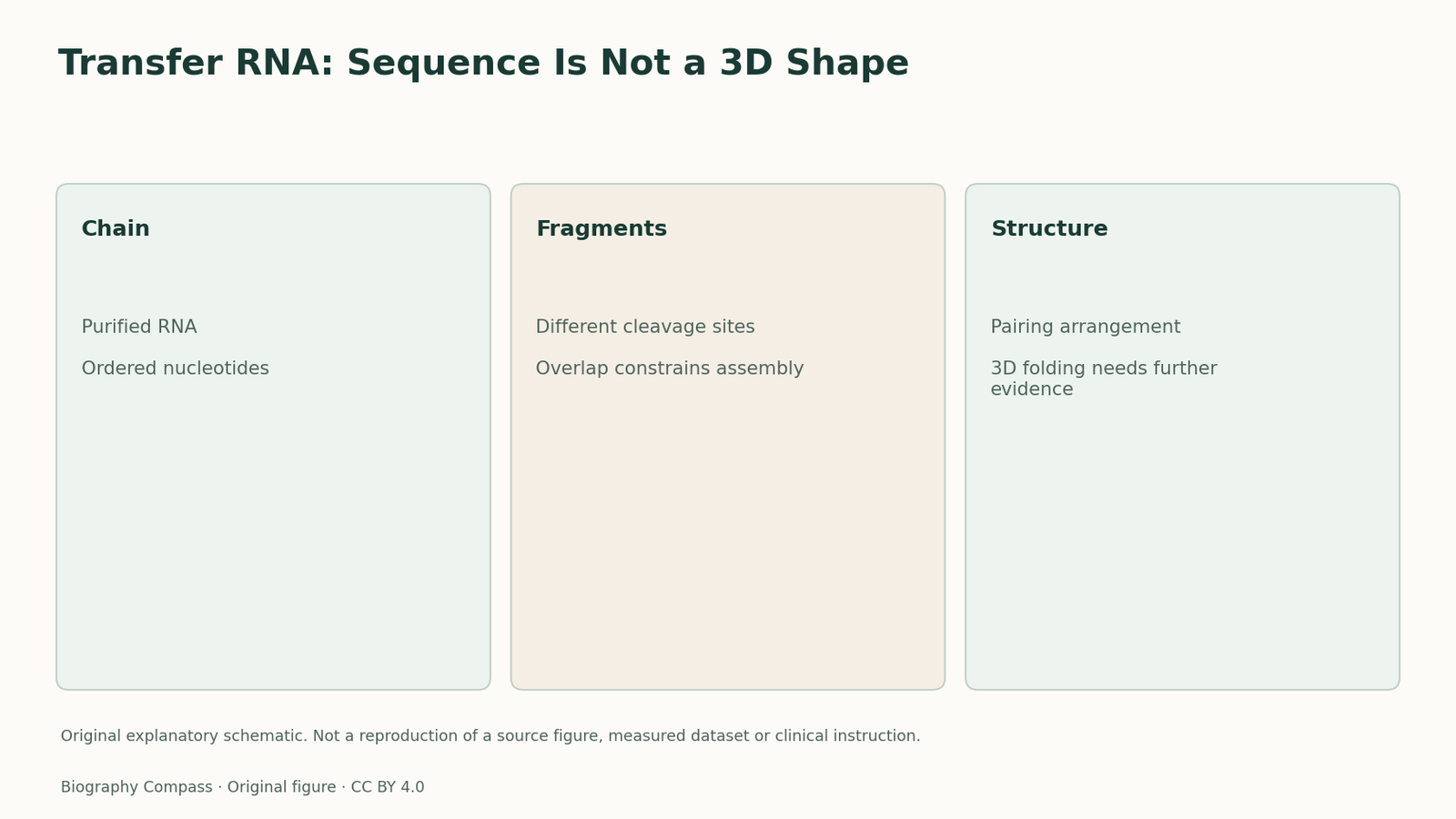
Holley's group determined the nucleotide sequence of an alanine transfer RNA isolated from yeast. This was a particular purified molecule, rather than an average sequence assembled indiscriminately from every transfer RNA in a cell. His lecture explains why purification mattered: a mixture could produce incompatible fragments and make a supposedly single chain impossible to reconstruct. Chemical identity and functional amino-acid acceptance were therefore connected checks on the starting material.
Use overlap to constrain an order
The USDA account describes digestion with nucleases that cut at different sites. Comparing overlapping fragments allowed the investigators to constrain the order of shorter sequences within longer ones. In a paper analogy, fragments ABC and BCD permit the combined string ABCD because BC overlaps. ABC and DEF do not establish which fragment comes first. These invented letters explain the logic of an overlap; they are not the historical RNA sequence or experimental measurements.
Sources for this section: [4]
Sequence, pairing and folding answer different questions
Holley's lecture then discusses a cloverleaf arrangement based on complementary pairing and comparison with other transfer-RNA sequences. He calls it a partial description of the three-dimensional structure. A sequence lists chemical order; a pairing scheme proposes which stretches associate; a three-dimensional model places those associations in space. Reading all three as the same kind of evidence erases the further experiments needed to connect them.
Sources for this section: [3]
An answerable classroom comparison
Draw a straight string and two different folded arrangements of it. Ask which claim survives in both drawings. The answer is the order of the letters, provided the string has not been rearranged. Ask what additional evidence could choose between the folds: observations sensitive to proximity or three-dimensional structure would be required. This exercise separates a secure ordering claim from a geometric interpretation without pretending that any arbitrary fold fits real transfer RNA.
Sources for this section: [3]
Continue the chronology
Related history guides
Biography context
Explore United States through connected lives
Connected biographies
Researchers and related questions
1922–1993
Robert W. Holley
Biochemist and transfer-RNA researcherA sabbatical with James Bonner at Caltech helped focus Holley's interest on protein synthesis.Read biography1927–2010
Marshall Nirenberg
Biochemist and genetic-code researcherWorking with Heinrich Matthaei, Nirenberg developed a cell-free system in which added RNA could guide amino-acid incorporation.Read biography1939–2022
Sidney Altman
Molecular biologist and RNA-catalysis researcherRNase P contains RNA and protein components.Read biographyQuick answers
Common questions
- What did the first complete transfer-RNA sequence reveal?
- Constrain nucleotide order. Do not themselves give every spatial coordinate.
- Are the classroom examples historical measurements?
- No. Invented examples are labelled as classroom models; the source-based discussion identifies the historical evidence separately.
Primary and institutional sources
How this history was checked
Official biographical and award records are read alongside the researcher’s technical account. Source scope and hypothetical examples remain distinct. This article was reviewed on 7 November 2026.