
The short answer
A famous business slogan can identify a real innovation without describing every transaction. Read Mitsui Bunko’s translated family record alongside later research to decide what “cash at fixed prices” actually establishes.
Compare the evidence
A slogan, a family record and a research abstract
Match each source’s date and purpose to the question before broadening its claim.
| Record or claim | What the evidence supports | What it does not establish |
|---|---|---|
| Shobaiki, 1722 | A participant’s retrospective description of cash and fixed-price selling. | A complete ledger or proof of worldwide invention. |
| Nineteenth-century shop prints | Later public visibility of the slogan. | A view of the 1673 storefront. |
| Research on the 1719 method | Credit business and a later double-price method. | The payment terms of every earlier sale or a rate not supplied in the abstract. |
Chronology
A timeline of the turning points
Edo shop opens
Echigoya develops storefront textile sales with Kyoto procurement.
Takatoshi dies
His children continue the business.
A later pricing method
Atsuko Suzuki’s study identifies a double-price method in the Kyoho period.
A family account is completed
Takaharu’s Shobaiki recalls and praises the founding generation.
Ask which customers and transactions changed
The question is more precise than whether Mitsui “invented modern shopping.” Mitsui Bunko explains that established kimono merchants often visited wealthy households, negotiated purchases and collected combined payments at intervals. Takatoshi’s family lacked that established customer base. In-store cash sales at prices without bargaining offered another way to attract customers in a growing Edo market.
Two changes worked together: where a customer bought and how the price was settled. Fixed prices reduced dependence on specialist knowledge and negotiation. Cash settlement avoided waiting for a later household payment. The archive also identifies Izu-kura, a related Matsusaka merchant, as a precedent for in-store selling. That evidence does not support an unrestricted claim of invention everywhere.
Read the remembered practice with its date
The archive publishes a translated selection from Shobaiki, completed by Takatoshi’s son Takaharu in 1722. He had worked in the business, which makes the recollection valuable. But the archive also explains its commemorative purpose: it praised his father and selected material for descendants. It is not a complete transaction register from the founding shop.
The illustration captions supply another useful limit. The pictured shop-sign phrases come from nineteenth-century woodblock prints. They show the later visibility of the slogan, not the precise appearance of the storefront in 1673. A narrative’s event date, the date it was written down and the date of a surviving illustration must remain separate.
Put credit evidence beside the slogan
Atsuko Suzuki’s 2023 English research abstract describes cash business as one method among several, alongside substantial credit sales. Her study concerns a double-price method established in 1719, after Takatoshi died in 1694. It used a fixed calculation relationship of sixty momme of silver to one ryo of gold koban. The selected abstract does not supply a complete reconstructed schedule of interest charges.
This evidence challenges “Echigoya never sold on credit.” It does not by itself identify the settlement method of an unspecified sale in 1673. Kikkawa’s chapter likewise notes a scholarly qualification that conventional credit continued. Distinguishing periods makes the comparison stronger: it tests the reach of a claim without making later practice disappear or attributing it to a dead founder.
Original exercise: edit three museum labels
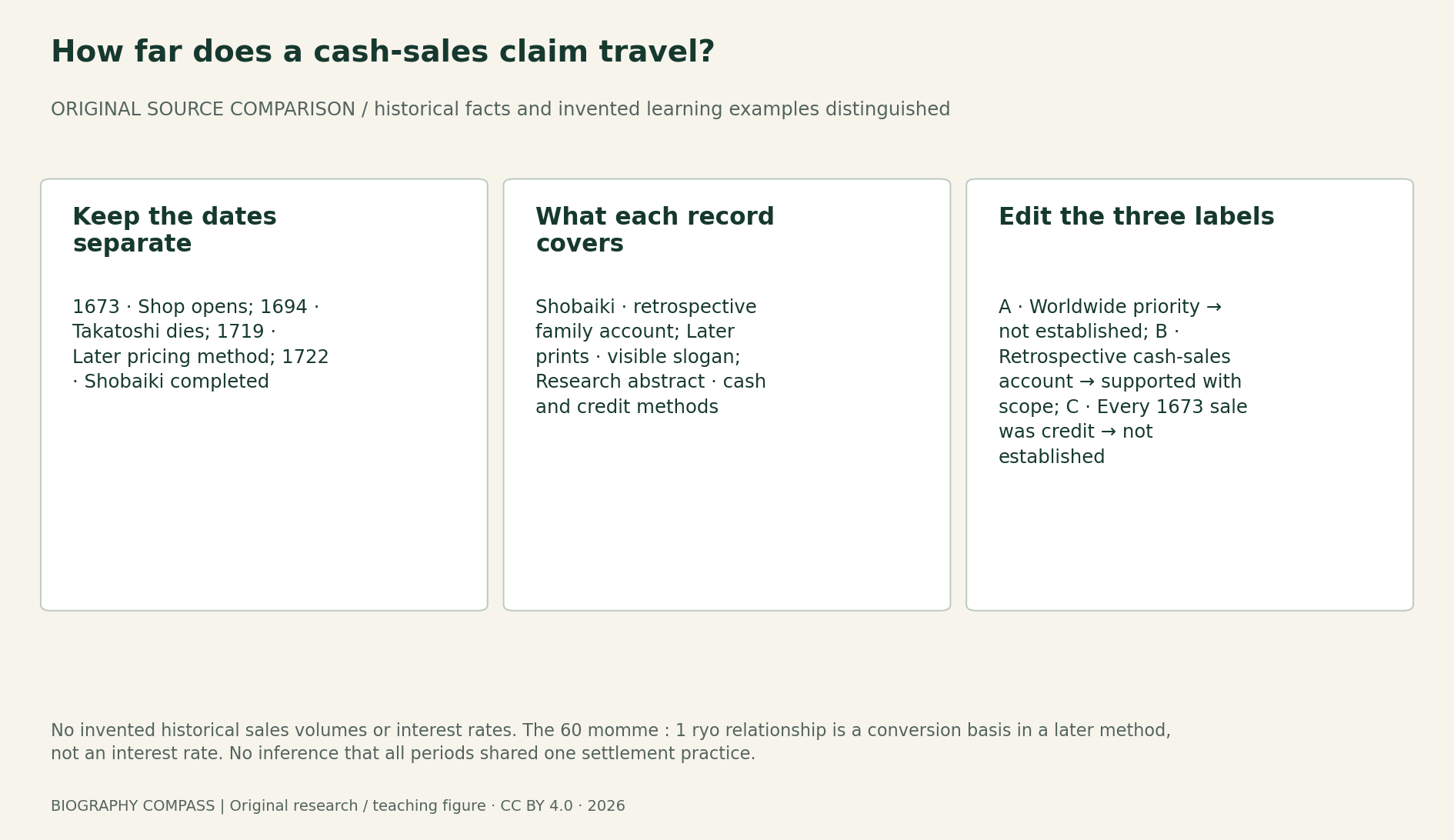
Use only the selected records to classify and rewrite these proposed labels. A: “Takatoshi invented cash retail throughout the world.” B: “The family’s retrospective record describes cash purchases at set prices without haggling.” C: “Because the 1719 method involved credit, every sale in the 1673 shop must have been credit.” For each, decide whether the claim is supported, needs a narrower scope or is not established. Name the date or source purpose that controls your decision.
Then choose a source for a fourth question: what interest charge applied to a particular purchase? Would a sign, the translated family reminiscence or the relevant account and pricing records be the best evidence? Do not create a historical interest rate from the sixty-to-one conversion relationship.
Reference answer and a better research question
A is not established: the archive describes a local commercial development and names a precedent; a family success story cannot prove worldwide priority. A defensible replacement is “The family developed successful cash-sales practices in Edo.” B fits the selected translated account, provided the label retains its retrospective character and 1722 date.
C is not established: 1719 and 1673 describe different periods, and evidence of some credit business does not classify every transaction. A better label is “Later research identifies credit as well as cash business at Echigoya.” For a particular interest charge, seek the relevant account and pricing records, with dates, units and payment period. The abstract points toward that research; it does not replace reading those records.
Continue the chronology
Related history guides
What did a Japanese national-bank note promise?
Trace national-bank note redemption before the Bank of Japan, compare gold with government paper, and work through a clearly labelled historical-rule example.
Read the timeline1952–1954How could Power Free run with or without pedalling?
Read Suzuki’s Power Free archive and period-history brochure, trace three propulsion modes, and test what their claims reveal about the 1952 auxiliary engine.
Read the timelineBiography context
Explore Japan through connected lives
Takatoshi Mitsui
Place the pricing practice within the merchant’s family, shops and succession.
Explore the biographiesCompare another recordA catalogue and product availability
Compare the different question of what a dated catalogue can establish about goods available for sale.
Explore the biographiesConnected biographies
People in this guide
1622–1694
Takatoshi Mitsui
Merchant and organizer of the Echigoya businessTakatoshi Mitsui organized textile shops and procurement networks whose cash-sales practices became famous in Edo. His children and employees helped build the business.Read biographyQuick answers
Common questions
- Does later credit evidence make the cash-sales story false?
- No. A practice can be important without covering every transaction. The evidence narrows the scope of the slogan rather than erasing the innovation.
- Is sixty momme to one ryo an interest rate?
- No. In the selected abstract it is the fixed silver-to-gold calculation relationship used by the later pricing method, not an annual interest charge.
Primary and institutional sources
How this history was checked
These selected historical records have different purposes and reading scopes. Translated archival extracts and later research are identified in the text; original learning exercises are labelled. This article was reviewed on 27 October 2026.
- Mitsui BunkoMitsui Takatoshi—The Founder of the Mitsui Family
- Mitsui BunkoNew Commercial Practices
- Mitsui BunkoThe Children of Takatoshi
- Takeo Kikkawa / Springer, History of Innovative Entrepreneurs in JapanCase 2 Takatoshi Mitsui: New Business Opportunities and the Retail Revolution
- Atsuko Suzuki / Osaka University Graduate School of EconomicsThe novel business method of kimono merchant Mitsui Echigoya: English abstract, Discussion Paper 23-06