
The short answer
An auxiliary bicycle engine did not have to replace pedalling in every situation. Two Suzuki records describe the 1952 Power Free at different levels: a technical model archive and a later brochure explaining three operating modes.
Compare the evidence
A mode description is not a complete mechanism
The brochure and archive support complementary, bounded questions.
| Record or claim | What the evidence supports | What it does not establish |
|---|---|---|
| 2016 history column | Three functional possibilities for the 1952 Power Free. | An eyewitness ride test or complete internal design. |
| Digital Library table | Named model, year, displacement and explicitly engine-only mass. | Whole bicycle mass or specifications of every later model. |
| Patent number in the archive | A pointer to a potentially relevant original record. | Inventorship, valid claims or legal scope without the patent itself. |
Chronology
A timeline of the turning points
Power Free
A 36 cm³ auxiliary bicycle engine with double sprocket wheels.
Diamond Free
A distinct enlarged-engine model appears.
Mini Free
A further model changes the engine and operating arrangement.
Read the product’s name before drawing its mechanism
The technical archive identifies Power Free as a 1952 auxiliary bicycle engine. Its table lists a 36 cm³, air-cooled, two-stroke single-cylinder engine, a two-speed constant-mesh transmission and a wet multiple-disc clutch. The description also names double sprocket wheels. These are records about a company product, not proof that every detail was personally designed by Michio Suzuki.
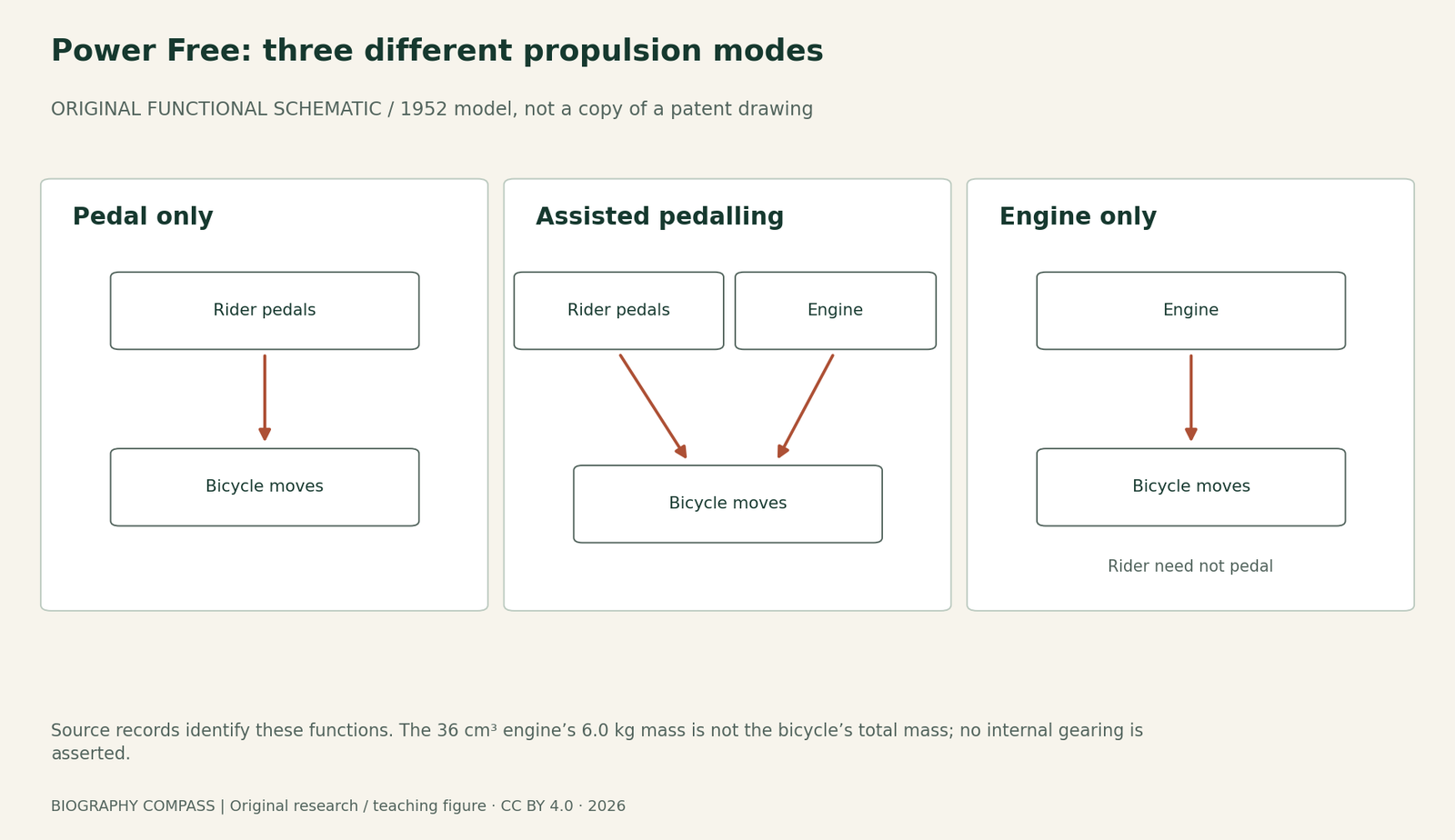
The 2016 Suzuki brochure’s historical column adds the functional explanation: riders could pedal without engine assistance, pedal with assistance, or travel entirely under engine power. A mode describes a possible way of operating the system. It does not tell us every internal engagement, freewheel arrangement or patent claim needed to build a replica.
Draw three paths, not an imagined patent
For pedal-only travel, the rider is the stated propulsion source. For assisted pedalling, the rider and engine both contribute. For engine-only travel, propulsion does not require the rider to keep pedalling. An original explanatory diagram can show these three relationships using arrows from rider and engine toward the driven bicycle.
Those arrows should be labelled as functional paths. They do not establish precise internal gearing or a control sequence for the original machine. The archive mentions two Japanese patents, including No. 180512, but the original patent document has not been read here. The mechanism’s patentability, inventors and claim boundaries therefore remain outside this guide’s evidence.
Keep the next models out of the first specification
The same archive dates Diamond Free to 1953 and Mini Free to 1954. Their details cannot be silently transferred to the original Power Free. For example, Diamond Free’s prose describes a sixty-cubic-centimetre class engine while its specification table gives 58 cm³. That is a rounded description and an exact table entry for a different model, not a reason to change Power Free’s 36 cm³ figure.
The archive labels Power Free’s 6.0 kg as engine weight. A bicycle frame, wheels, rider and other equipment are outside that measurement. Likewise, the Mini Free description of switching by clutch lever belongs to the later model. It should not be used to invent the complete operating instructions of the 1952 product.
Sources for this section: [1]
Original exercise: classify three workshop cards
Treat the following as fictional observation cards, not historical test reports. A: the rider pedals, the engine supplies no assistance and the bicycle moves. B: the rider pedals while the engine contributes propulsion. C: the engine propels the bicycle while the rider is not pedalling. Match each card to a brochure mode, then decide whether any card by itself proves the exact internal clutch design.
Now edit two proposed captions: “The complete Power Free bicycle weighed 6.0 kg” and “The 1952 Power Free had Diamond Free’s 58 cm³ engine.” Use the technical archive to say which measurement or model each caption has confused. Finally, identify what additional record would be needed to make a statement about a named inventor’s patent claims.
Reference answer and the next document to request
A is pedal-only; B is assisted pedalling; C is engine-only. The three cards are consistent with the brochure’s functional description. None establishes the exact internal clutch layout: the same observed function does not identify every mechanism that could produce it. A diagram of these cards must therefore show operating possibilities rather than claim to reproduce a patent drawing.
The weight caption should say “The archive lists 6.0 kg for the Power Free engine.” The displacement caption should retain 36 cm³ for the 1952 Power Free and reserve the 58 cm³ table entry for the 1953 Diamond Free. For patent inventorship and claims, obtain and read the relevant original patent, checking its identity and dates. A later promotional history can explain a product without settling that different legal and technical question.
Continue the chronology
Related history guides
Did Echigoya’s cash-sales slogan exclude credit?
Compare Echigoya’s cash-sales story with later credit evidence, then test three claims against the dates, purposes and limits of the surviving records.
Read the timeline1872–1885What did a Japanese national-bank note promise?
Trace national-bank note redemption before the Bank of Japan, compare gold with government paper, and work through a clearly labelled historical-rule example.
Read the timelineBiography context
Explore Japan through connected lives
Michio Suzuki
Read the loom-making background and later move into transport manufacturing.
Explore the biographiesCompare another productHonda’s Super Cub development
Compare a later complete motorcycle’s design, production and distribution question with an earlier auxiliary-engine system.
Explore the biographiesConnected biographies
People in this guide
1887–1982
Michio Suzuki
Loom maker and manufacturing entrepreneurMichio Suzuki began with textile machinery in the Hamamatsu region. The business carrying his name later added auxiliary bicycle engines and small cars.Read biographyQuick answers
Common questions
- Does engine-only mode mean the engine ran without fuel?
- No. It means the rider did not need to pedal for propulsion. The source describes an operating mode, not a new source of energy.
- Can the three arrows replace a patent drawing?
- No. They explain the stated functions. Exact mechanical construction and patent claims require the relevant original records.
Primary and institutional sources
How this history was checked
These selected historical records have different purposes and reading scopes. Translated archival extracts and later research are identified in the text; original learning exercises are labelled. This article was reviewed on 27 October 2026.