
The short answer
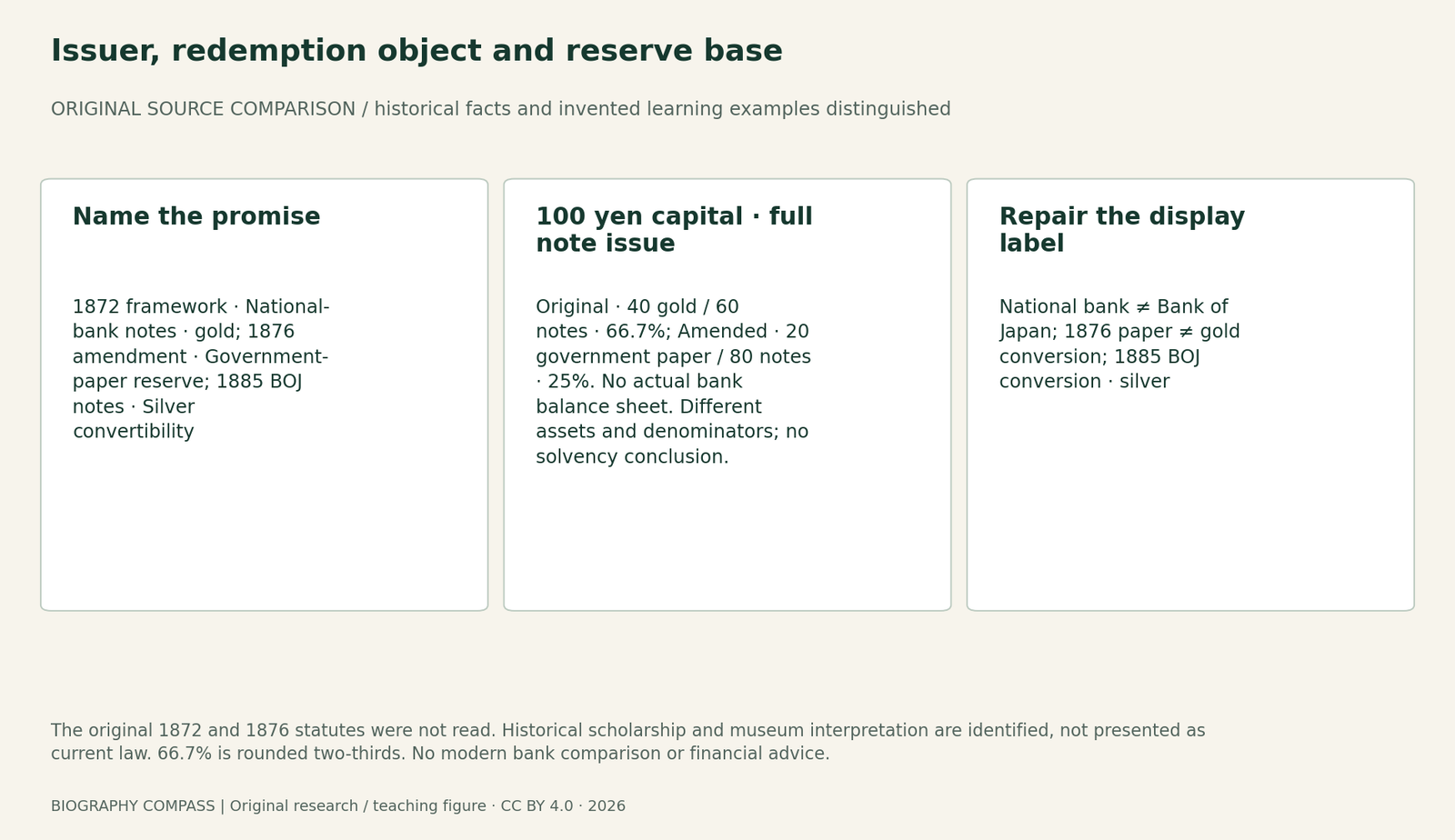
“National bank,” “convertible” and “reserve” do not describe the same thing. Compare a currency museum’s overview with selected scholarship on the 1872 and 1876 rules, then follow the actual promise behind each kind of note.
Compare the evidence
Three promises require three descriptions
Keep issuer, date and redemption object attached to the claim.
| Record or claim | What the evidence supports | What it does not establish |
|---|---|---|
| Original national-bank arrangement | Gold redemption and a capital-based gold reserve. | That national banks were the Bank of Japan. |
| Amended arrangement, 1876 | Government-paper reserve; paper redemption is an explicit scholarly inference. | Gold conversion or an observed reserve at a particular bank. |
| Bank of Japan notes, 1885 | A separate issuer and silver convertibility in the museum account. | A continuation of every earlier national-bank rule. |
Chronology
A timeline of the turning points
National-bank framework
Private banks could issue notes under a national chartering system.
First National Bank
Shibusawa joined the new bank as superintendent.
Amended framework
The reserve and redemption arrangement changed.
Bank of Japan begins
A separate central bank began operations in October.
BOJ notes appear
The first Bank of Japan notes were convertible into silver.
Start with the issuer
Shibusawa’s First National Bank belonged to the national banking system created in 1872. The Currency Museum describes these as private banks authorized to issue notes. The adjective “national” referred to the framework; it did not make every issuer the central bank. Shibusawa’s appointment as superintendent in 1873 therefore predates a different institution, the Bank of Japan, which began operating in 1882.
A note’s issuer is only the first question. The reader must also ask what could be received in exchange, what backed the issue and when the rules applied. Those questions help explain why a museum can describe a later note as inconvertible while scholars still discuss its redemption in another form of paper currency.
Gold, government paper and an explicit inference
Miyajima and Weber’s 2001 study explains that the original Japanese rules required national-bank notes to be redeemed in gold coins. After the 1876 amendment, the reserve requirement used government paper currency instead. Their footnote carefully marks a step in interpretation: the amended wording about currency reserved for redemption is understood by the authors and others to mean redemption in government paper.
The museum’s description of the later notes as inconvertible concerns conversion into specie, meaning metal money. Exchanging one paper instrument for government paper is a different promise from receiving gold. These statements can coexist when the redemption object is specified. The study is historical scholarship, with views expressly attributed to its authors; it is not a substitute for an original statute edition.
Keep reserves and collateral in separate roles
The selected study describes government bonds deposited as collateral for note issue and a reserve held for redemption. Under the original arrangement, forty percent of capital was held in gold and sixty percent in the bond allocation associated with the note ceiling. In 1876 those proportions became twenty percent in government paper and eighty percent in the bond allocation.
Capital is the base for those percentages. Outstanding notes are a different base. The authors consequently express the original reserve relative to the maximum notes as about sixty-seven percent, and the later figure as twenty-five percent. This does not mean that the later twenty-five percent consisted of gold: both the denominator and the reserve asset must be carried into the comparison.
Sources for this section: [4]
Original exercise: audit a display card
Use a fictional bank with 100 yen of capital, issuing the maximum notes allowed by each simplified rule as described in the study. A: calculate reserve divided by maximum notes under the original arrangement. B: repeat for the amended arrangement and name the reserve asset. C: assess the label “Every Japanese note issued after 1876 promised gold, including the Bank of Japan’s first notes.” Explain both errors using the museum sequence.
This is an original teaching example, not a surviving bank balance sheet. Assume only the selected capital allocations and full permitted issue. Do not add note liabilities to bond collateral as if both were additional funds owned by the bank, and do not infer actual solvency from this small model.
Reference answer: preserve the objects as well as the numbers
A: 40 yen of gold divided by 60 yen of notes is two-thirds, approximately 66.7 percent. B: 20 yen of government paper divided by 80 yen of notes is one-quarter, or 25 percent. Calling B a twenty-five-percent gold reserve would change the historical asset. Forty percent and twenty percent remain the figures measured against capital, not against notes.
C is incorrect. The post-1876 national-bank arrangement discussed here concerned government-paper redemption rather than a gold promise. The museum separately dates the Bank of Japan’s first notes to 1885 and identifies their convertibility into silver. A useful replacement label distinguishes issuer, date and redemption object. The calculations explain the selected rules; neither they nor the overview establish the cash available at any particular historical branch.
Continue the chronology
Related history guides
Did Echigoya’s cash-sales slogan exclude credit?
Compare Echigoya’s cash-sales story with later credit evidence, then test three claims against the dates, purposes and limits of the surviving records.
Read the timeline1952–1954How could Power Free run with or without pedalling?
Read Suzuki’s Power Free archive and period-history brochure, trace three propulsion modes, and test what their claims reveal about the 1952 auxiliary engine.
Read the timelineBiography context
Explore Japan through connected lives
Eiichi Shibusawa
Follow the organizer who joined the First National Bank in 1873.
Explore the biographiesCompare another financial recordOriginal and present holders in public credit
Compare a different legal question about who holds a claim; it is not the Japanese banknote-redemption system.
Explore the biographiesConnected biographies
People in this guide
1840–1931
Eiichi Shibusawa
Banker, industrial organizer and public-service advocateEiichi Shibusawa moved from his family’s indigo business through shogunal and government service into banking, company organization and social institutions.Read biographyQuick answers
Common questions
- Were national banks government-owned central banks?
- The Currency Museum describes privately established national banks. The Bank of Japan was a separate institution that began operating in 1882.
- Why is the original reserve about 67 percent rather than 40 percent?
- Forty percent refers to capital. Dividing the same gold reserve by the maximum note issue of sixty percent of capital gives two-thirds, about 66.7 percent.
Primary and institutional sources
How this history was checked
These selected historical records have different purposes and reading scopes. Translated archival extracts and later research are identified in the text; original learning exercises are labelled. This article was reviewed on 27 October 2026.
- Shibusawa Eiichi Memorial FoundationShibusawa Eiichi: Biography
- Shibusawa Eiichi Memorial FoundationShibusawa Eiichi Biographical Materials, volume 4: English content summaries
- Currency Museum, Bank of Japan Institute for Monetary and Economic StudiesThe History of Japanese Currency: Modern Times
- Shigeki Miyajima and Warren E. Weber / Monetary and Economic Studies, February 2001A Comparison of National Banks in Japan and the United States between 1872 and 1885