
The short answer
Does listing a product establish that a customer could actually obtain it at the printed price?
Original source comparison
Which stage does the record establish?
A description of an offer and evidence of delivery answer different questions.
| Record | What it supports | What remains unestablished |
|---|---|---|
| Library catalogue description | A surviving catalogue’s extent, contents and advertised ordering structure. | Daily stock, every printed price or completed customer orders. |
| 1916 advertisement | A contemporary reference to catalogue freight information. | Free delivery or a complete rate schedule. |
| Fictional order ledger | Defined exact, substituted and backordered requests at one cutoff. | Laidlaw’s actual historical fill rate or each customer’s payment. |
Chronology
A timeline of the turning points
Business established
Laidlaw Leeds begins in the institutional record.
Catalogue described
Library records an extensive sales catalogue and wartime supply context.
Freight cross-reference
Contemporary advertisement directs readers to catalogue front pages.
Negotiation record
Report still describes purchase discussions as incomplete.
Separate an advertised range from a completed order
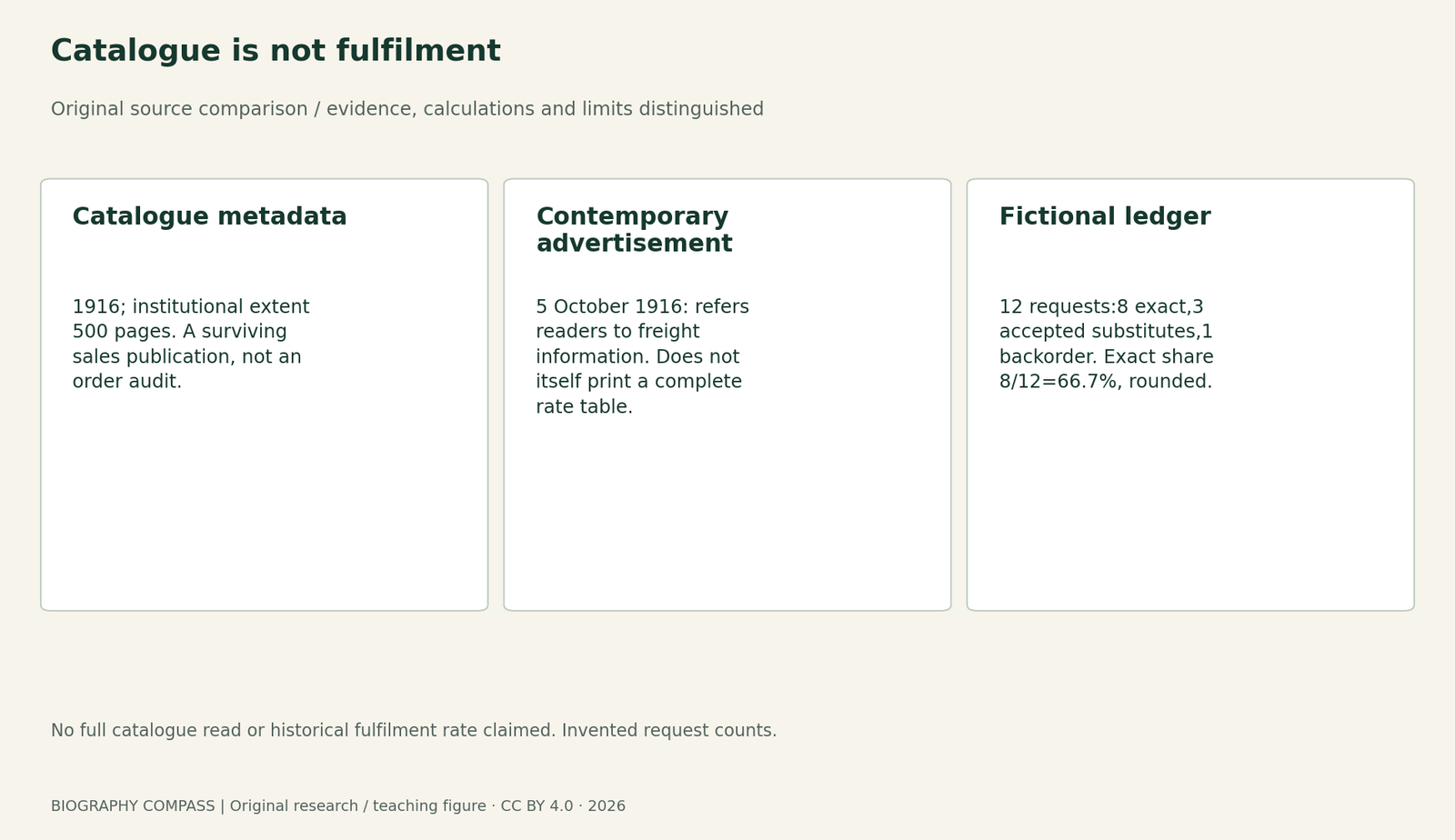
The National Library describes Laidlaw Leeds’ 1916 catalogue as a 500-page sales publication. Its record identifies departments, illustrations and information about ordering, payment and freight. That establishes the kind of publication and its advertised range. It does not establish the stock held on a particular day, the quantity supplied to a particular customer or the price ultimately charged. A catalogue is part of a selling process. A completed order belongs to a later documentary stage, where correspondence, invoices and dispatch records may show substitutions, price changes or unavailable goods.
Sources for this section: [1]
Wartime conditions made the distinction consequential
The Library’s curator discusses the catalogue in the context of wartime changes in prices and supplies. Freight and insurance costs rose, while some materials were scarce or had previously come from enemy countries. The selected account also explains competition for New Zealand-made materials needed overseas. These are reasons to ask how an advertised offer met actual supply conditions. They are not a quantified estimate of Laidlaw’s fulfilment performance. The full catalogue and its entire ordering section were not read here; the evidence is the institutional description and the curator’s bounded discussion.
A small advertisement points beyond itself
A Laidlaw advertisement in the Kaipara and Waitemata Echo of 5 October 1916 directs readers to freight rates in the front pages of its wholesale catalogue. The short message shows that delivery costs formed part of the company’s sales communication. It does not itself print all those rates or prove that freight was free. A researcher should preserve that cross-reference as a route to another record. Filling the gap with an assumed rate would turn a contemporary advertisement into evidence it does not contain. Other advertisements on the newspaper page are separate items, not Laidlaw’s promises.
Sources for this section: [3]
Compare a catalogue description with a transaction record
The Library’s catalogue entry describes a surviving object; its authority heading dates the firm’s establishment to 1909 and its 1918 combination with Farmers. A contemporary newspaper report in June 1918 instead records negotiations that were not yet complete. These examples illustrate a shared reading discipline: name the stage reached. A publication can advertise an item; correspondence can accept an order; an invoice can charge for it; a dispatch record can show shipment. None automatically proves the next step. Likewise, authorisation to negotiate a business purchase is different from evidence of its completion.
Original exercise: audit a fictional fulfilment ledger
A deliberately fictional ledger contains twelve customer requests for catalogue-listed items. Eight were supplied exactly as requested, three were supplied only after customers accepted substitutes, and one remained on backorder at the observation cutoff. Calculate the share supplied exactly as requested. Then assess two headlines: “Every listed item was available” and “Eleven of twelve requests were fulfilled exactly.” Finally, identify the records needed to determine what each customer paid, including freight. These counts are invented teaching inputs, not a reconstruction of Laidlaw’s actual sales, stock or service quality.
Reference answer: define fulfilment before calculating it
Eight of twelve requests were supplied exactly as requested: 8 ÷ 12 = 66.7%, rounded to one decimal place. Eleven received some goods, but three involved accepted substitutes, so eleven is not the exact-fulfilment numerator. The remaining request was still on backorder at the stated cutoff. The catalogue alone cannot establish universal availability, and even this fictional ledger does not cover every product or every customer. Actual payment requires the relevant invoice, payment and freight records, with substitutions and credits retained. A percentage becomes useful only when its numerator, denominator and observation point are explicit.
Write the historical conclusion at the evidence’s scale
A careful conclusion says that Laidlaw used an extensive catalogue and advertised its freight information during a period of disrupted trade. It then leaves actual fill rates, final prices and customer outcomes unestablished until appropriate records are found. This does not diminish the achievement of building a mail-order organisation. It identifies what that organisation had to do between printing a range and delivering goods. The distinction is useful beyond retail history: a published offer, a completed transaction and a satisfied customer are different claims, each requiring evidence suited to the question.
Continue the chronology
Related history guides
Who Turned a Humidifier Idea into a Product?
Which records support credit for a medical product’s development, and which claims require different evidence?
Read the timeline1880s–1897Was a Workplace Benefit Freely Chosen?
Does an employer’s support for a benefit fund establish that joining it was free and voluntary?
Read the timelineBiography context
Explore New Zealand through connected lives
Connected biographies
Business lives in context
1885–1971
Robert Laidlaw
Mail-order retailer and evangelical philanthropistRobert Laidlaw developed a mail-order business and later managed the enlarged Farmers enterprise, while maintaining a substantial evangelical and charitable life.Read biographyQuick answers
Common questions
- Does a catalogue listing prove stock was available?
- No. Stock and order records are needed to establish availability at a particular time.
- Why do substitutes not count as exact fulfilment?
- The exercise explicitly defines exact fulfilment as supplying the original request; accepted substitutes are recorded separately.
Primary and institutional sources
How this history was checked
Compare the stated source scopes. The original exercises and reference answers are teaching material; fictional records are labelled. No complete catalogue, inquiry, clinical archive or full economic report was read. This article was reviewed on 27 October 2026.
- National Library of New ZealandLaidlaw Leeds (Firm): authority and related catalogue description
- National Library of New ZealandWorld War One at home: In ephemera
- Laidlaw Leeds advertiser / Papers Past, National LibraryKaipara and Waitemata Echo,5 October 1916, page 3: Laidlaw catalogue advertisement
- Otago Witness / Papers Past, National LibraryOtago Witness,5 June 1918: purchase negotiations report