
The short answer
What did acetylation assays establish about coenzyme A, and how was its role different from ATP’s energy-transfer role?
Read the evidence
Different records within the same investigation
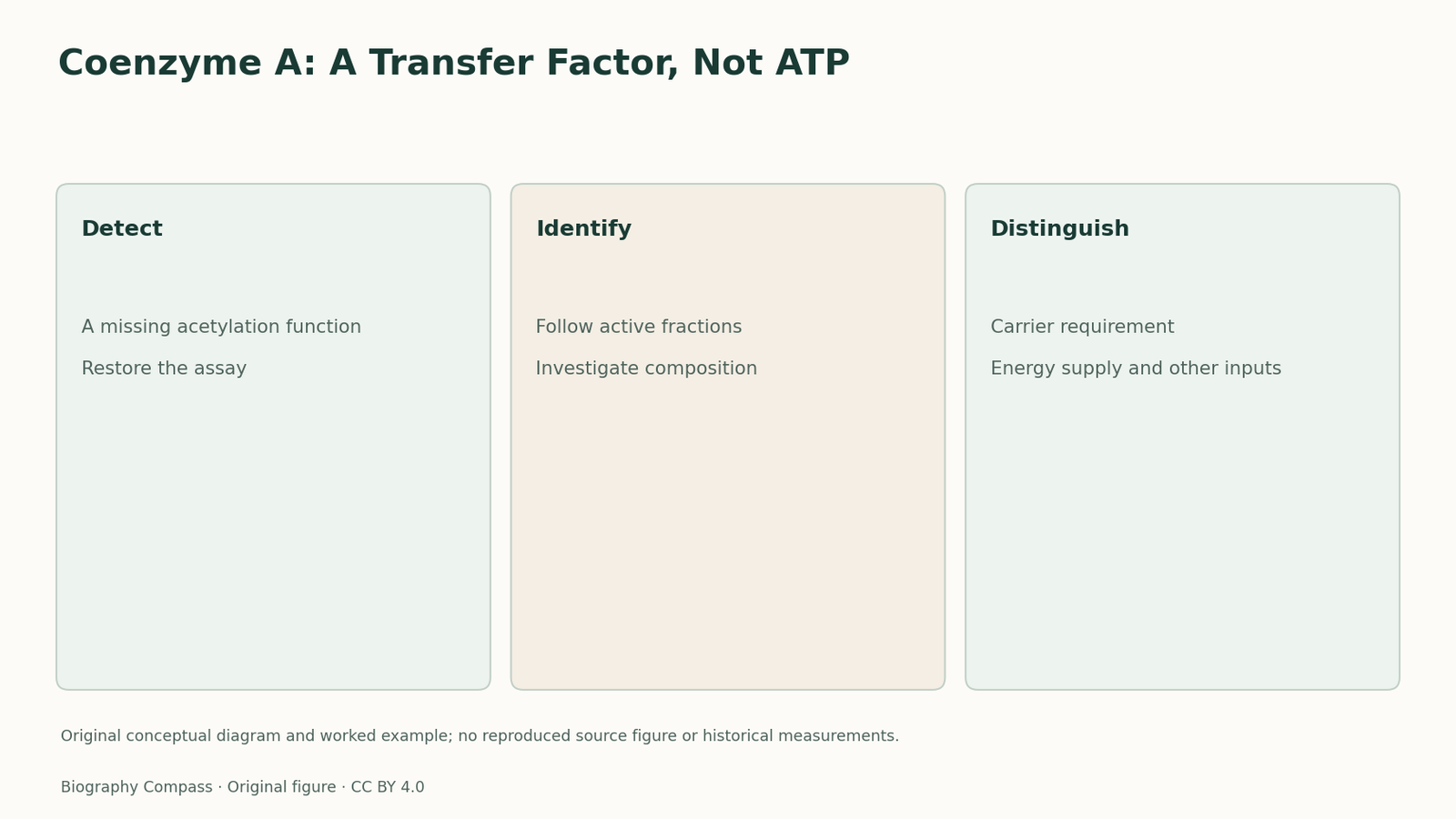
The following comparison distinguishes the specific questions answered by the inspected records.
| Record or test | What it establishes | What remains different |
|---|---|---|
| Restoration assay | Detects a function missing from the test system. | Does not establish complete molecular identity. |
| Purified active fraction | Tracks that function through separation. | Activity concentration is not automatically chemical purity. |
| Energy and carrier requirements | Tests distinct necessary inputs in the reaction system. | One positive addition does not make the inputs interchangeable. |
A useful reaction exposed a missing function
Lipmann’s lecture describes a cell-free acetylation system chosen because its activity could be followed experimentally. During treatment, the preparation could lose a heat-stable factor while retaining other necessary components. Restoring that activity supplied a way to detect and compare preparations containing the factor. The experiment therefore made an otherwise unidentified substance accessible through what it enabled the system to do. It was a functional assay, not yet a direct determination of the substance’s entire molecular structure.
Sources for this section: [3]
Purification depended on following the same requirement
Kaplan’s National Academy memoir recalls the small Massachusetts General Hospital team and the use of restoration in aged extracts to follow coenzyme activity. Such an assay lets a researcher ask whether activity accompanies a particular fraction as purification proceeds. The logic requires the rest of the test system to remain suitable for comparison. A more concentrated active fraction is useful evidence, but it does not automatically prove that the material is chemically pure or that every component in the fraction is necessary.
Identifying a constituent was another stage
The 1947 publication identified coenzyme A as a pantothenic-acid derivative. Lipmann’s later lecture and Kaplan’s memoir place Guirard, Novelli, Tuttle and others within the developing composition and structural programme. Demonstrating that a vitamin-derived component belongs to the cofactor is more specific than finding that a crude extract restores a reaction, but it is still different from completing every linkage in its structure. The record should preserve that progression rather than turning one short early report into the entire later chemical account.
ATP and coenzyme A should not be substituted for one another
The lecture distinguishes the energy supply in the acetylation system from the newly recognised cofactor requirement. Having an energy source does not necessarily supply the activated-group carrier a reaction needs. Conversely, supplying a carrier does not establish that an energy-dependent system can proceed without its other requirements. The printed lecture also contains later proof-stage additions, so details explicitly added afterward should not be silently dated to the original 1953 delivery. This guide uses the historical assay logic without reconstructing a modern experimental recipe.
Sources for this section: [3]
An original restoration matrix and answer
Imagine a fictional extract supplied with an adequate energy source and an acetyl-group precursor. It shows little activity until fraction C is added. A student concludes that C must simply be “more energy.” What comparison would help? Test whether C still restores the defined reaction when energy supply is already controlled, and separately test the requirement for that supply. If both are necessary under those conditions, they are not interchangeable inputs. These are conceptual teaching comparisons, not quantities or rescue instructions from a laboratory protocol. The supported answer also distinguishes a required activity from a purified molecular identity. C might contain several substances, and a negative result with a damaged base extract would not resolve which requirement was missing. A useful conclusion states exactly what was restored and which alternative the control addresses.
Continue the chronology
Related history guides
Yeast Juice: Two Fractions and Fermentation
Read Harden and Young’s fractionation logic through Harden’s 1914 account, with an original recombination exercise separating cofactor restoration from phosphate.
Read the timeline1936–1953Krebs and Johnson 1937: Testing a Cycle
Examine the evidence behind the 1937 citric acid cycle, separating catalytic regeneration from simple citrate consumption through a worked reasoning exercise.
Read the timeline1942–1964Tracing Cholesterol: Label and Pathway
Compare early deuterium-labelled acetate experiments with later carbon mapping, and use an original tracer exercise to test what product labelling establishes.
Read the timelineBiography context
Explore United States through connected lives
Connected biographies
Researchers and related approaches
1899–1986
Fritz Lipmann
Biochemist and coenzyme researcherFritz Lipmann investigated metabolic energy and acetyl transfer, identifying coenzyme A through assays and a collaborative programme of purification and chemistry.Read biography1918–2007
Arthur Kornberg
Biochemist and DNA-replication researcherKornberg's group isolated DNA polymerase from bacteria in 1956.Read biographyQuick answers
Common questions
- Does restoration prove a fraction is pure?
- No. It establishes a functional effect within the stated test system.
- Is coenzyme A another name for ATP?
- No. Their roles in activated-group transfer and energy coupling must be distinguished.
Primary and institutional sources
How this history was checked
The references below distinguish the original study from later explanations. The worked exercise and comparison are newly written for this article. This article was reviewed on 8 November 2026.
- Lipmann, Kaplan, Novelli, Tuttle and Guirard, Journal of Biological Chemistry, 1947Coenzyme for acetylation, a pantothenic acid derivative
- W. D. McElroy, National Academy of Sciences, 1994Nathan Oram Kaplan: A Biographical Memoir
- Nobel Prize OutreachFritz Lipmann — Nobel lecture
- Nobel Prize OutreachFritz Lipmann — Facts
- Nobel Prize OutreachFritz Lipmann — Biographical