
The short answer
Which observations supported a catalytic cycle rather than citrate being simply another consumed fuel?
Read the evidence
Different records within the same investigation
The following comparison distinguishes the specific questions answered by the inspected records.
| Record or test | What it establishes | What remains different |
|---|---|---|
| Simple extra fuel | The added amount is consumed once. | Its own oxidation sets a limited direct contribution. |
| Regenerative intermediate | A pool participates repeatedly as reactions restore it. | Requires evidence connecting the reactions. |
| Complete pathway | Specifies chemical links and their relevant operation. | Cannot be read from oxygen uptake alone. |
Why did a small addition have a large effect?
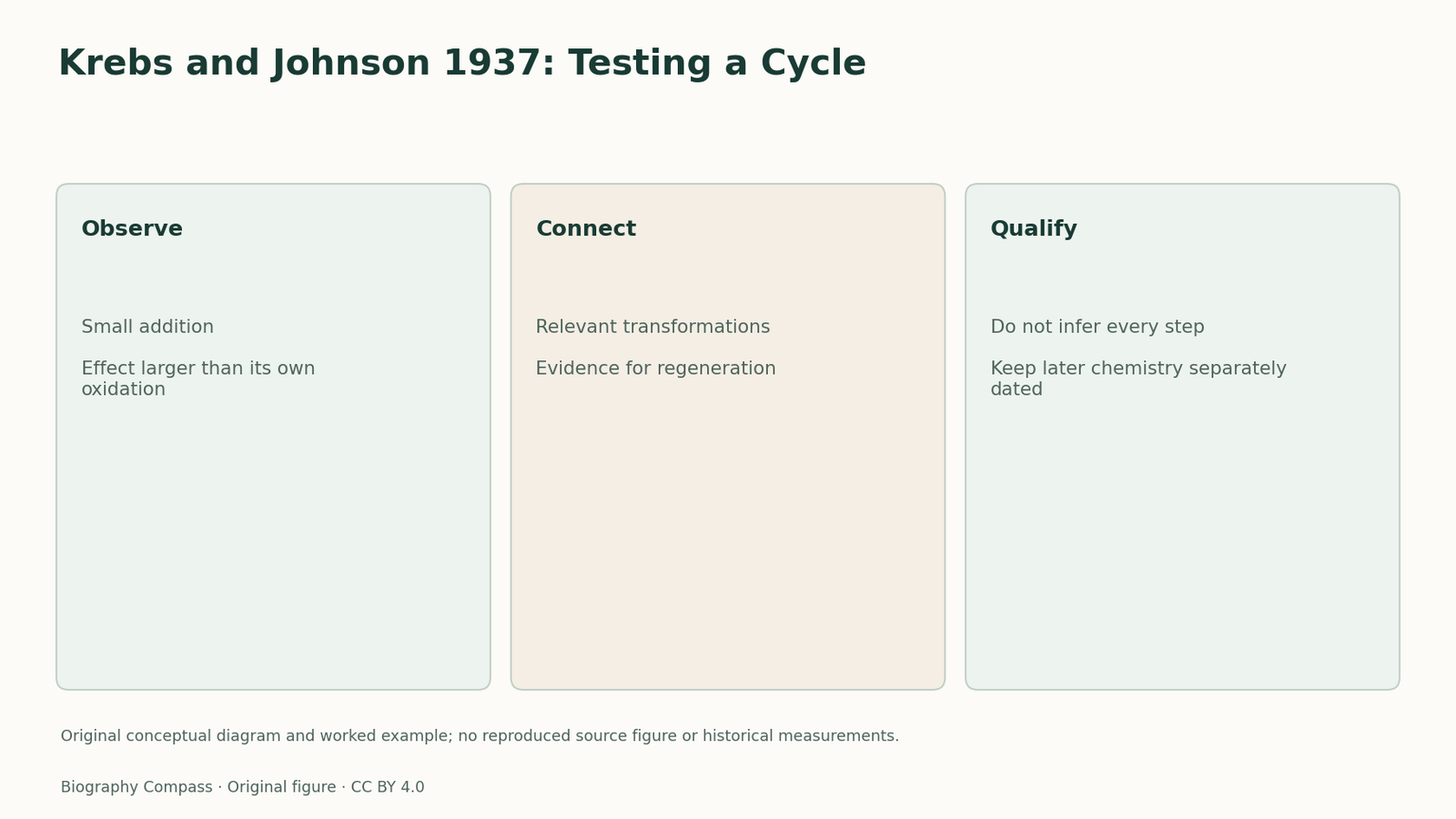
The question behind the cycle was not merely whether tissue could oxidise citrate. A substance consumed as an extra fuel could increase oxygen uptake without forming part of a regenerating pathway. Krebs’s lecture describes earlier experiments in which small amounts of related acids stimulated respiration by more than their own complete oxidation could explain. The 1937 proposal placed citrate within that wider problem. An informative account therefore compares the observed effect with an explicit alternative, rather than treating any stimulation as proof of a cycle.
The proposal assembled evidence from several laboratories
Krebs and Johnson’s original report acknowledged work on the four-carbon acids and on citrate oxidation. In his later lecture, Krebs described Szent-Györgyi’s suitable muscle preparation, Stare and Baumann’s catalytic interpretation and Martius and Knoop’s work on citrate transformations. Those contributions supplied different parts of the argument. A list of oxidisable substances would not itself establish their order. Connecting transformations with regeneration was the substantive step, supported by rates and intermediate formation as well as respiration measurements.
Regeneration is a stronger claim than stimulation
In a cycle, an intermediate can participate repeatedly because subsequent reactions restore it. That interpretation can explain why a small starting pool supports a much larger total conversion. Nevertheless, excess oxygen uptake alone does not identify each chemical connection or exclude every alternative network. It becomes more persuasive when combined with evidence that candidate steps occur in the relevant tissue at adequate rates. This is a reasoning distinction derived from the historical programme, not a reconstruction of a modern laboratory protocol or a claim that one graph independently established every step.
The 1937 account should retain its historical limits
The early paper’s scheme was a developing explanation, not a complete modern textbook pathway. Krebs’s institutional biography also places the cycle within a much broader programme of intermediary metabolism. Lipmann’s subsequent coenzyme-A work helped make the chemistry of activated groups accessible; that later knowledge should not be assigned to the original cycle announcement. Separating dates makes the collaboration clearer: recognising cyclic organisation and establishing the detailed entry chemistry were related achievements, reached through different experiments and records.
An original comparison and answer
Imagine a fictional system in which one unit of an added compound could consume two oxygen units if oxidised just once. After a small addition, the measured increase is twenty oxygen units. Does that prove a particular cycle? No. It rejects the narrow explanation that oxidation of the added amount alone accounts for the whole increase, assuming the measurements and background comparison are sound. Regeneration is a candidate explanation, but the reaction connections still need evidence. These invented units are not historical Krebs data. The answer should ask whether the compound or its functional pool is restored, whether the proposed transformations occur, and whether another stimulatory process could explain the result. The calculation distinguishes an explanatory constraint from a complete pathway identification.
Continue the chronology
Related history guides
Coenzyme A: A Transfer Factor, Not ATP
Follow Lipmann’s cofactor assay and collaborative identification programme, with an original exercise separating restored acetylation from energy and molecular purity.
Read the timeline1942–1964Tracing Cholesterol: Label and Pathway
Compare early deuterium-labelled acetate experiments with later carbon mapping, and use an original tracer exercise to test what product labelling establishes.
Read the timelineBiography context
Explore United Kingdom through connected lives
Connected biographies
Researchers and related approaches
1900–1981
Hans Adolf Krebs
Biochemist and metabolic researcherHans Krebs investigated how cells transform nutrients, bringing separate metabolic reactions into the citric acid cycle with William Arthur Johnson in Sheffield.Read biography1918–2007
Arthur Kornberg
Biochemist and DNA-replication researcherKornberg's group isolated DNA polymerase from bacteria in 1956.Read biographyQuick answers
Common questions
- Does increased respiration alone prove a cycle?
- No. It constrains explanations but does not establish all reaction links.
- Did the 1937 scheme include the complete later coenzyme-A mechanism?
- No. The detailed chemistry continued to develop.
Primary and institutional sources
How this history was checked
The references below distinguish the original study from later explanations. The worked exercise and comparison are newly written for this article. This article was reviewed on 8 November 2026.