
The short answer
How did fractionating yeast juice distinguish a heat-stable cofactor requirement from the protein component of fermentation?
Read the evidence
Different records within the same investigation
The following comparison distinguishes the specific questions answered by the inspected records.
| Record or test | What it establishes | What remains different |
|---|---|---|
| Boiled-juice addition | Can supply several factors at once. | A response does not uniquely identify one ingredient. |
| Matched-phosphate restoration | Tests a requirement beyond a phosphate-only explanation. | Does not alone determine a cofactor’s molecular structure. |
| Preparation controls | Check whether a fraction retains the capability needed for comparison. | An irreversibly damaged fraction can make a negative result ambiguous. |
An extract made the component question accessible
Once fermentation could occur outside intact yeast cells, activity in an extract still needed explanation. Harden and Young investigated preparations whose fermenting power could diminish or be restored. That moved the question from whether a living cell was essential toward which parts of a cell-derived mixture were required. Harden’s contemporary account separates a heat-sensitive enzyme component from a heat-stable, dialysable coferment. Those were operational experimental distinctions before the coferment’s complete molecular identity was known.
Adding boiled juice could change more than one ingredient
Boiled juice contained both phosphate and the coferment activity. A stronger response after its addition therefore could not automatically be assigned to only one of them. Harden’s book explicitly discusses distinguishing these requirements with preparations and controls. This is an early example of a general problem in mixture experiments: one addition can carry several potentially relevant substances. The useful test changes or restores a defined factor while making the competing explanation as comparable as the preparation permits.
Sources for this section: [1]
Recombination supplied evidence for a missing requirement
The book describes an inactive residue that could regain fermentation when a coenzyme-containing solution was supplied under matched phosphate conditions. That result supported the presence of an enzyme component unable to operate without the missing factor. It did not yet establish the factor’s full chemical structure. Likewise, calling the factor heat-stable described its behaviour relative to the tested treatment, not an unlimited resistance to every chemical or thermal condition. The observed restoration and the later identification of a purified molecule belong to different stages of investigation.
Sources for this section: [1]
The retrospective lecture keeps phosphate in the picture
Harden’s Nobel lecture revisits the distinction between coenzyme and inorganic phosphate and discusses how phosphate availability affects fermentation. The records therefore should not be condensed into a claim that one mysterious additive explains every change in an extract. A sample may cease functioning because different components become limiting or lose activity. The appropriate restoration test depends on that preparation. A careful history preserves the operational meaning of the early terms rather than treating a crude fraction as though it had already been a chemically pure modern reagent.
An original two-fraction exercise and answer
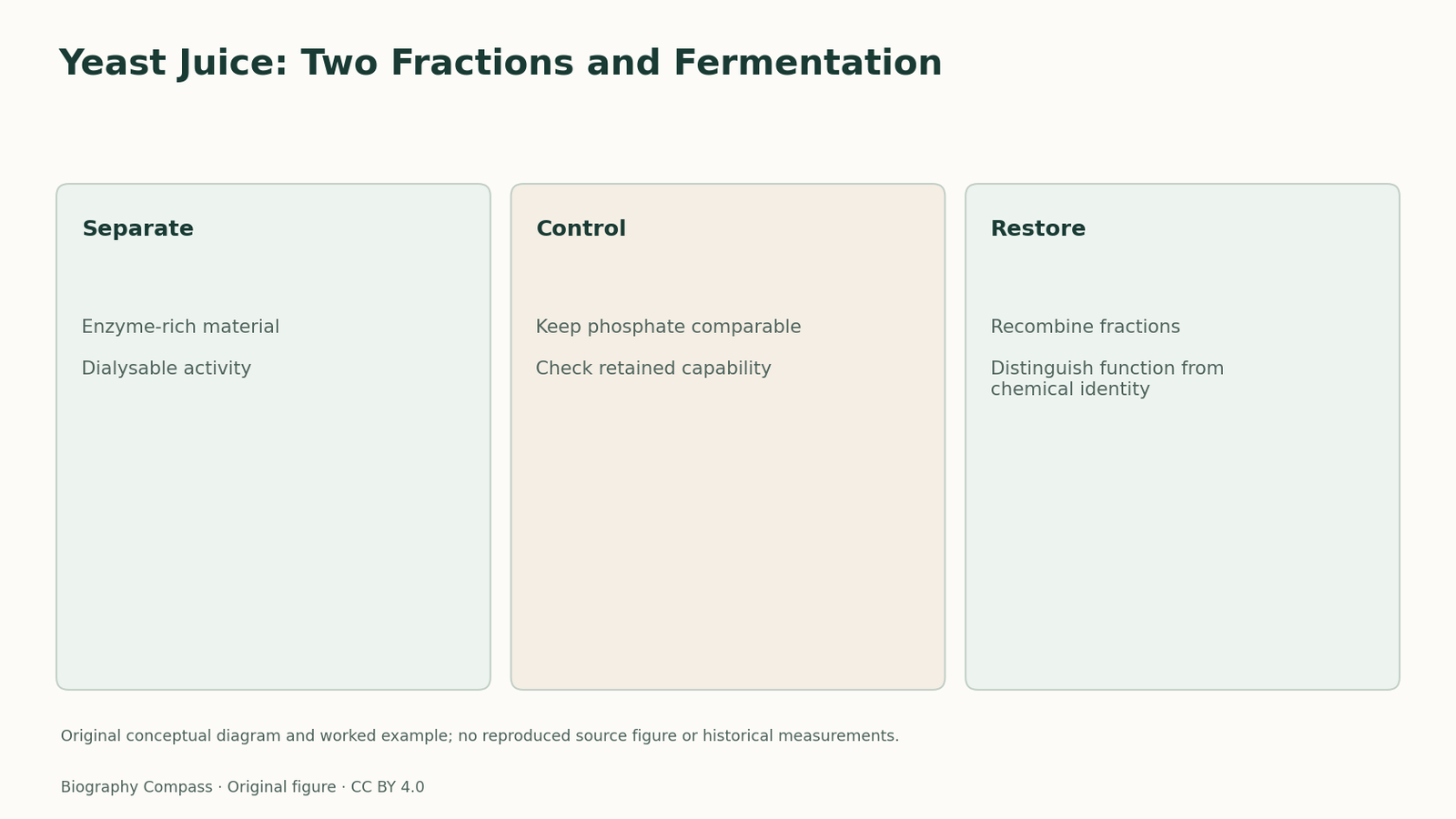
Imagine an invented enzyme-rich fraction R and a dialysable fraction F. Neither produces the measured reaction alone, while R plus F does. Phosphate is held at the same adequate level in all comparisons. What does the restoration support? Under those assumptions, F supplies a requirement missing from R, and that requirement is not explained merely by adding more phosphate. It does not establish that F contains only one molecule or that its active component has been chemically identified. These are teaching labels, not copied laboratory quantities or a fermentation recipe. If R had been irreversibly damaged, failure of R plus F would not show that F was irrelevant. The supported answer therefore distinguishes a positive complementation result from an uninterpretable failed preparation and asks how the material’s retained capability was checked.
Continue the chronology
Related history guides
Coenzyme A: A Transfer Factor, Not ATP
Follow Lipmann’s cofactor assay and collaborative identification programme, with an original exercise separating restored acetylation from energy and molecular purity.
Read the timeline1936–1953Krebs and Johnson 1937: Testing a Cycle
Examine the evidence behind the 1937 citric acid cycle, separating catalytic regeneration from simple citrate consumption through a worked reasoning exercise.
Read the timelineBiography context
Explore United Kingdom through connected lives
Connected biographies
Researchers and related approaches
1865–1940
Arthur Harden
Biochemist and fermentation researcherArthur Harden studied fermentation in yeast extracts with William Young, distinguishing phosphate effects from a heat-stable cofactor required by the enzyme system.Read biography1918–2007
Arthur Kornberg
Biochemist and DNA-replication researcherKornberg's group isolated DNA polymerase from bacteria in 1956.Read biographyQuick answers
Common questions
- Why hold phosphate comparable?
- It separates the cofactor question from a second ingredient that boiled juice can also supply.
- Does heat-stable mean indestructible?
- No. It describes behaviour under specified treatments, not every possible condition.
Primary and institutional sources
How this history was checked
The references below distinguish the original study from later explanations. The worked exercise and comparison are newly written for this article. This article was reviewed on 8 November 2026.