
The short answer
A recording of water can document a place, but a composer can also use it to change the direction of a work. Records surrounding Douglas Lilburn’s Soundscape with Lake and River distinguish the source of a sound from the formal job assigned to it. An original paper cue plan makes that distinction practical.
Original source comparison
Compare what each record actually describes
Keep the record’s purpose attached to the claim drawn from it.
| Record | What it establishes | How the guide uses it |
|---|---|---|
| Label and institutional records | Identity, context and variety of source material across electronic works. | Distinguish a work’s metadata from a complete listening analysis. |
| Young’s selected thesis pages | A reproduced composer note and an argument about formal pivots. | Name the route through which the statement was read. |
| Original cue plan | Stated block durations and two specified overlaps. | Test assembly choices without claiming a reconstruction of Soundscape. |
Chronology
A timeline of the turning points
Studio exploration
Lilburn studied electronic-music practice overseas.
University facility
The Wellington studio began operations.
Soundscape
The work combined environmental reference with electronic composition.
Record note
The composer’s note later cited by Young explained the recordings’ formal role.
Electronic music describes a field of practice, not one source of sound
Atoll’s description of Lilburn’s collected electronic works distinguishes purely electronic pieces from works inspired by natural sounds or literary writing. The detailed biography places his experiments after studio visits in 1963 and the opening of the university studio in October 1966. These records challenge the assumption that electronic composition must consist entirely of synthetic tones. Equipment provides ways to record, arrange and transform material; it does not determine that every source must be electronically generated. The question is what a particular composition does with the materials it uses.
Identify the work without pretending the record is the sound
The Te Ara caption identifies Soundscape with Lake and River as a 1979 electroacoustic composition. The biographical account relates it to aural impressions of Lake Taupō, while Atoll supplies a later recording entry. Those records locate the work, but a track title or duration does not reveal its complete form. The audio was not played for this guide. Instead, the analysis begins with a written account of the relationship between recorded environmental material and electronically generated material, and identifies the route by which that account survives.
A reproduced composer note gives the recordings a formal role
John Young’s university thesis reproduces a passage from Lilburn’s note to the 1980 record release. In that passage, the lake and river sounds come from recorded experience and function as pivots in the composition, suggesting transitions between parts of a day. Young’s surrounding analysis distinguishes the natural material from electronic sections and treats the contrast as a matter of musical form. Here the composer’s account is encountered through Young’s cited reproduction, not through an independently inspected record sleeve. The distinction preserves both the statement and its documentary route.
Sources for this section: [4]
Source recognition does not make a work an unedited field document
Recognising water in a recording answers a question about its apparent source. It does not establish that the complete composition reproduces one continuous outdoor event or that every sound was captured at the same time. Selection, placement and the surrounding material can give a recording a new function. This is the useful implication of the formal-pivot account: an environmental sound may connect two sections rather than supply their subject matter in a literal narrative. The label’s broader description and Young’s analysis therefore answer related but different questions about material and organisation.
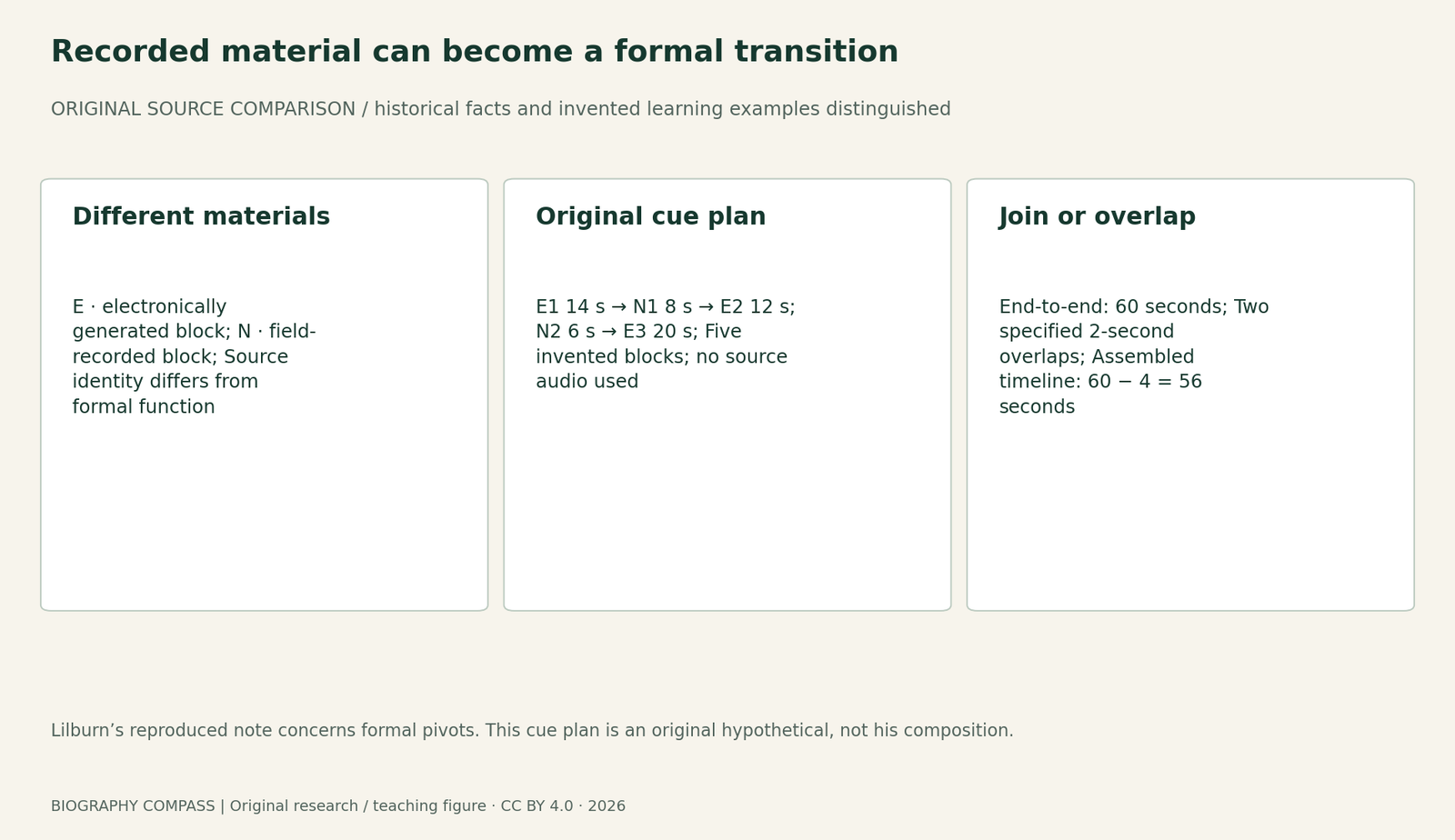
Original exercise: arrange five imaginary sound blocks
Use invented blocks E1, N1, E2, N2 and E3 in that order. E means an electronically generated block; N means a field-recorded block. Their source durations are fourteen, eight, twelve, six and twenty seconds respectively. First calculate the duration with simple end-to-end joins. Then apply a two-second overlap only at N1→E2 and N2→E3, leaving the other joins unchanged. Calculate the resulting duration and explain how the two N blocks might serve as transitions. The numbers, source labels and order are original teaching assumptions, not a transcription of Lilburn’s composition.
Reference answer: a transition is an arrangement decision
End-to-end duration is 14 + 8 + 12 + 6 + 20 = 60 seconds. The two specified overlaps remove four seconds from the finished timeline, giving 56 seconds. An N block could mark a change of atmosphere or bridge contrasting electronic textures, while the overlaps let the next block enter before it ends. That is one compositional proposal, not the only meaning of recorded water. The exercise also separates source duration from assembled duration. The historical records support a question about how materials are organised; they do not authorise replacing Lilburn’s actual work with this invented sequence or presenting the diagram as a listening analysis.
Continue the chronology
Related history guides
Why are three Len Lye films three different production problems?
Compare three original gallery programme entries to distinguish direct painting, stencilling and puppet animation, then solve a short original frame-planning exercise.
Read the timeline1948–1951Why did buying Pleasure Garden not put it in the public gallery?
Compare museum records of Pleasure Garden’s selection, subscriber purchase and rejected gift, then test which decision a short historical caption can support.
Read the timelineBiography context
Explore New Zealand through connected lives
Douglas Lilburn biography
Read the wider working life behind this focused question.
Explore the biographiesRelated learning guideWhy are three Len Lye films three different production problems?
Compare three original gallery programme entries to distinguish direct painting, stencilling and puppet animation, then solve a short original frame-planning exercise.
Explore the biographiesRelated learning guideWhy did buying Pleasure Garden not put it in the public gallery?
Compare museum records of Pleasure Garden’s selection, subscriber purchase and rejected gift, then test which decision a short historical caption can support.
Explore the biographiesConnected biographies
People connected with these records
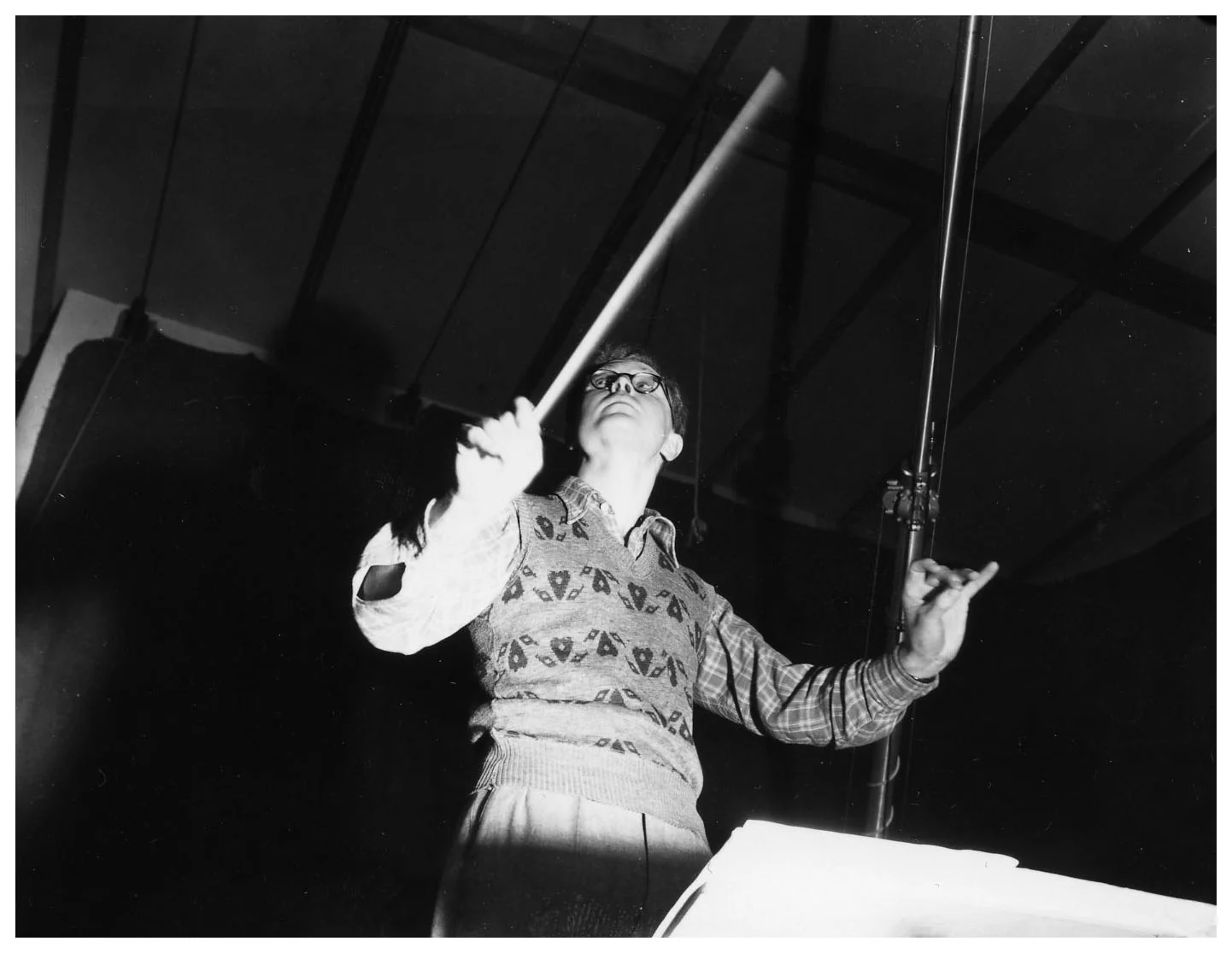
1915–2001
Douglas Lilburn
Composer, music teacher and supporter of New Zealand musicDouglas Lilburn was a New Zealand composer whose career moved from orchestral and chamber music towards electronic composition. Teaching, publishing and archival work accompanied his music and helped later composers build working careers.Read biographyQuick answers
Common questions
- Does an electronic work have to use only synthetic sounds?
- The label’s account explicitly distinguishes purely electronic works from those using natural or literary inspiration.
- Is the fifty-six-second plan Lilburn’s actual structure?
- No. It is an original exercise in arranging materials and calculating overlaps.
Primary and institutional sources
How this history was checked
Compare the dated records and named interpretations. The exercises and reference answers are original teaching examples. This article was reviewed on 27 October 2026.
- Atoll RecordsComplete Electro-Acoustic Works, ACD404
- Philip Norman, Dictionary of New Zealand Biography / Manatū TaongaLilburn, Douglas Gordon
- William Dart, Te Ara / Manatū TaongaDouglas Lilburn: Soundscape with Lake and River
- John Young, University of Canterbury thesis, volume2Source recognition of environmental sounds in the composition of sonic art: selected analysis