
In this biography
Quick facts
- Born
- 2 November 1915
- Died
- 6 June 2001
- Birthplace
- Whanganui, New Zealand
- Country
- New Zealand
- Nationality
- Not independently established
- Known for
- Orchestral and chamber works, electronic music and musical institutions
- Birth
- 2 November 1915, Whanganui
- London study
- Royal College of Music, 1937–1940
- Electronic studio
- Operations began October 1966
- Death
- 6 June 2001, Wellington
Why this life matters
He made local experience a continuing compositional question across changing techniques, while helping establish the studio, editions, archive and financial support through which New Zealand music could develop.
Timeline
Key moments
Birth
Born in Whanganui.
London study
Studied composition with Ralph Vaughan Williams.
Literary collaboration
Composed Landfall in Unknown Seas to Allen Curnow’s words.
Wellington
Moved permanently for a full-time university position.
Electronic studio
The university studio began operations in October.
Music editions
Founded Wai-te-ata Press Music Editions.
Archive
Helped establish the Archive of New Zealand Music.
Death
Died in Wellington on 6 June.
A rural childhood preceded formal musical training
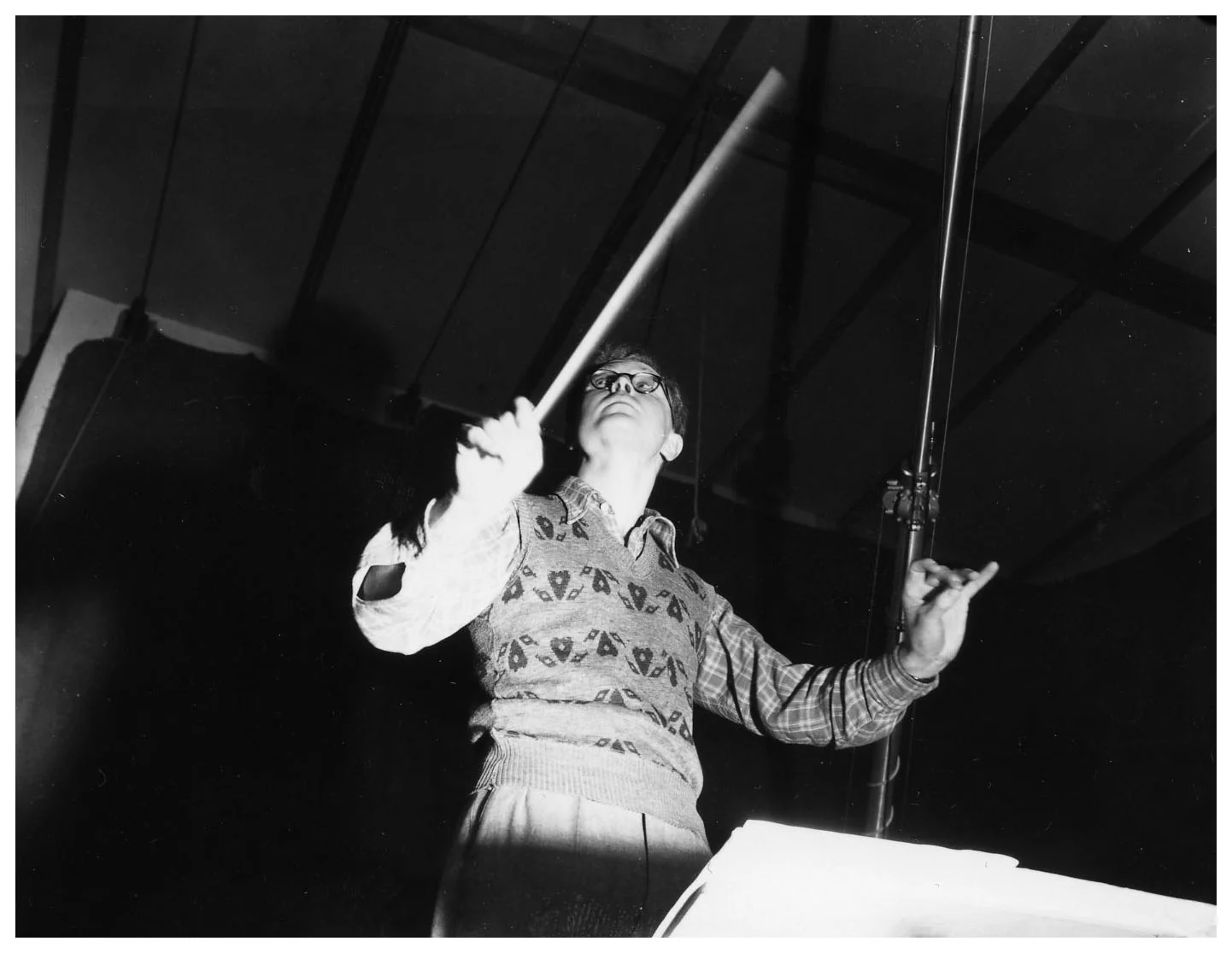
Lilburn was born in Whanganui on 2 November 1915 and spent his early childhood at Drysdale Station in the Turakina valley. Schooling eventually took him to Waitaki Boys’ High School and then Canterbury University College. He began with journalism before turning to music study. A composition prize encouraged the developing ambition. Between 1937 and 1940 he studied at London’s Royal College of Music, with Ralph Vaughan Williams as his principal composition tutor. College awards and success in the New Zealand Centennial competitions helped establish a professional direction before his return home in 1940.
Sources for this section: [1]
Christchurch brought literary friendships and substantial works
During the 1940s Lilburn worked in Christchurch as a freelance composer, conductor, teacher and critic. His circle included Denis Glover, Allen Curnow, Ngaio Marsh and artists such as Rita Angus and Leo Bensemann. Landfall in Unknown Seas, composed in 1942 to Curnow’s words, is one example of the connections between writing and music. Chamber pieces and orchestral works also occupied this period. The career depended on relationships with performers and other artists as well as the solitary work of composition, within a country where opportunities for professional music-making were still developing.
Sources for this section: [1]
Teaching accompanied a changing musical language
An offer from Frederick Page brought Lilburn into part-time teaching at Victoria University College. He commuted for a period before moving permanently to Wellington for full-time employment in 1949. His first two symphonies and song cycles belonged to the following years. An overseas sabbatical in 1955 exposed him to a different musical environment, and serial techniques briefly became part of his work. Symphony No. 3 in 1961 was among his last major works for conventional forces. The biographical account describes a composer reconsidering technique rather than remaining within one fixed national style.
Sources for this section: [1]
Electronic composition opened another working medium
After visiting studios overseas in 1963, Lilburn explored taped and electronically generated sound more seriously. The Return in 1965 related electronic composition to Alistair Campbell’s poetry and was realised at broadcasting studios in Wellington. A custom-built university studio began operations in October 1966. It provided facilities for Lilburn and younger composers to work with a different set of materials. His later compositions included Three Inscapes, Carousel and Soundscape with Lake and River. The label’s description distinguishes purely electronic pieces from works drawing on natural sounds or literary sources, indicating variety within the electronic period itself.
Publishing and preservation extended the practical support
In 1967 Lilburn founded Wai-te-ata Press Music Editions to make New Zealand compositions available for performance and study. He also helped establish the Archive of New Zealand Music at the Alexander Turnbull Library in 1974. The library’s institutional account credits his suggestion and describes a collection extending beyond published scores to composers’ papers and sound materials. A decade later he established the Lilburn Trust using his savings. These initiatives addressed different needs: a composition had to be distributed, performed, preserved and supported if it was to become part of a durable musical culture.
Retirement did not end his support for other composers
Lilburn retired in 1980 and divided his time between Wellington and a retreat in Central Otago. He continued correspondence, charitable giving and work supporting composition. The Order of New Zealand in 1988 recognised a career that included both music and the encouragement of others. He died in Wellington on 6 June 2001. Later recordings and preservation projects have made more of the work accessible, while the studio and archival initiatives remain important parts of the historical record. His legacy joins artistic experimentation to the practical institutions needed by subsequent generations.
Quick answers
Frequently asked questions about Douglas Lilburn
- Did the electronic studio begin operating in 1963?
- The detailed biography distinguishes overseas study in 1963 from the studio’s operation beginning in October 1966.
- Was electronic composition his only contribution?
- No. He also wrote orchestral and chamber music, taught, published scores and supported archival preservation and other composers.
Keep exploring
Lives connected to this story
- Gillian Whitehead
Compare another New Zealand composer’s work across musical traditions and institutions.
- Kiri Te Kanawa
Place composition alongside a different career in musical performance.
- Ngaio Marsh
Read another member of the Christchurch artistic circle of the 1940s.
Sources and further reading
Explore the evidence
These references support the biography and offer further reading. Official records, first-person accounts and independent reporting provide different perspectives; image records document attribution and licensing.
- 1. Philip Norman, Dictionary of New Zealand Biography / Manatū TaongaLilburn, Douglas Gordon
Actual original substantive biography read through saved web-tool text: exact life dates, studies, named literary/teaching relationships,1963 experiments,October 1966 studio,1965 The Return,1979 Soundscape,1967 press/1974 archive/1984 trust. Direct HTML 403 retained. No compositions, complete score or recording heard/read; biographer’s musical characterisations remain attributed.
- 2. National Library of New Zealand / Alexander Turnbull LibraryArchive of New Zealand Music
Actual indexed original institutional account read: archive established 1974 atLilburn’s suggestion; material types and preservation/access through surrogate copies. Saved actual web response; no underlying collection items, audio, full archive or donor instruments inspected.
- 3. Atoll RecordsComplete Electro-Acoustic Works, ACD404
Actual original label title/description and selected track listing acquired/read. Distinguishes purely electronic works and those inspired by natural/literary sources; Soundscape listed 11:04 on this release. No streaming, samples, booklet, entire album or DVD consumed; release duration not treated as composition’s universal timing.
- 4. William Dart, Te Ara / Manatū TaongaDouglas Lilburn: Soundscape with Lake and River
Actual indexed original short caption read:1963 study,1966 studio,1979 electroacousticwork and separate audio/image restrictions. Direct 403 retained. The audio clip was not played/downloaded and no photograph/audio reused.