
The short answer
Private supporters bought a painting, yet it still did not enter the city’s public collection. The history of Frances Hodgkins’s Pleasure Garden separates decisions that a short acquisition caption can easily collapse: choosing a work, paying for it and accepting it into a municipal collection.
Original source comparison
Compare what each record actually describes
Keep the record’s purpose attached to the claim drawn from it.
| Record | What it establishes | How the guide uses it |
|---|---|---|
| Current collection fields | Title, medium and 1951 gift credit; current creation date 1932. | Separate the work’s record fields from the later event sequence. |
| Preserved historical labels | Earlier descriptions, a 1949 offer and a 1933 creation date in older text. | Retain date and narrative conflicts without confusing creation with acquisition. |
| Te Papa narrative | Subscription organised by Barbara Frankel and later municipal acceptance. | Identify different actors and the distinction between payment and acceptance. |
Chronology
A timeline of the turning points
Works arrive
Six Hodgkins works reached Christchurch for consideration.
Offer rejected
The gallery’s historical label dates an initial gift offer to this year.
Gift accepted
The painting entered the city’s public collection after renewed consideration.
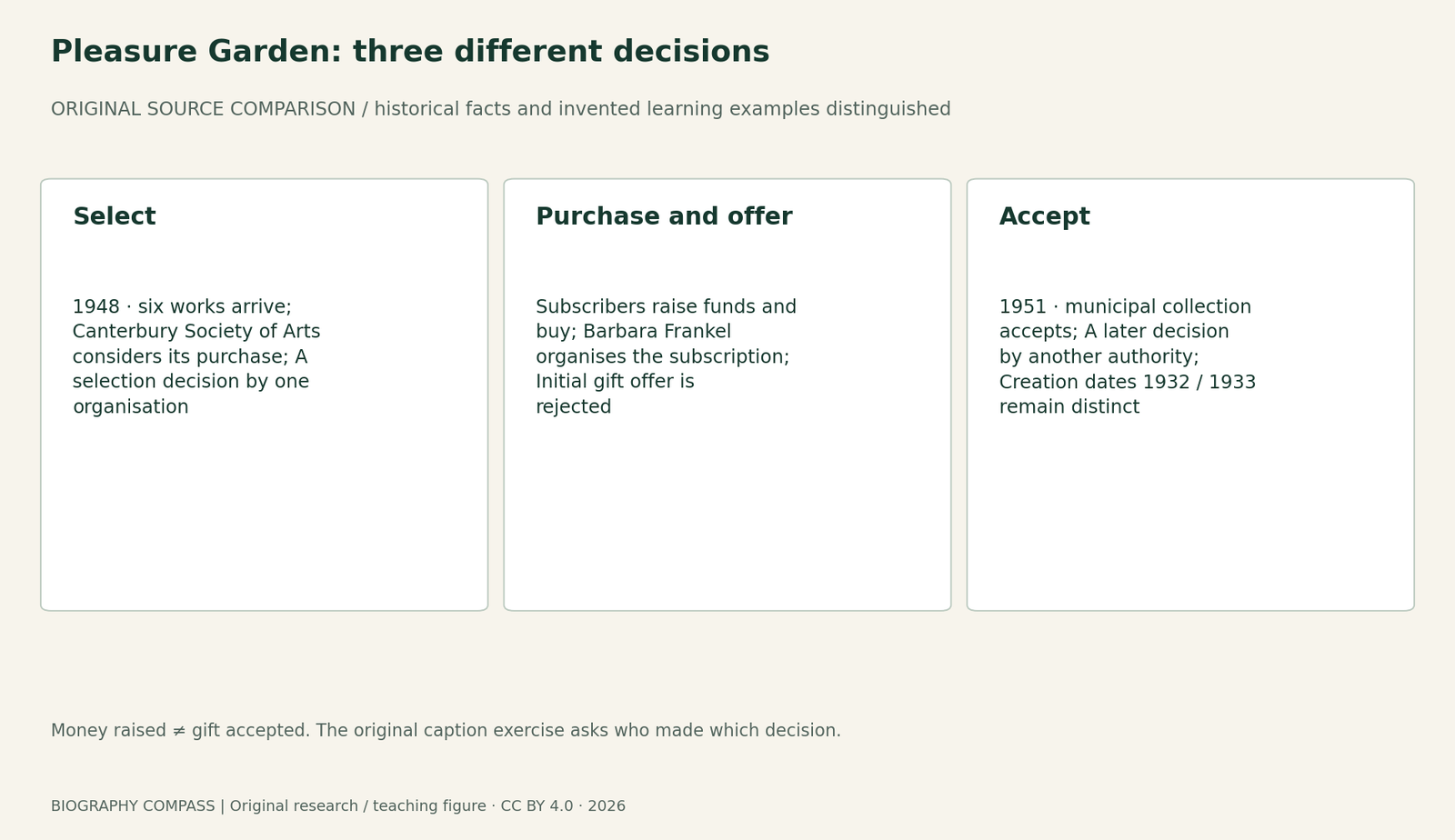
Selection was a decision by a particular organisation
The two museum accounts begin with six Hodgkins works sent to Christchurch in 1948 after the Canterbury Society of Arts asked for a selection. The Society’s decision was about what it would acquire. It should not automatically be read as a decision by every local artist, donor or public institution. The current gallery label names artists including Rita Angus, Colin McCahon and Olivia Spencer Bower among supporters of Pleasure Garden. The record thus contains disagreement within the local art world, rather than one unanimous public response to modern painting.
The subscribers’ purchase created a second stage
Te Papa’s account identifies Barbara Frankel as an organiser of the public subscription. Money was raised and the painting was purchased. That act changed who could offer the work, but it did not itself require the city to take ownership or display it. A purchase receipt would answer who bought what and when; it would not necessarily establish a municipal accession. The supporters then offered the painting to the city’s gallery. Understanding the sequence requires keeping the subscribers’ action distinct from the authority that would decide whether to accept their gift.
The offer and its acceptance were separate events
The Christchurch gallery’s 2009–2011 label dates the initial offer to 1949 and records its rejection. Both museum accounts identify acceptance in 1951, after further controversy. Te Papa describes petitions, letters and renewed consideration, including interest from Auckland. These are retrospective institutional accounts, not original council minutes inspected for this guide. They nevertheless establish a crucial distinction: public debate and a willing donor did not amount to completed acceptance. The painting’s eventual place in the collection resulted from a later decision, after an earlier refusal.
Even one collection page can retain different historical descriptions
The current record dates the painting to 1932, while older labels preserved on the same page use 1933. That concerns the work’s creation, not the later gift. Older and current labels also differ in how they describe the Society’s choice among the offered works. Those differences should be retained as questions rather than silently combined into a perfectly uniform narrative. For this guide the stable point is the sequence of selection, subscriber purchase and municipal acceptance in 1951. A creation date, an offer date and an accession decision are different fields.
Original exercise: repair a caption with the wrong decision-maker
A fictional caption says: “The Canterbury Society of Arts purchased Pleasure Garden in 1948, so the city’s public gallery accepted it immediately. The collection number proves the creation year.” Identify three unsupported moves in that sentence. Write a replacement of no more than sixty words using only the stable information in the two museum accounts. Then name the specific original record you would seek to test a claim about the council vote. Do not treat the museum narratives as though they were a photographed minute book, or infer an artwork’s date from an unexplained registration number.
Reference answer: name the actor and the event
One possible replacement is: “Pleasure Garden reached Christchurch in 1948 among works sent for consideration. Supporters organised its purchase and offered it to the city’s gallery. The offer was initially rejected; acceptance followed in 1951. The collection page retains differing creation dates.” The errors concern the buyer, immediate acceptance and an unexplained code used as a date. An actual vote claim would require the relevant council minutes and decision, ideally read with the gift correspondence. This correction preserves the significance of the controversy while identifying the separate actions that made a public acquisition possible.
Continue the chronology
Related history guides
Why are three Len Lye films three different production problems?
Compare three original gallery programme entries to distinguish direct painting, stencilling and puppet animation, then solve a short original frame-planning exercise.
Read the timeline1963–1979How can recorded nature organise an electronic composition?
Compare Lilburn’s Soundscape records with a reproduced composer note, then build an original cue plan that separates recorded material from musical structure.
Read the timelineBiography context
Explore New Zealand through connected lives
Frances Hodgkins biography
Read the wider working life behind this focused question.
Explore the biographiesColin McCahonColin McCahon biography
Read the wider working life behind this focused question.
Explore the biographiesRelated learning guideWhy are three Len Lye films three different production problems?
Compare three original gallery programme entries to distinguish direct painting, stencilling and puppet animation, then solve a short original frame-planning exercise.
Explore the biographiesRelated learning guideHow can recorded nature organise an electronic composition?
Compare Lilburn’s Soundscape records with a reproduced composer note, then build an original cue plan that separates recorded material from musical structure.
Explore the biographiesConnected biographies
People connected with these records
1869–1947
Frances Hodgkins
Painter and art teacherFrances Hodgkins was a New Zealand-born painter whose long working life centred increasingly on Europe. Teaching, travel, friendships and commercial support helped sustain a career that moved from figure painting towards a distinctive modernist language.Read biography1919–1987
Colin McCahon
Painter, gallery worker and art teacherColin McCahon was a New Zealand painter whose work joined landscape, religious questions and written language. Employment in galleries and teaching ran alongside an evolving practice that drew on local places and international art.Read biographyQuick answers
Common questions
- Did paying for the work guarantee public display?
- No. The subscriber purchase and the council’s acceptance were separate stages.
- Does this guide settle the painting’s 1932/1933 date?
- No. It records the difference and uses the stable acquisition sequence without forcing a single creation year.
Primary and institutional sources
How this history was checked
Compare the dated records and named interpretations. The exercises and reference answers are original teaching examples. This article was reviewed on 27 October 2026.