
The short answer
An artist’s name does not identify a single production method. The gallery programme for Len Lye’s Colour Box puts three adjacent films beside one another, but describes different ways of making their images. Reading those entries closely turns a broad label such as experimental animation into a set of practical decisions.
Original source comparison
Compare what each record actually describes
Keep the record’s purpose attached to the claim drawn from it.
| Record | What it establishes | How the guide uses it |
|---|---|---|
| Gallery filmography | Technique, dates, colour processes and named collaborators. | Compare separate workflows within one artist’s practice. |
| Foundation work record | Direct painting and the GPO commission for A Colour Box. | Identify the relation between experimentation and a commissioned production. |
| Original frame model | A stated frame count and two assumed projection rates. | Calculate hypothetical duration without claiming historical timing measurements. |
Chronology
A timeline of the turning points
Photographed drawings
The programme describes Tusalava’s earlier conventional animation process.
Direct techniques
A Colour Box and Kaleidoscope use direct painting and stencilling.
Puppet production
The Birth of a Robot combines puppet animation with a different colour process.
Start with the actual programme entries
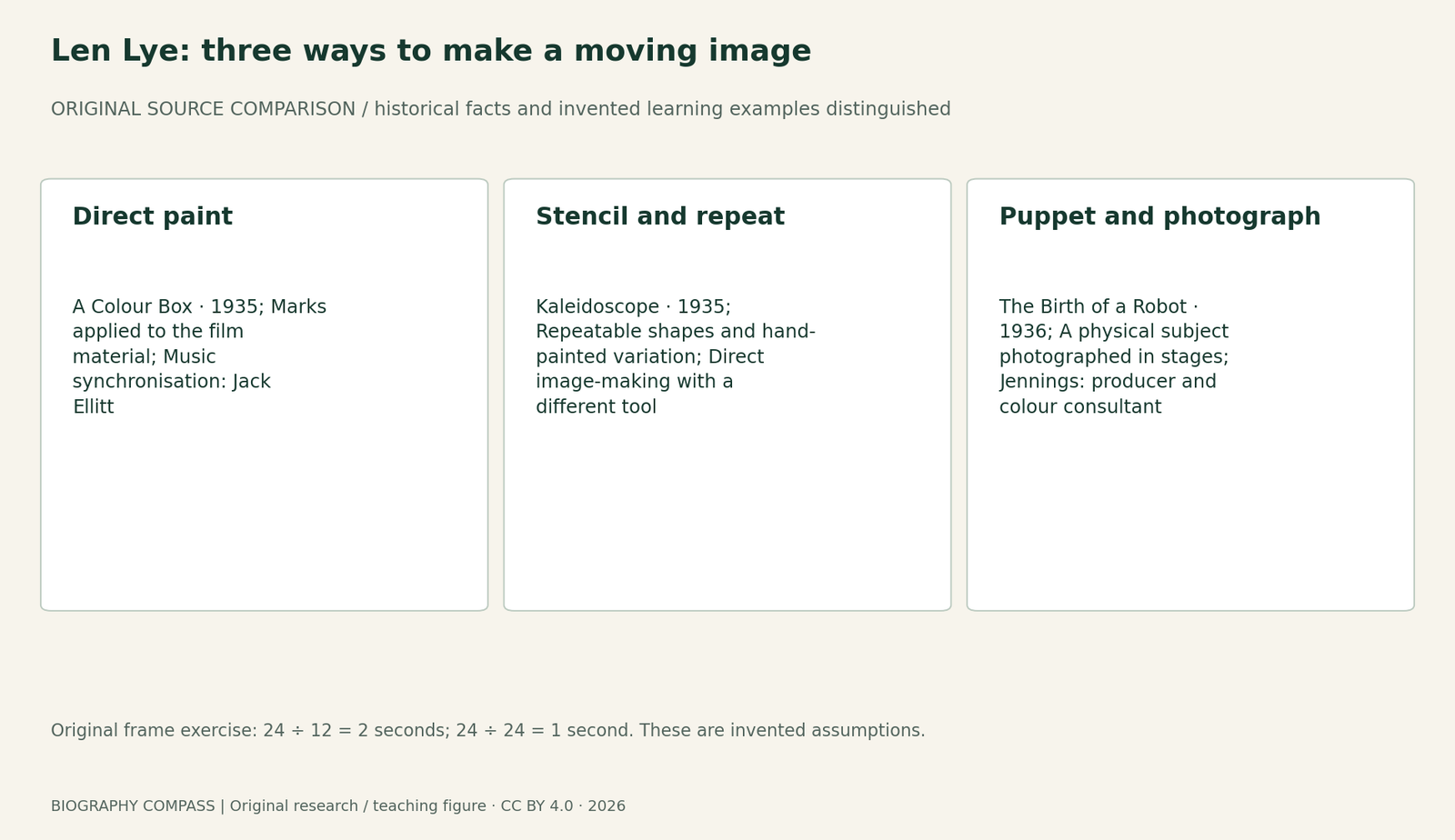
The Govett-Brewster programme’s filmography places A Colour Box, Kaleidoscope and The Birth of a Robot on one spread. It identifies the first two as 1935 films and the third as a 1936 production. Their proximity invites comparison, but their entries should not be flattened into one account of hand-painted animation. The first entry describes direct painting; the second adds stencilling; the third describes puppet animation. These are the programme’s explicit technical distinctions, rather than conclusions drawn here from watching the complete films.
Sources for this section: [1]
Direct painting places the image on the film material
For A Colour Box, the programme describes paint applied directly to film. The Foundation likewise identifies it as a camera-less work, combining designs with dance music. In that workflow, the image need not begin as a drawing photographed from another surface. Colour and marks become part of the strip itself. This is different from Lye’s earlier Tusalava, which the introductory essay describes as thousands of photographed drawings. The comparison identifies where the image is made, a more precise question than whether the result looks abstract, colourful or rhythmic.
Stencilling changes how a direct mark can be repeated
Kaleidoscope extends direct work through stencilling. A stencil provides a repeatable shape or opening while leaving choices about colour, placement and variation. The programme identifies both stencilled and hand-painted imagery in the film. Those methods can coexist within one production; it is unnecessary to force a film into only one tool category. The entry also identifies its sponsor and musical synchronisation with Jack Ellitt. The record therefore connects image-making technique with the other work needed to complete and circulate a commissioned film.
Sources for this section: [1]
Puppet animation introduces a different image-making chain
The Birth of a Robot is described as an elaborate puppet animation using Gasparcolour. Unlike a mark placed directly on a filmstrip, a puppet is a physical subject arranged for the camera. The programme names Humphrey Jennings as producer and colour consultant, with Ellitt working on music. The credits make the change of workflow visible: materials, photography, colour and musical work have to meet in one production. Shared authorship by Lye does not make this the same technical problem as a directly painted strip. Nor does the difference diminish the experimental character of either approach.
Sources for this section: [1]
Original exercise: match the instruction to the workflow
Consider three invented instruction cards. A says to paint changing marks directly onto a filmstrip. B says to apply colour through a repeating mask onto the strip, varying its position between units. C says to reposition a small physical figure between photographed exposures. Match each card to the closest method described in the programme, and identify which card necessarily introduces a photographed physical subject. Then suppose each plan supplies twenty-four projected frames. Calculate the running time at twelve frames per second and at twenty-four frames per second. These are teaching assumptions, not measurements of Lye’s actual films.
Reference answer: keep method, timing and collaboration distinct
A models direct painting; B models stencilling on film; C models puppet animation and requires photographing the physical subject. Twenty-four frames at twelve frames per second last two seconds; at twenty-four frames per second they last one second. That arithmetic tells us duration under the exercise’s assumptions, not how a historical soundtrack was synchronised. Ellitt’s named contribution in the programme is separate evidence about musical work. A useful production description should therefore identify where images are created, how change or repetition is organised, and who performs the other credited tasks. The three records support those questions without requiring copied frames, music or a complete-film review.
Continue the chronology
Related history guides
Why did buying Pleasure Garden not put it in the public gallery?
Compare museum records of Pleasure Garden’s selection, subscriber purchase and rejected gift, then test which decision a short historical caption can support.
Read the timeline1963–1979How can recorded nature organise an electronic composition?
Compare Lilburn’s Soundscape records with a reproduced composer note, then build an original cue plan that separates recorded material from musical structure.
Read the timelineBiography context
Explore United Kingdom through connected lives
Len Lye biography
Read the wider working life behind this focused question.
Explore the biographiesRelated learning guideWhy did buying Pleasure Garden not put it in the public gallery?
Compare museum records of Pleasure Garden’s selection, subscriber purchase and rejected gift, then test which decision a short historical caption can support.
Explore the biographiesRelated learning guideHow can recorded nature organise an electronic composition?
Compare Lilburn’s Soundscape records with a reproduced composer note, then build an original cue plan that separates recorded material from musical structure.
Explore the biographiesConnected biographies
People connected with these records
1901–1980
Len Lye
Filmmaker, kinetic sculptor and visual artistLen Lye was a New Zealand-born artist whose career crossed London and New York. His experiments joined painting, film and sculpture through a lasting interest in how movement could become an artistic medium.Read biographyQuick answers
Common questions
- Does direct film mean the soundtrack was created without recording equipment?
- No. The term here concerns image-making on film; the programme separately credits musical synchronisation.
- Are the twenty-four frames taken from a Lye film?
- No. They are an original numerical exercise, with no source image or music reproduced.
Primary and institutional sources
How this history was checked
Compare the dated records and named interpretations. The exercises and reference answers are original teaching examples. This article was reviewed on 27 October 2026.