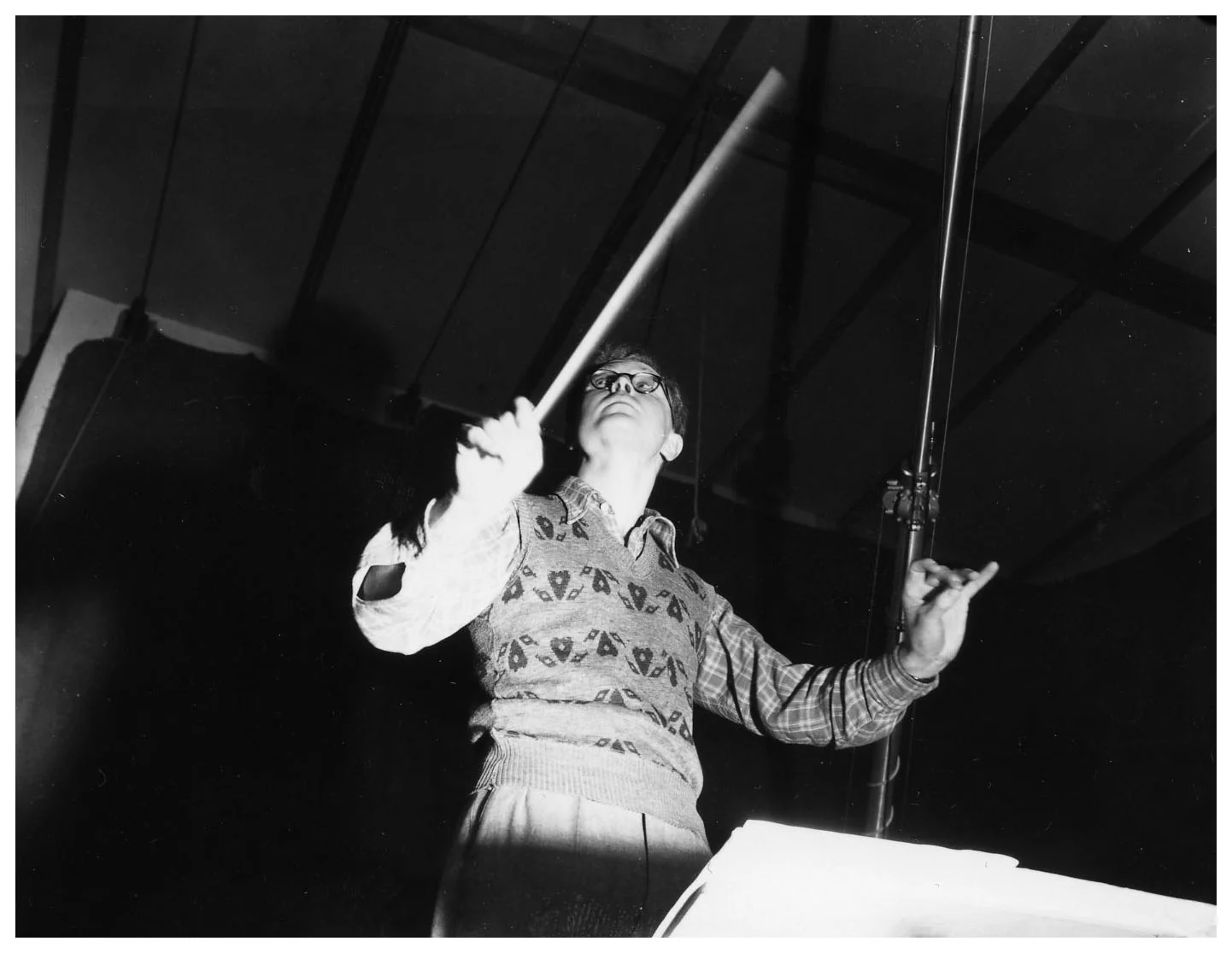
In this biography
Quick facts
- Born
- 5 July 1901
- Died
- 15 May 1980
- Birthplace
- Christchurch, New Zealand
- Country
- New Zealand
- Nationality
- Not independently established
- Known for
- Direct film, A Colour Box and sculptures composed through movement
- Birth
- 5 July 1901, Christchurch
- Early film
- Tusalava, 1929
- Direct film
- A Colour Box, 1935
- Foundation
- Established in 1980
Why this life matters
He helped extend animation beyond photographed drawings and developed kinetic sculpture as a form of performance, working with musicians, producers, engineers and institutions across several countries.
Timeline
Key moments
Birth
Born Leonard Charles Huia Lye in Christchurch.
London
Settled in London after time in Australia and Samoa.
Tusalava
The London Film Society premiered his early animated film.
A Colour Box
Made a direct-painted colour film associated with the GPO Film Unit.
New York
Relocated to the United States.
Motion sculpture
Presented An Evening of Tangible Motion Sculpture at MoMA.
Foundation and death
Established the Len Lye Foundation; died on 15 May.
An early interest in motion crossed several places
Lye was born in Christchurch on 5 July 1901. His childhood included Cape Campbell and Wellington, before adult travels took him to Sydney and Samoa. Those places formed part of a wider visual education that continued after he settled in London in 1926. The Foundation describes an artist interested in modernism as well as Māori, Aboriginal and Pacific visual traditions. Rather than following one academic training programme, he developed across places, materials and artistic networks. Movement became the connecting concern through which otherwise different kinds of work could belong to one career.
London supplied a network for experimental work
Lye joined the Seven and Five Society in 1928, placing him within a circle that included artists such as Ben Nicholson and Barbara Hepworth. He also participated in the 1936 International Surrealist Exhibition. Painting, batik and sculpture accompanied his film experiments. Tusalava premiered through the London Film Society in 1929; the gallery programme explains that its thousands of drawings were photographed by a conventional animation process. This labour-intensive beginning is important beside the later reputation for films made directly on celluloid. The methods changed as he explored what the medium could do.
Direct film combined material invention with commissioned work
A Colour Box in 1935 used designs painted directly onto film. The GPO Film Unit, led by John Grierson, provided a route to funding and distribution, while a postal advertisement formed part of the commission. The gallery’s programme credits Jack Ellitt with musical synchronisation to Don Baretto’s Cuban dance music. Later commissions included Kaleidoscope for a tobacco company and The Birth of a Robot for Shell-Mex and BP. These films used different techniques and collaborators: the latter’s puppet animation involved Humphrey Jennings as producer and colour consultant. Experimental work and commercial production were closely connected.
New York brought another period of film experimentation
In 1944 Lye moved to the United States, working on film projects for Time Inc. His later experimental films included Color Cry, All Souls Carnival and Free Radicals. The Govett-Brewster timeline describes a subsequent movement away from filmmaking towards kinetic sculpture. This was a change of emphasis within the same interest in motion, rather than a complete break with the earlier work. Film offered moving light on a screen; sculpture made the behaviour of materials in actual space part of the artistic event. Both demanded practical experimentation as well as an idea of what movement might express.
Sculptures made movement an event in physical space
Lye tested Wind Wand sculptures in New York in 1960. The following April he presented An Evening of Tangible Motion Sculpture at the Museum of Modern Art. Exhibitions of kinetic work followed during the 1960s, including presentations at the Howard Wise Gallery and other institutions. The gallery record places these events within an international discussion of moving art. Their scale also made construction, space and technical support consequential. A sculpture intended to move had to be realised materially and presented under working conditions; it was not simply a still object with a suggestive title.
Sources for this section: [1]
A foundation continued the work after his lifetime
The Govett-Brewster presented Kinetic Works in 1977, an important return of Lye’s work to New Zealand. In 1980 he established the Len Lye Foundation to care for his work and continue the project. He died in Warwick, New York, on 15 May that year. The relationship with New Plymouth subsequently gave his films, sculptures and archive a durable institutional home. His legacy includes the surviving works and the working relationships needed to preserve and realise them, alongside an example of an artist finding opportunities across different media and production systems.
Quick answers
Frequently asked questions about Len Lye
- Were all Lye’s films made without a camera?
- No. The selected programme distinguishes photographed drawings, direct film methods and puppet animation.
- Did the Foundation begin only after his death?
- The gallery timeline records its establishment in 1980, shortly before he died.
Keep exploring
Lives connected to this story
- Peter Jackson
Compare another New Zealand-born filmmaker’s relationship with technical invention.
- Frances Hodgkins
Read another expatriate artist associated with the Seven and Five Society.
- Colin McCahon
Compare another visual artist’s approach to place and form.
- Oskar Fischinger
Explore another approach to visual music and film material.
- John Akomfrah
Compare another way that production form can organise moving images.
- Robert Breer
Read Robert Breer for a separate, documented example of animation production and artistic collaboration. This is a contextual comparison, not an assertion of personal collaboration.
- Dick Frizzell
Compare Dick Frizzell’s transformations between familiar images and their contested cultural associations.
Sources and further reading
Explore the evidence
These references support the biography and offer further reading. Official records, first-person accounts and independent reporting provide different perspectives; image records document attribution and licensing.
- 1. Govett-Brewster Art Gallery / Len Lye CentreLen Lye’s Life
Actual original timeline HTML acquired and complete short career timeline read. Exact birth/death, London/New York, dated films, exhibitions and foundation. Historical future sculpture installations not confused with works built by Lye personally. No linked film or sculpture performance viewed.
- 2. The Len Lye FoundationAs an Artist in England
Actual short original England biography read: London 1926–1944, artistic networks, Tusalava and direct-film development. Promotional firsts and the quoted McLaren assessment are not reproduced. No films viewed.
- 3. The Len Lye FoundationA Colour Box, 1935
Actual complete short original work record read: direct painting on film, Cuban dance music, GPO commission/distribution and postal advertisement. No film played. First-ever/world-first and unverified festival/disruption superlatives not adopted.
- 4. Govett-Brewster Art Gallery / Len Lye CentreProjection Series: Len Lye’s Colour Box
Actual 8-page original PDF acquired/extracted. PDF 3 / printed 4–5 introductory essay and PDF 6 / printed 10–11 three filmography records read; entire PDF 6 rendered spread visually inspected. A Colour Box direct painting/Dufaycolour, Kaleidoscope stencilling, The Birth of a Robot puppet animation/Gasparcolour, Jack Ellitt and Humphrey Jennings roles. No whole catalogue, underlying films, soundtrack or artwork collection viewed/heard. No source still reproduced.
- 5. The Len Lye FoundationEarly Years
Actual indexed original short early-life account read: childhood, Cape Campbell, libraries and part-time art study; study of Māori, Aboriginal and Pacific design. No original notebooks or image collection inspected. Biographical superlatives and differing accounts of the precise length of his Samoa stay are not adopted.