
The short answer
How did bacterial mating challenge the idea of strictly clonal inheritance?
Evidence comparison
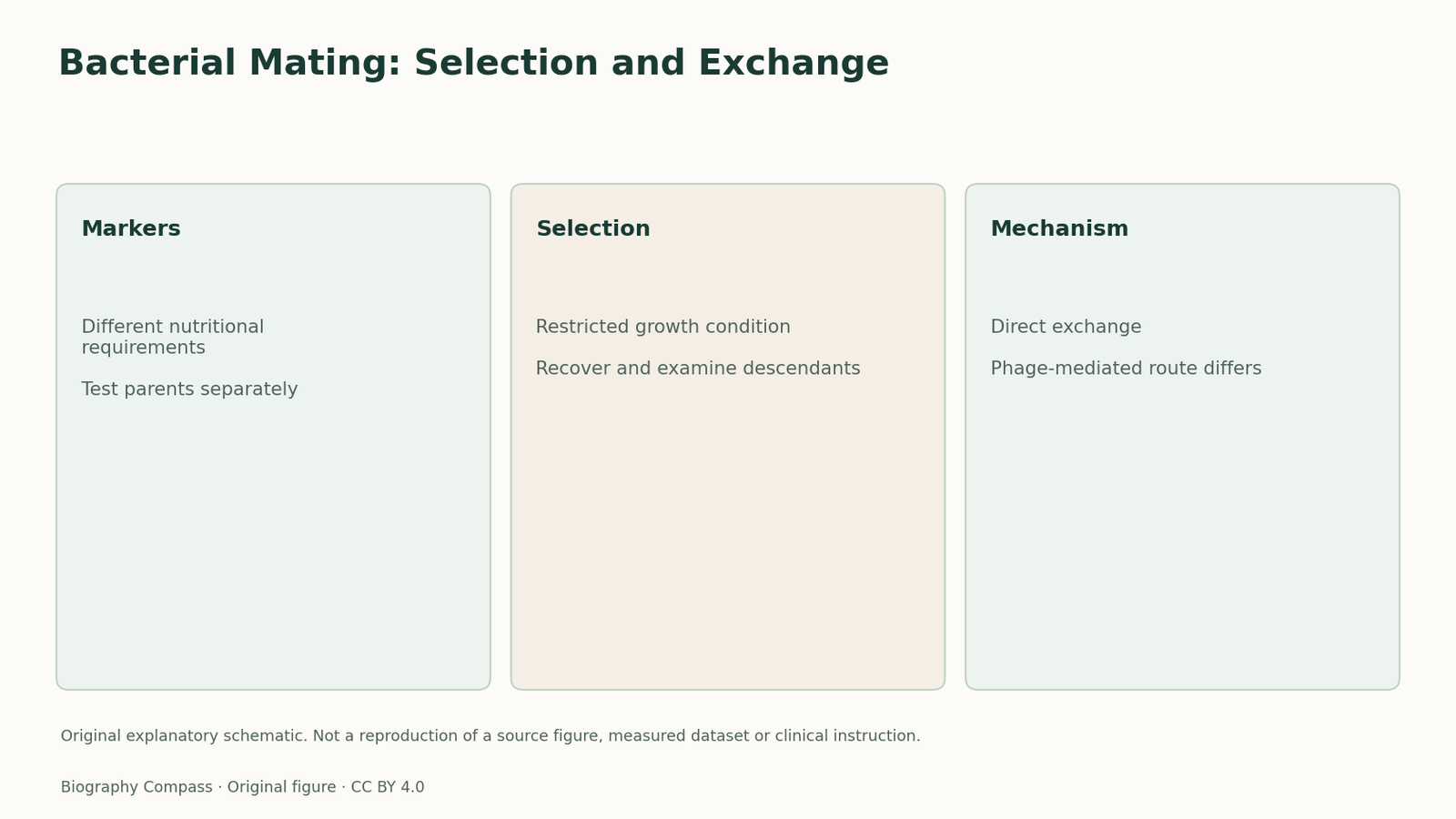
Bacterial Mating: Selection and Exchange
Compare the observations with the narrower conclusions they support.
| Record or observation | What it supports | What remains separate |
|---|---|---|
| Nutritional selection | Makes certain descendants detectable | Growth requires controls before a genetic explanation |
| Phage-mediated transduction | A virus transfers genetic information | Distinct from direct exchange between bacterial cells |
Why nutritional markers were useful
A bacterial strain's nutritional requirements can serve as inherited experimental markers. Lederberg's lecture connects bacterial nutrition with biochemical genetics: inability to synthesise a needed compound creates a selectable difference between strains. A combination of complementary markers therefore offers a way to ask whether descendants can acquire a new combination. Selection makes rare outcomes visible by allowing particular cells to grow under specified conditions.
Growth is an observation, exchange is an explanation
The discovery credited to Lederberg and Tatum was genetic recombination between bacteria. A historical account should separate that conclusion from the immediate observation of a colony on a plate. Growth under selection has to be interpreted against what each starting strain can do alone and against alternative sources of the new phenotype. The Nobel account also distinguishes direct genetic exchange from transduction mediated by bacteriophages.
An original marker exercise
Label an imaginary strain A as unable to make nutrient X and strain B as unable to make nutrient Y. Assume each grows when its missing nutrient is supplied. Ask what controls are needed before growth after mixing supports a new genetic combination. The answer includes testing A and B separately on the restrictive medium and checking the properties of recovered descendants. The exercise does not assert that any particular colony must be a recombinant; it identifies the comparisons needed to interpret it.
Sources for this section: [3]
Keep the mechanisms distinct
Draw separate routes for direct exchange and phage-mediated transfer. Both can alter a recipient's genetic constitution, but the carrier and experimental tests differ. A shared endpoint is insufficient to choose a route. That distinction also keeps Joshua Lederberg's history connected with Esther Lederberg's and Tatum's contributions without collapsing several collaborative discoveries into a single solitary event.
Continue the chronology
Related history guides
Biography context
Explore United States through connected lives
Connected biographies
Researchers and related questions
1925–2008
Joshua Lederberg
Geneticist and bacterial-recombination researcherIn 1946 Lederberg and Tatum demonstrated genetic recombination in bacteria.Read biography1890–1967
Hermann J. Muller
Geneticist and radiation-mutation researcherMuller reported X-ray-induced mutations in 1927, following experiments in late 1926.Read biography
1928–1999
Daniel Nathans
Molecular biologist and restriction-mapping researcherNathans became interested in tumour viruses and spent part of 1969 at the Weizmann Institute.Read biographyQuick answers
Common questions
- How did bacterial mating challenge the idea of strictly clonal inheritance?
- Makes certain descendants detectable. Growth requires controls before a genetic explanation.
- Are the classroom examples historical measurements?
- No. Invented examples are labelled as classroom models; the source-based discussion identifies the historical evidence separately.
Primary and institutional sources
How this history was checked
Official biographical and award records are read alongside the researcher’s technical account. Source scope and hypothetical examples remain distinct. This article was reviewed on 7 November 2026.