
The short answer
What did induced mutations establish about radiation and inheritance?
Evidence comparison
Induced Mutations: Observation and Cause
Compare the observations with the narrower conclusions they support.
| Record or observation | What it supports | What remains separate |
|---|---|---|
| Inherited variant in descendants | Evidence relevant to mutation | Different from immediate injury in an exposed parent |
| Treatment–baseline rate comparison | Tests an increase under defined conditions | Requires denominators and attention to uncertainty |
Identify the response being counted
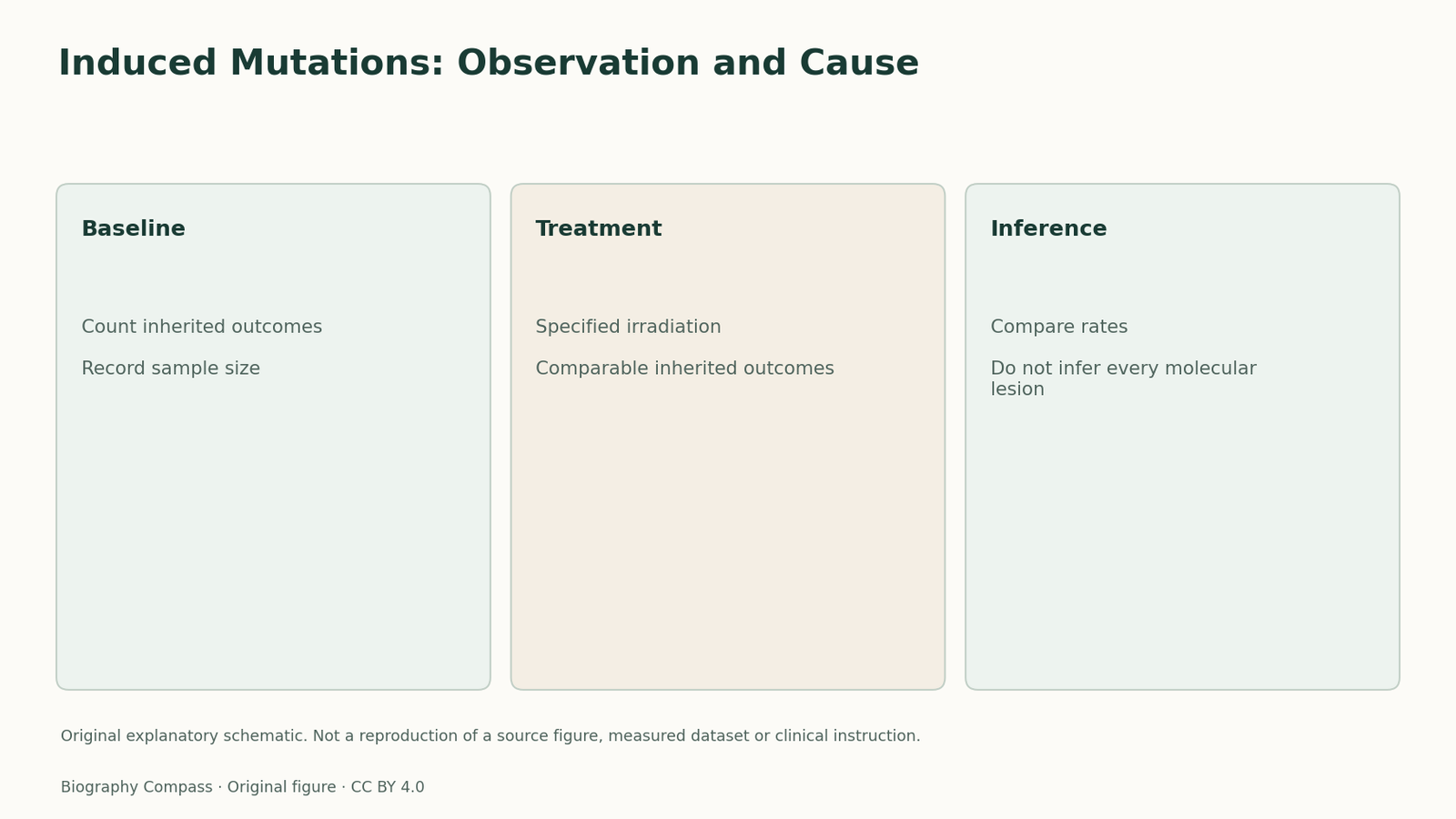
Muller's radiation work concerned inherited changes detected through genetic experiments with fruit flies. The Nobel facts account reports an increase in observed mutations after X-ray exposure and a relationship with dose. A reader should first distinguish an inherited outcome from the immediate illness or death of an exposed animal. These are different observations, even when the same treatment can affect both.
Compare treated and untreated groups
The essential inferential comparison is between mutation outcomes after a treatment and an appropriate baseline. An increase can support the claim that the treatment induces inherited changes under the tested conditions. It does not identify the exact molecular alteration in every affected chromosome. The Indiana archive places Muller's work within the history of the gene, reminding readers that experimental vocabulary and available methods developed over time.
Calculate a rate before making a claim
Consider invented classroom data: two inherited variants among one thousand baseline offspring, and eight among one thousand treated offspring. The respective observed rates are two and eight per thousand. The treated group has four times the observed rate, but the exercise has not established a precise population-wide effect or eliminated sampling uncertainty. Now change the treated sample to five hundred offspring: the denominator must change before the rates can be compared. These numbers are a teaching example, not Muller's results.
Sources for this section: [3]
State the boundary of the conclusion
The answer should name the organism, inherited response, treatment and comparison. Do not turn the example into a prediction about a person's exposure or a recommended medical threshold. Historical experiments can establish a causal research programme while leaving the scale, molecular details and applicability of an effect to other settings to additional evidence.
Sources for this section: [3]
Continue the chronology
Related history guides
Biography context
Explore United States through connected lives
Connected biographies
Researchers and related questions
1890–1967
Hermann J. Muller
Geneticist and radiation-mutation researcherMuller reported X-ray-induced mutations in 1927, following experiments in late 1926.Read biography1925–2008
Joshua Lederberg
Geneticist and bacterial-recombination researcherIn 1946 Lederberg and Tatum demonstrated genetic recombination in bacteria.Read biography
1959–
Andrew Z. Fire
Molecular geneticist and RNA-interference researcherFire's collaboration with Mello and other investigators asked why introduced RNA could silence a corresponding gene.Read biographyQuick answers
Common questions
- What did induced mutations establish about radiation and inheritance?
- Evidence relevant to mutation. Different from immediate injury in an exposed parent.
- Are the classroom examples historical measurements?
- No. Invented examples are labelled as classroom models; the source-based discussion identifies the historical evidence separately.
Primary and institutional sources
How this history was checked
Official biographical and award records are read alongside the researcher’s technical account. Source scope and hypothetical examples remain distinct. This article was reviewed on 7 November 2026.