
The short answer
How can a protein-kinase cascade amplify a hormone signal?
Evidence comparison
Kinase Cascades: Steps and Amplification
Compare the observations with the narrower conclusions they support.
| Record or observation | What it supports | What remains separate |
|---|---|---|
| One phosphorylation step | Changes a defined protein state | Does not describe the complete pathway |
| A catalytic cascade | Connects several regulated reactions | Arrow count alone gives no measured amplification factor |
A sequence of catalytic steps
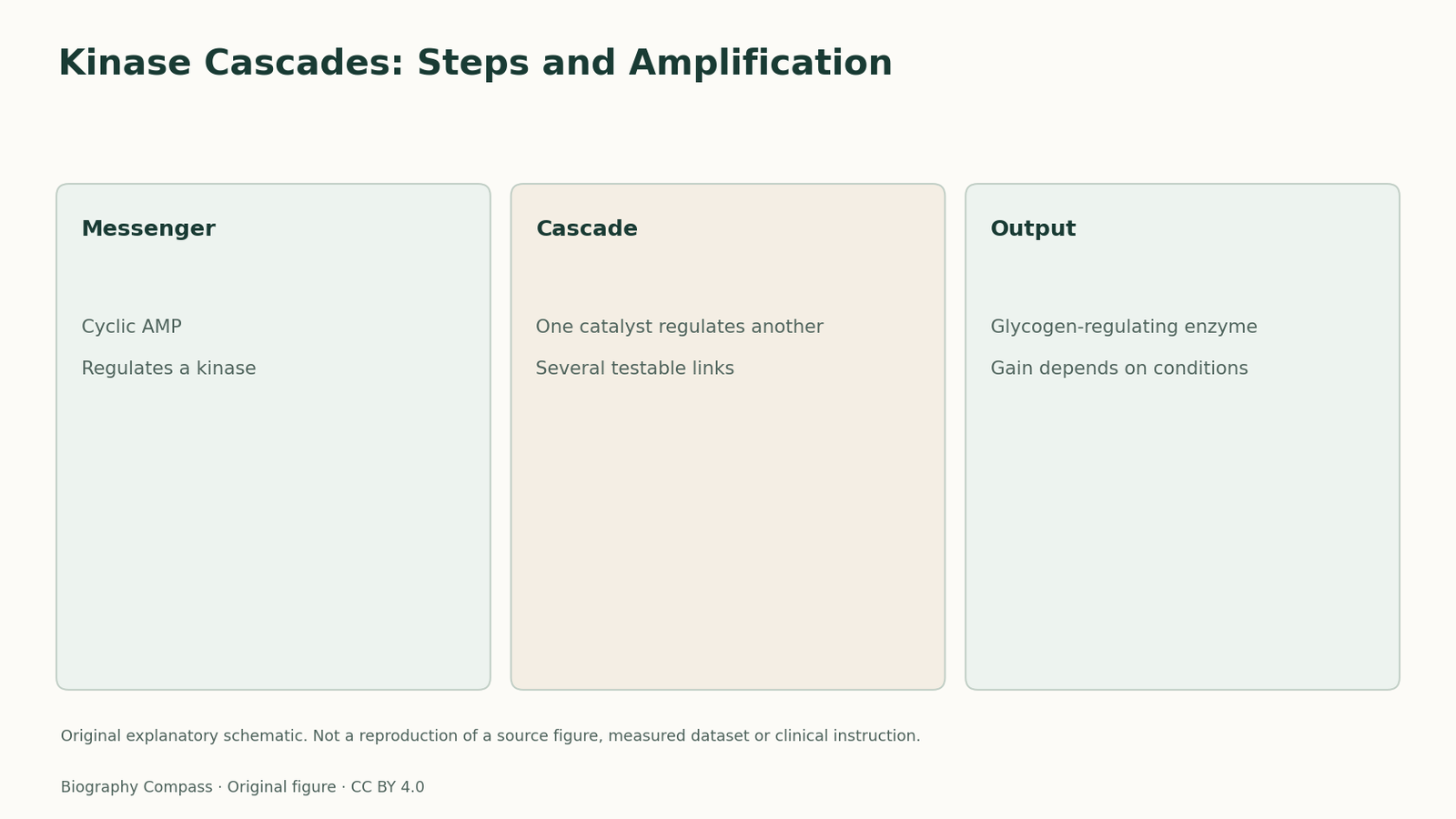
Krebs's account of glycogen regulation describes cyclic AMP activating a protein kinase, which activates phosphorylase kinase, which then changes phosphorylase into its active form. These are distinct links. A pathway diagram that jumps from hormone to glycogen breakdown can show the overall association while concealing the intermediate reactions that made the mechanism experimentally tractable. Each step supplies a separate question about the identity and regulation of the catalyst.
Why a cascade can amplify
An active enzyme can catalyse more than one substrate conversion. When the product of one regulatory step is an active catalyst at the next, the initial influence can be amplified. Krebs's lecture explicitly discusses amplification and branch points as potential uses of a cascade. The word potential matters: the number of arrows does not determine an actual amplification factor. Substrate availability, competing reactions and the duration of activity all affect the result.
Sources for this section: [3]
Use a deliberately idealised counting model
Suppose one active enzyme activates three molecules at the next stage, and each of those activates three at a final stage. Under the stated toy assumptions, the final count is nine. Ask whether the example proves ninefold amplification in Krebs's experiments. The answer is no: the numbers were chosen for teaching, and the model ignores deactivation, saturation and timing. Then change the second-stage yield to one and recalculate, showing how the assumed catalytic output determines the result.
Sources for this section: [4]
A useful comparison with a reversible switch
Fischer's associated guide follows one protein through addition and removal of phosphate. This guide follows a signal through several catalytic stages. The two views are compatible but answer different questions: how a state changes, and how multiple state changes are organised into a pathway.
Continue the chronology
Related history guides
Biography context
Explore United States through connected lives
Connected biographies
Researchers and related questions
1918–2009
Edwin G. Krebs
Biochemist and protein-kinase researcherKrebs and Fischer investigated differences between forms of glycogen phosphorylase and discovered that reversible phosphorylation explained their interconversion.Read biography
1920–2021
Edmond H. Fischer
Biochemist and protein-phosphorylation researcherFischer and Krebs investigated glycogen phosphorylase and established reversible phosphorylation as a way to regulate protein activity.Read biography1941–2015
Alfred G. Gilman
Pharmacologist and G-protein researcherGilman's group used S49 lymphoma-cell variants with defective signalling as experimental material.Read biographyQuick answers
Common questions
- How can a protein-kinase cascade amplify a hormone signal?
- Changes a defined protein state. Does not describe the complete pathway.
- Are the classroom examples historical measurements?
- No. Invented examples are labelled as classroom models; the source-based discussion identifies the historical evidence separately.
Primary and institutional sources
How this history was checked
Official biographical and award records are read alongside the researcher’s technical account. Source scope and hypothetical examples remain distinct. This article was reviewed on 7 November 2026.