
The short answer
What makes reversible phosphorylation a switch rather than protein destruction?
Evidence comparison
Phosphorylation: Reversal Is Not Disposal
Compare the observations with the narrower conclusions they support.
| Record or observation | What it supports | What remains separate |
|---|---|---|
| Reversible phosphate modification | Changes the state of an existing protein | Different from destroying and replacing its chain |
| Kinase and phosphatase activities | Support distinct directions of a regulatory cycle | A phosphate label does not universally mean activation |
A state change can preserve the molecule
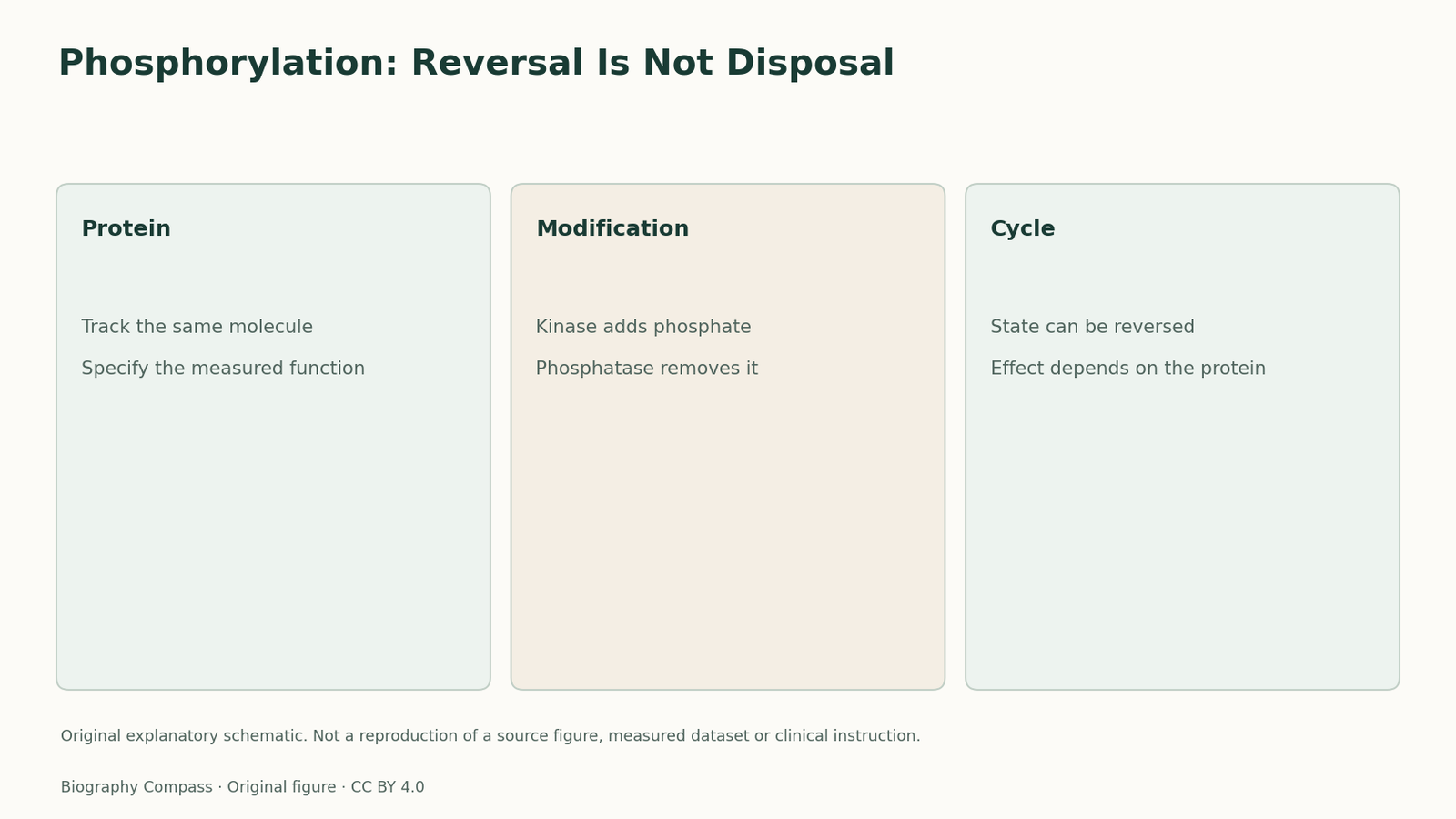
Reversible protein phosphorylation changes a protein by adding or removing a phosphate group. Fischer and Krebs's work on phosphorylase made such interconversion a central example of biochemical regulation. The key contrast is with destruction followed by replacement. A reversible modification can alter the functional state of an existing protein, allowing regulation to operate on a different timescale and through different chemical steps from making an entirely new protein chain.
Two enzyme activities do different jobs
A kinase catalyses phosphorylation; a phosphatase catalyses removal of the phosphate. Their opposing actions can form a regulatory cycle. The existence of a cycle does not imply that one enzyme simply runs the other's reaction backwards under identical conditions. Fischer's lecture places the early phosphorylase experiments within a larger field of enzymes with different substrates, sites and regulatory properties.
Sources for this section: [3]
Track a molecule through a paper cycle
Draw one invented protein as a circle with a labelled attachment site. Add a detachable P card, then remove it, keeping the same circle on the page. Ask what changed and what persisted. The answer is modification state versus the identity of the protein molecule in this model. Next replace the circle entirely with a new one and explain why that represents a different operation. The exercise illustrates bookkeeping, not an exact kinetic model of the historical experiments.
Sources for this section: [3]
Do not use the switch metaphor too literally
An on–off drawing is useful for a specified assay, but phosphorylation can alter proteins in different ways. It can change interactions, location or activity, and its direction of effect is context-dependent. The correct conclusion names the protein, modification and measured response rather than assigning a universal meaning to the letter P.
Sources for this section: [3]
Continue the chronology
Related history guides
Biography context
Explore United States through connected lives
Connected biographies
Researchers and related questions

1920–2021
Edmond H. Fischer
Biochemist and protein-phosphorylation researcherFischer and Krebs investigated glycogen phosphorylase and established reversible phosphorylation as a way to regulate protein activity.Read biography1918–2009
Edwin G. Krebs
Biochemist and protein-kinase researcherKrebs and Fischer investigated differences between forms of glycogen phosphorylase and discovered that reversible phosphorylation explained their interconversion.Read biography1925–1998
Martin Rodbell
Biochemist and cellular-signalling researcherRodbell's work separated reception of a chemical signal from the machinery that carries the influence onward and generates a cellular response.Read biographyQuick answers
Common questions
- What makes reversible phosphorylation a switch rather than protein destruction?
- Changes the state of an existing protein. Different from destroying and replacing its chain.
- Are the classroom examples historical measurements?
- No. Invented examples are labelled as classroom models; the source-based discussion identifies the historical evidence separately.
Primary and institutional sources
How this history was checked
Official biographical and award records are read alongside the researcher’s technical account. Source scope and hypothetical examples remain distinct. This article was reviewed on 7 November 2026.