
The short answer
How can an RNA chain grow from a primer without copying that primer's sequence?
Evidence comparison
RNA Synthesis: Primer Versus Template
Compare the observations with the narrower conclusions they support.
| Record or observation | What it supports | What remains separate |
|---|---|---|
| A primer enables or stimulates extension | Provides a starting end for chain growth | Does not automatically encode the added sequence |
| A proposed template specifies an output pattern | Makes a sequence-information claim | Requires more than observing a longer RNA chain |
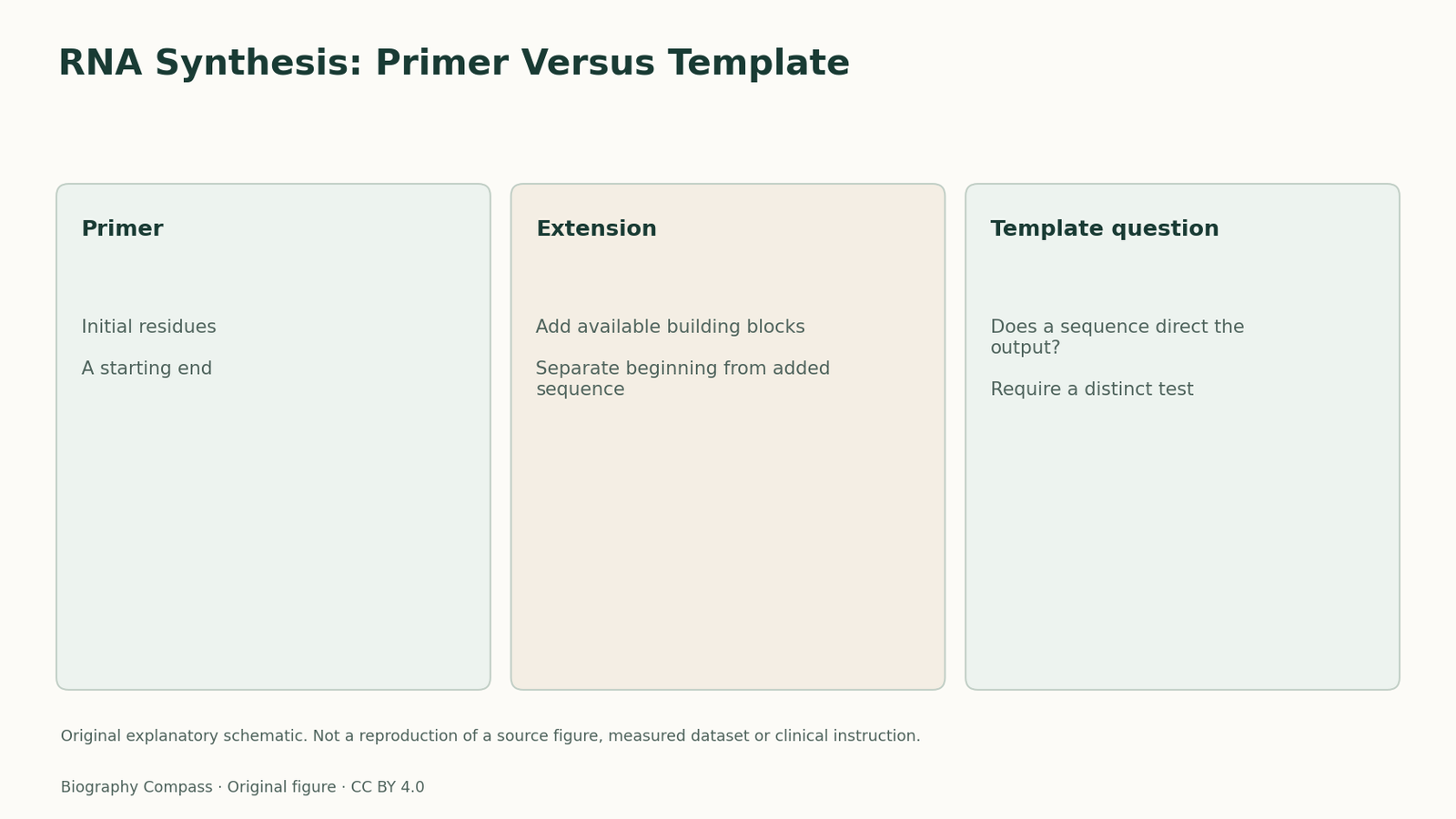
A starting end and a sequence pattern are different roles
Ochoa's 1959 lecture describes polynucleotide phosphorylase and the stimulation of chain synthesis by short oligonucleotides. Such a primer can provide a beginning from which additional residues are added. A template has a different informational role: its sequence directs the sequence of the new product through a specified relationship. Calling both a primer and a template simply a piece of RNA hides the distinction that the experiments were trying to resolve.
A mixed-sequence example makes the distinction visible
The lecture discusses synthesis in which a short adenylate primer can precede an extended uridylate chain. The initial residues and the added residues therefore need not carry the same base identity. It also states that the proposed use of polyribonucleotides as templates for their own replication had not been experimentally substantiated. These claims concern the described phosphorylase system; they should not be extended into a statement that RNA can never act as a template in other biological reactions.
Sources for this section: [3]
A starting-piece exercise
For an original classroom model, write two A symbols followed by a space for a growing chain. Supply only U symbols for additions and complete the row as AAUUUU. Ask what the initial AA tells us: it marks where growth began, but the added sequence follows the supplied building material in this model. It does not show copying of the starting sequence. These invented symbols illustrate priming logic and are not a transcription of a measured experimental product or instructions for an assay.
Sources for this section: [3]
Use a claim that matches the observation
Chain growth establishes a synthetic capability. A sequence-copying claim additionally requires evidence connecting an input pattern to the output sequence. The associated Kornberg and Greider guides provide different experimental settings in which that further informational question can be examined.
Continue the chronology
Related history guides
Biography context
Explore United States through connected lives
Connected biographies
Researchers and related questions
1905–1993
Severo Ochoa
Biochemist and enzymatic nucleic-acid synthesis researcherOchoa and Marianne Grunberg-Manago discovered polynucleotide phosphorylase through experiments involving phosphate exchange.Read biography1918–2007
Arthur Kornberg
Biochemist and DNA-replication researcherKornberg's group isolated DNA polymerase from bacteria in 1956.Read biography1961–
Carol W. Greider
Molecular biologist and telomerase researcherGreider and Blackburn identified telomerase activity in 1984 and published the initial work in 1985.Read biographyQuick answers
Common questions
- How can an RNA chain grow from a primer without copying that primer's sequence?
- Provides a starting end for chain growth. Does not automatically encode the added sequence.
- Are the classroom examples historical measurements?
- No. Invented examples are labelled as classroom models; the source-based discussion identifies the historical evidence separately.
Primary and institutional sources
How this history was checked
Official biographical and award records are read alongside the researcher’s technical account. Source scope and hypothetical examples remain distinct. This article was reviewed on 7 November 2026.